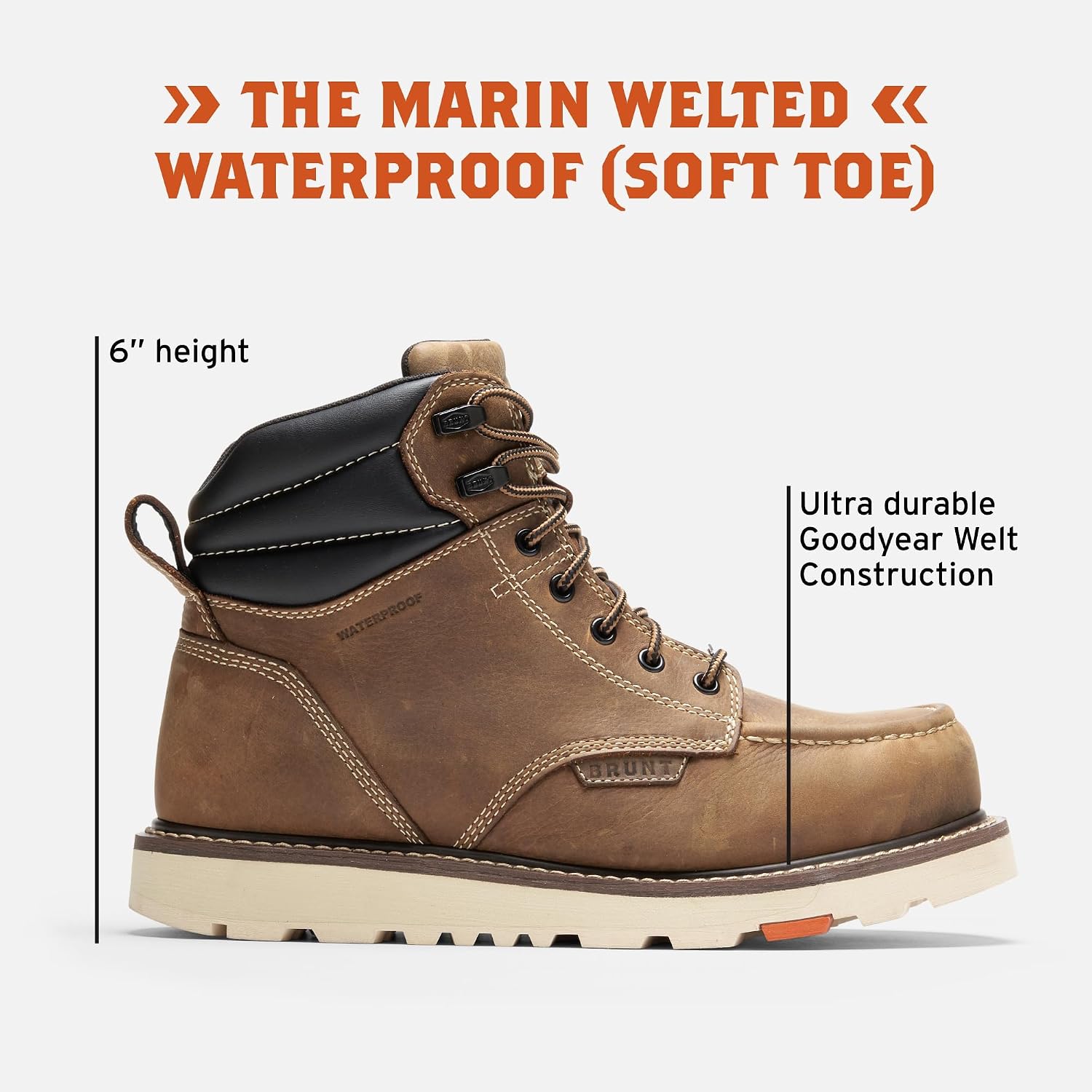
You just started researching work boots, landed on a $175 pair from a brand you’ve never heard of called BRUNT, and noticed they’re advertising something called “Goodyear welt construction” — the same phrase that shows up on $500 boots from brands your grandfather might have worn. Is it the same thing? Does it matter? And is a three-year-old direct-to-consumer startup actually capable of delivering it?
This article answers those questions directly. Goodyear welt construction (explained fully below) is a specific method of attaching a boot’s sole to its upper that allows for resoling — meaning a quality pair can last a decade or more instead of being thrown away when the sole wears out. BRUNT entered the work boot market around 2020 with that construction at a mid-tier price point, targeting tradespeople who felt squeezed between cheap glued-together boots and heritage brands priced above $400. Here’s an honest evaluation of what BRUNT delivers, where they fall short, and how they compare against the established names in this space.
What Goodyear Welt Construction Actually Means — and Why It’s the Right Benchmark
Before scoring BRUNT, it’s worth being precise about what you’re evaluating. A Goodyear welt (named after Charles Goodyear Jr., who mechanized the process in the 1870s) is a construction method where a strip of leather or synthetic material — the welt — is stitched to both the upper and an interior insole, and then the outsole is stitched to that welt. The result is a boot you can take to a cobbler and have resoled multiple times without compromising the upper.
The alternative is cement construction, where the sole is simply glued to the upper. Cement boots are cheaper to manufacture, lighter, and often more immediately comfortable — but once the sole wears through, the boot is done. Working Person’s Store’s overview of Goodyear welt versus cement construction puts it plainly: cement boots average two to four years of heavy use before they’re disposable; a well-maintained Goodyear welt boot can realistically hit ten to fifteen years with one or two resoles.
That distinction matters enormously for cost-per-wear math. A $175 cement boot replaced every three years costs more over a decade than a $350 Goodyear welt boot resoled once at $80. The construction type is the entire foundation of the buy-it-for-life argument.
BRUNT’s flagship boots — the Marin, the Cesar, and the Gronk (yes, that Gronk, who is a company investor and spokesperson) — are all marketed as Goodyear welt. The question is whether the execution matches the marketing.
BRUNT vs. Heritage Standards: Where They Align and Where They Don’t
Construction Spec Comparison
By the numbers:
| Brand | Construction | Upper Leather | Price Range | Made In |
|---|---|---|---|---|
| BRUNT Marin | Goodyear welt | Full-grain leather | $165–$195 | China |
| Thorogood Moc-Toe | Goodyear welt | Full-grain leather | $185–$220 | USA (Heritage line) |
| Danner Bull Run | Goodyear welt | Full-grain leather | $220–$260 | USA / Vietnam |
| White’s Semi-Dress | Goodyear welt | Full-grain leather | $600–$700 | USA |
The construction fundamentals check out. Heddels’ BRUNT brand profile confirms the Goodyear welt is genuine — the stitch-down construction is visible and verifiable, not a marketing exaggeration. The upper leather on BRUNT’s flagship models is full-grain (the highest-quality cut of leather, taken from the outermost layer of the hide, which develops a patina and resists moisture better than corrected or split-grain alternatives).
Where BRUNT diverges from the Thorogoods and Danners of the world is in the sourcing and finishing details that don’t show up in a spec list. Heddels’ breakdown notes that BRUNT manufactures in China, which isn’t automatically a quality disqualifier — plenty of legitimate technical footwear is produced there — but it does mean the supply chain lacks the decades of institutional knowledge embedded in a factory like Weinbrenner (which produces Thorogood) or the Whites Boots shop in Spokane, Washington.
Primer Magazine’s 2025 work boot roundup places BRUNT in a “strong mid-tier” category: legitimate construction, meaningful durability upgrade over cement alternatives, but with leather quality and lasting (the process of shaping leather over a foot-shaped mold) that falls short of heritage American makers. The practical translation: BRUNT boots will likely outlast any glued boot you’ve worn, but they probably won’t develop the character or structural integrity of a boot built by a cobbler with forty years of muscle memory.
The Resole Ecosystem — The Hidden Variable
Here’s the tradeoff that rarely gets discussed upfront. Goodyear welt construction only pays off if you can actually get the boots resoled when the time comes. That requires a cobbler willing to work on them and replacement soles that fit the platform.
White’s Boots, Danner, and Thorogood all have established resole programs — either in-house or through authorized repair networks. Owners across long-run forum discussions consistently report that heritage brands’ resole programs have multi-decade track records; you can send a pair of fifteen-year-old Whites back to Spokane and get them rebuilt.
BRUNT is four years old. As of mid-2026, they offer a resole service through their website, which is a meaningful commitment for a young brand. But the practical question — whether that program is still operational in 2031 when your soles finally wear through — is unanswerable. Gear Junkie’s work boot buyer’s guide makes this point explicitly: for the resole ecosystem to be a real asset, the brand needs longevity and institutional infrastructure. BRUNT has made the right structural decisions; they haven’t yet had time to prove them.
This is the core risk you’re accepting with any young brand: you’re betting on their staying power in addition to their product quality.
Fit, Sizing, and Break-In
Across aggregated owner reviews on retail platforms, BRUNT boots trend slightly wide — owners with a standard D width frequently report that EE sizing details are unnecessary, and those with genuinely narrow feet flag fitment issues. Primer Magazine’s roundup echoes this: BRUNT runs “generously wide,” which is welcome news for tradespeople on their feet ten hours a day but a miss for anyone with a narrow to medium foot profile.
Break-in period, per consistent owner reporting, runs three to five weeks of daily wear before full comfort — comparable to Thorogood and Danner in the same construction tier. This is normal for full-grain leather Goodyear welt boots; the leather needs time to conform to your foot shape. If you’re coming from foam-midsole athletic work boots, the first two weeks will feel punishing regardless of brand.
Popular Mechanics’ work boot coverage notes that BRUNT’s EVA midsole (a cushioning layer between the insole and outsole, common in athletic footwear and increasingly used in hybrid work boots) delivers immediate underfoot comfort that traditional cork-filled heritage boots don’t offer right out of the box. That’s a real differentiator for buyers who can’t afford a multi-week break-in on an active job site.
The Direct-to-Consumer Model: What You’re Actually Getting for the Price
BRUNT sells almost exclusively direct — their website, a limited retail presence, and Amazon. That model cuts out the distributor and retailer margin that adds $60–$100 to a comparable boot sold through traditional channels. It’s why a Goodyear welt boot with full-grain leather retails at $175 instead of $240.
The tradeoff is less obvious: you lose the ability to try before you buy, you’re dependent on the brand’s own customer service rather than a local retailer relationship, and returns/exchanges involve shipping. For boots — where fit is everything — that’s a meaningful inconvenience. Thorogood or Danner purchased through a working person’s store or a regional boot dealer gives you a fitting, an experienced floor staff recommendation, and a local exchange option if the sizing is off.
That said, BRUNT’s return policy (as documented on their site in mid-2026) offers a 30-day wear trial, which partially addresses this risk. Owners across review aggregates consistently rate the return process as low-friction, which matters.
The Decision Frame: If X, Then Y
Here’s the honest breakdown by buyer profile:
If you’re a first-time Goodyear welt buyer who has been in cement or injection-molded boots and wants to understand what the construction upgrade actually feels like — BRUNT is a well-priced entry point. You’ll get legitimate construction at a cost that doesn’t require a full heritage-brand financial commitment. If you love the platform, you’ll have context to evaluate White’s or Wesco when you’re ready to step up.
If you’re outfitting a crew and need Goodyear welt durability at a budget that makes sense per-pair — BRUNT competes seriously with Thorogood’s import lines and Danner’s lower tiers. The cost-per-wear math holds up better than any cement alternative.
If you’re a buy-it-for-life buyer who plans to resole these boots in 2032 and wear them into 2038 — the risk calculus shifts. Thorogood’s Heritage line (made in the USA at Weinbrenner’s Wisconsin factory), Danner’s Union line, or a direct order from White’s Boots or Wesco gives you a brand with demonstrated resole infrastructure, better leather sourcing, and a track record spanning decades rather than years. You’ll pay $200–$500 more upfront. The cost-per-wear math still favors the heritage option if the boots actually make it to resole number two.
If you have a narrow foot — skip BRUNT entirely and go directly to a brand with a wider range of lasts (the foot-shaped mold boots are built around). Thorogood’s American Heritage line offers multiple width options; White’s will build to your foot measurements.
If the EVA midsole matters to you — immediate comfort on day one, forgiving underfoot feel on concrete — BRUNT’s hybrid construction is genuinely competitive. Traditional heritage boots with cork fill and leather insoles require real break-in time and reward patience; BRUNT does not.
The Honest Bottom Line
BRUNT Workwear has done something legitimately difficult: they’ve brought real Goodyear welt construction to a price point that was previously occupied only by cement alternatives or entry-level imports from established brands. The construction fundamentals are sound. The leather quality is honest. The direct-to-consumer model passes meaningful savings to the buyer.
What BRUNT cannot yet offer is the institutional depth of a heritage brand — the generational factory relationships, the decades of resole program track record, the earned reputation that makes a purchase feel like a bet on something that will outlast the seller. That’s not a criticism of BRUNT specifically; it’s a structural reality of being four years old in a category where brands earn trust across decades.
Buy BRUNT if the price-to-construction ratio is the primary variable and you’re realistic about what you’re getting: a well-built mid-tier boot from a brand still proving itself. Hold out for Thorogood, Danner, or a custom American maker if the decade-spanning resole relationship is the point. Both are defensible decisions — but they’re different bets.