You just started a new job — or you’re outfitting a crew on a tight budget — and the consensus online keeps pointing at moc toe wedge boots as the go-to for all-day comfort on concrete and light terrain. The style gets its name from the stitched, raised seam across the toe box (that’s the “moc,” short for moccasin) and the flat, foam-filled wedge sole that runs the full length of the boot instead of a traditional heel. The wedge design distributes your weight more evenly and grips flat surfaces like warehouse floors and scaffolding planks better than a heeled boot. Thorogood — an American brand out of Marshfield, Wisconsin — basically wrote the playbook on this style with their American Heritage line. But at $145–$180 for a Thorogood, a lot of buyers are eyeing SUREWAY and EverBoots at $60–$90 and wondering: how much quality are you actually trading away? This article answers that question honestly, drawing on aggregated owner reviews, published specifications, and documented failure patterns — so you know exactly what you’re buying before you commit.
| EDITOR'S PICKChippewa Men's 8" Lace-To-Toe W… | Mid-tierSUREWAY Mens Heavy Duty Soft/Co… | Budget pickEverBoots Mens Work Boots for M… | |
|---|---|---|---|
| Material | — | Full Grain Leather | Soft Oil Grain |
| Toe Type | Steel Toe | Steel Toe | — |
| Waterproof | Waterproof | — | — |
| Construction | — | GoodyearWelt | Goodyear Welt |
| Shaft Height | 8" | 6" | — |
| Slip Resistant | — | — | Anti Slip |
| Price | $247.96 | $82.99 | $79.99 |
| See on Amazon → | See on Amazon → | See on Amazon → |
What Makes the Thorogood the Benchmark
To comparison-shop intelligently, you need to understand what you’re comparing against. Gear Junkie’s “Best Work Boots” roundup and Popular Mechanics’ “Best Work Boots of 2025” guide both identify Thorogood’s American Heritage moc toe as the entry point for serious tradespeople — not because it’s the most expensive option, but because it hits a specific combination of features that are genuinely hard to replicate cheaply.
The construction method matters most here. Thorogood uses a Goodyear welt on its American Heritage line. The welt is a strip of leather stitched around the perimeter of the upper (the part of the boot above the sole), creating a structural join between upper and sole that can be unstitched, resoled, and rebuilt by a cobbler. That’s what makes a boot a long-term capital investment rather than a disposable commodity. Pair that with full-grain leather — the outermost, densest layer of the hide, the material that develops a patina and resists abrasion — and domestic manufacturing, and you have a boot that Heddels’ “The Moc Toe Boot: A Style Guide” describes as legitimately repairable over a decade or more with proper care.
The Thorogood American Heritage also uses a Vibram MAX Wear wedge outsole compound, a material with published abrasion ratings that consumer-grade alternatives do not typically match.
That’s the standard. Now let’s look at what $60–$90 actually gets you.
The Four Boots, Head to Head
The following sections evaluate each boot at its tier. Understanding where each one sits in the quality hierarchy — and why — is more useful than a simple price ranking.
Thorogood American Heritage Moc Toe
Thorogood’s American Heritage is the reference point for this entire category. Workingpersonstore.com’s review aggregation for the 804-4521 model consistently surfaces long-term owners who have resoled the same pair multiple times — a use pattern that is structurally impossible with cemented boots at lower price points.
The full-grain leather upper, Goodyear welt construction, and Vibram MAX Wear outsole combine into a boot designed for a multi-decade ownership horizon. The break-in period is real: most owners report 2–4 weeks before the leather conforms to their foot. After that point, the boot’s lasted shape and leather quality become genuine ergonomic assets.
The honest limitation: at $145–$180, the Thorogood is a capital purchase. For a crew rotation or a role that destroys boots through chemical exposure, the economics may not pencil out even if the quality is unambiguous.
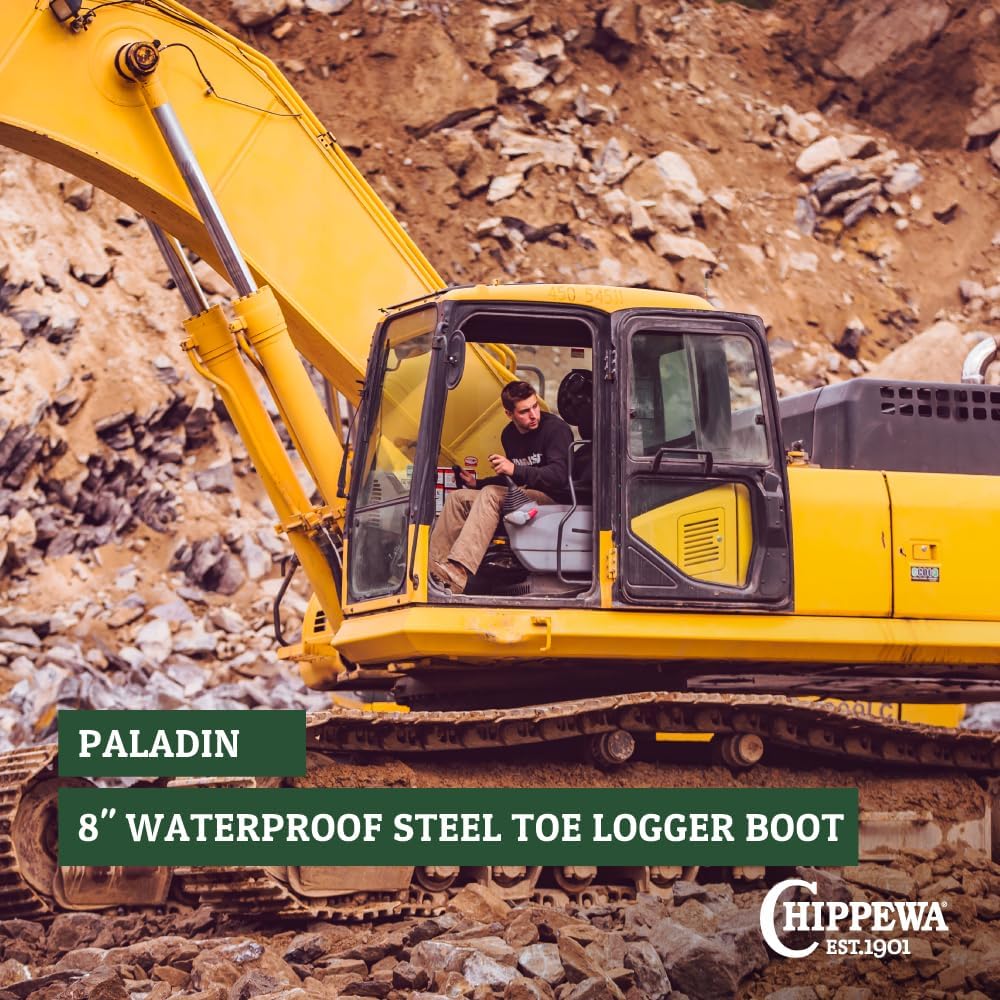
Chippewa
$247.96
In stock on Amazon
Check price on AmazonTimberland PRO Wedge
At roughly $100–$110 — a $30–$40 premium over SUREWAY and EverBoots — the Timberland PRO Wedge enters a meaningfully different tier. Primer Magazine’s “Best Boots for Men” guide and Popular Mechanics’ work boot roundup both position Timberland PRO as the credible step up from unbranded budget options: not because it’s glamorous, but because the leather is denser, the outsole compound is more durable, and the brand’s warranty and customer service infrastructure is real and accessible.
One documented owner pattern worth noting: buyers who specifically researched leather sourcing before purchasing identified Timberland’s scale as a genuine differentiator. As a major global brand, Timberland negotiates hide quality standards with tanneries that smaller private-label manufacturers cannot. The starting material quality is higher, and the gap is measurable in how the boot holds up past the 18-month mark.
Is it resoleable? The Timberland PRO Wedge is cemented construction, not Goodyear welt — so the same caveat applies as with budget options. But the superior starting materials mean the boots are realistically likely to outlast SUREWAY by enough margin to justify the price gap for buyers who want a single pair to last two-plus years.
If you’re deciding between SUREWAY and Timberland PRO at the same retailer, the $35 gap buys meaningfully better leather and a more durable outsole compound. The comfort advantage narrows at this tier — Timberland PRO is comfortable from the start — but the durability advantage is real.
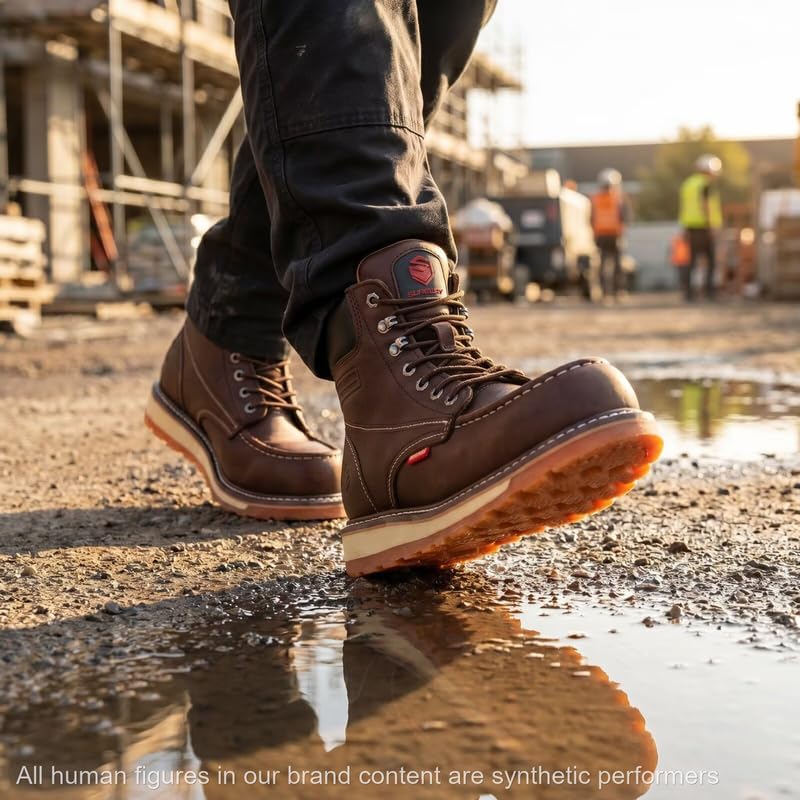
SUREWAY
$82.99
In stock on Amazon
Check price on AmazonSUREWAY Moc Toe
SUREWAY is a Chinese-manufactured boot sold under packaging that has — and this deserves direct acknowledgment — featured American flag imagery that has led some buyers to assume domestic manufacturing. One documented reviewer explicitly called this out as misleading, purchased the boots anyway, wore them extensively, and reported they held up adequately for their price. That’s the honest framing: the patriotic branding is marketing, not a country-of-origin claim, and buyers in aggregated review pools have noted the discrepancy without it necessarily affecting their long-term satisfaction.
The behavior pattern that makes SUREWAY genuinely interesting to analyze is repeat-purchase loyalty alongside documented early failures, simultaneously. Across aggregated owner reports, one of the most common patterns is a buyer on their third pair of SURWEYs despite reporting insole compression failure within months of the first pair and moc toe stitching separation in subsequent pairs. Their repair method: shoe adhesive on the stitching, continued wearing. Their verdict: still coming back.
That is a useful data point, not a fluke. What it tells you is that SUREWAY’s foam wedge and last shape are genuinely well-calibrated for wide-foot, high-arch-friendly comfort. The comfort floor is real. The construction ceiling is low.
Where SUREWAY fails, specifically:
- Insole foam compresses faster than the outsole wears — owners report the “dead” insole feeling within 3–6 months of daily wear
- Moc toe stitching separates at the toe seam under flexion stress; adhesive repair extends life but does not restore structure
- The welt construction is cemented (glued), not Goodyear — resoling by a cobbler is not a realistic option
Where SUREWAY delivers:
- Out-of-box comfort that most owners describe as immediate, with minimal break-in required
- Adequate leather quality for the price tier — not full-grain, but holds up to light moisture and abrasion
- Price-per-wear on a single pair is acceptable if you treat it as a 12–18 month consumable
The honest positioning: SUREWAY is a solid consumable boot, not an investment boot. If you’re in a role where boots get destroyed by chemicals, concrete, or extreme conditions and you’d rather spend $70 three times than $200 once, the math can work. If you expect resoleability or multi-year structural integrity, look elsewhere.
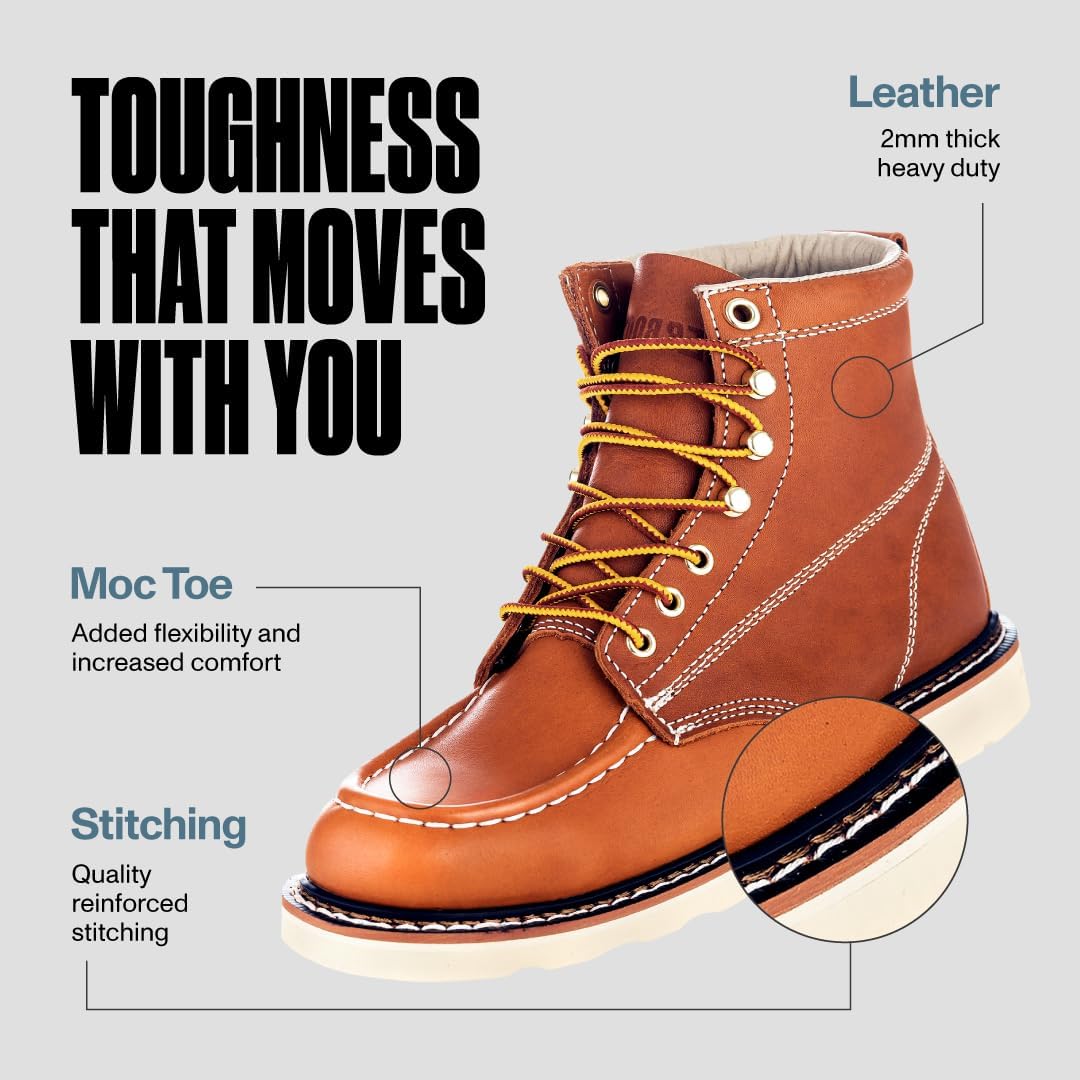
EverBoots
$79.99
In stock on Amazon
Check price on AmazonEverBoots Moc Toe
EverBoots occupies a similar price band to SUREWAY but has a different failure profile — and one of the most instructive documented owner journeys in this category.
An owner reviewed EverBoots favorably on initial purchase, citing comfort and appearance. Months later, that same owner returned to update their review: the moc toe seam had separated. They had subsequently purchased a pair of Golden Fox boots at a comparable price and reported Golden Fox as the superior product. That review arc — initial satisfaction, documented seam failure, direct competitor comparison — is exactly the kind of longitudinal owner data that is useful for buying decisions.
The moc toe seam is the structural weak point across all boots in this price tier. The seam is decorative in origin (it mimics moccasin construction) but on wedge work boots it runs across the highest-flex zone of the toe box. Budget boots use lighter thread and less reinforcement at this seam than heritage-tier boots. EverBoots’ failure at this seam, under real work conditions, appears to occur in roughly the same timeline as SUREWAY’s — 4–8 months of regular use — but EverBoots has drawn less repeat-purchase loyalty than SUREWAY, which suggests the comfort advantage that keeps SUREWAY buyers coming back is not as pronounced here.
Based on aggregated owner reports, EverBoots sits below Golden Fox and roughly level with SUREWAY on construction quality, while potentially sitting below SUREWAY on the comfort-per-dollar metric that drives repeat purchases in this segment. If you’re shopping in this price band and specifically considering EverBoots, Golden Fox at a similar price point appears to offer better construction based on documented owner comparisons.
EverBoots
$79.99
In stock on Amazon
Check price on AmazonSide-by-Side Comparison
| Boot | Est. Street Price | Construction | Resole-Ready | Avg. Failure Timeline |
|---|---|---|---|---|
| Thorogood American Heritage | $145–$180 | Goodyear welt, full-grain leather | Yes | 5–10+ years with resoles |
| Timberland PRO Wedge | $100–$110 | Cemented | No | 2–3 years typical |
| SUREWAY Moc Toe | $65–$80 | Cemented | No | 12–18 months (insole/seam) |
| EverBoots Moc Toe | $60–$75 | Cemented | No | 4–8 months (seam failure common) |
Should You Replace the Stock Insoles Immediately?
This question comes up constantly in workwear communities, and the honest answer is: yes, within the first week, for SUREWAY and EverBoots. The stock foam in budget moc toe boots is the first component to fail, and it fails faster than the upper or outsole. Aftermarket insoles — Superfeet Green or Orange are among the most commonly recommended for standing and walking work — cost $40–$55 and will outlast two or three pairs of budget boots’ stock insoles. Installing them immediately extends the useful comfort life of the boot significantly and delays the “dead boot” feeling that drives premature replacement.
For the Thorogood, the stock insole is serviceable for 6–12 months before most owners swap it out. For Timberland PRO, a similar timeline applies. Neither requires an immediate swap the way budget options do.
Frequently Asked Questions
Are SUREWAY boots Goodyear welted and can they be resoled? No. SUREWAY uses cemented (glued) welt construction, which mimics the appearance of a welt without the stitched structure that makes Goodyear welt boots resoleable. A cobbler cannot strip and replace the sole the way they can on a Thorogood. Treat SUREWAY as a consumable boot.
Are SUREWAY work boots made in the USA? SUREWAY boots are manufactured in China. The American flag imagery on some packaging is branding, not a country-of-origin claim. Multiple documented owners have noted the discrepancy. Country of origin matters for quality insofar as it correlates with material standards and labor quality controls — but the more direct quality signal is construction method and material specification. SUREWAY’s limitations are construction-related (cemented sole, budget foam) rather than solely a function of manufacturing location.
How long do EverBoots last under real work conditions, and what fails first? Based on owner review patterns, EverBoots typically show moc toe seam separation within 4–8 months of regular work use. The toe seam is the documented first failure point. Owners who have purchased both EverBoots and Golden Fox at similar price points have generally reported Golden Fox as the more durable option.
Is the Timberland PRO Wedge worth the premium over SUREWAY? Yes, if you’re buying a single pair and want it to last two-plus years. The $30–$40 premium buys better leather stock and a more durable outsole compound. If you’re buying for a large crew on a tight per-unit budget and plan to cycle out boots annually, SUREWAY’s comfort and low cost may win on total program math.
Should I replace the stock insoles in budget moc toe boots immediately? Replace them within the first week for SUREWAY and EverBoots. The stock foam is the weakest component and begins compressing immediately under daily use. Aftermarket insoles extend comfortable wearable life substantially and cost far less than buying replacement boots ahead of schedule. For Thorogood and Timberland PRO, you can wait 6–12 months before making that call.
The Decision Rule
Here’s the if/then that should drive your choice:
- If you need one pair to last 5+ years and you’re willing to invest up front: Buy the Thorogood American Heritage. It’s the only boot in this comparison with a genuine resole pathway and full-grain leather that rewards long-term care. Heddels’ moc toe style guide and Gear Junkie’s work boot roundup both arrive at the same conclusion for serious tradespeople.
- If you’re budget-constrained but want two-plus years of service from a single pair: The Timberland PRO Wedge is the move. Better leather than budget options, credible brand infrastructure, and a realistic 2–3 year lifespan without the Thorogood’s price tag.
- If you’re equipping a crew annually or treating boots as consumables: SUREWAY delivers real comfort at a price that makes annual replacement tolerable. Go in with eyes open on the insole and seam — swap the insoles immediately, carry adhesive for the seam, and budget for replacement at 12–18 months.
- If you’re considering EverBoots: Based on documented owner comparisons, Golden Fox at a similar price point appears to offer better construction. EverBoots is not the value leader in its own tier.
The Thorogood exists to solve a different problem than SUREWAY and EverBoots — it’s a decade-long relationship with a boot, not a seasonal purchase. If that’s not where your budget is right now, SUREWAY with aftermarket insoles is a defensible choice. Just know what you’re buying.