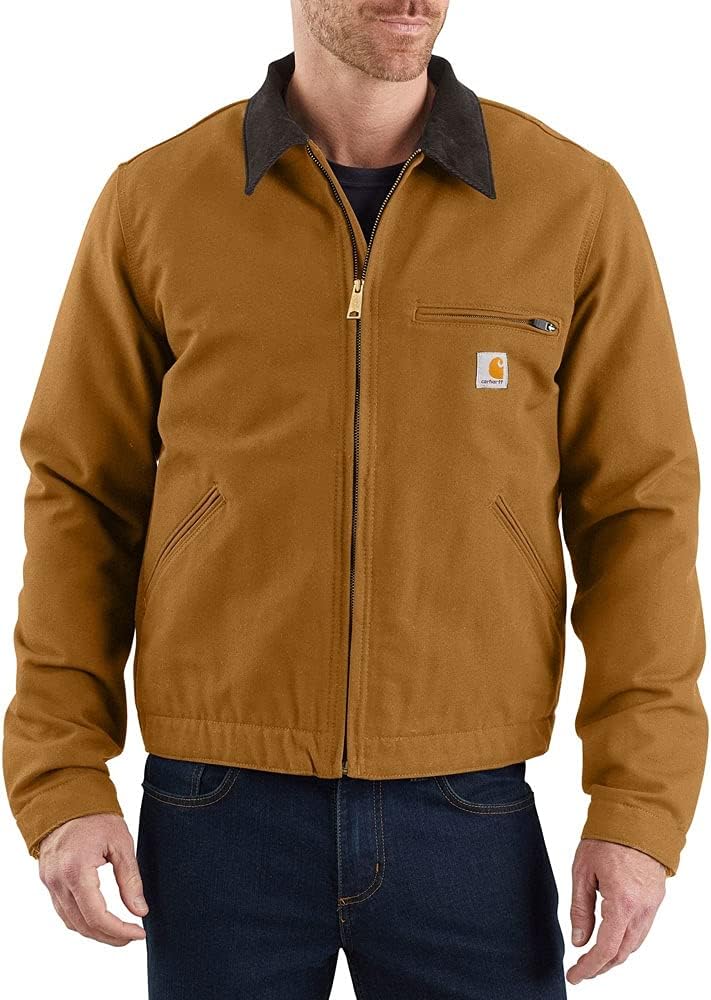
You just ordered what you thought was a straightforward work jacket, and two days later you’re standing in the parking lot of a job site, arms extended, wondering why a Large from a brand you’ve worn for fifteen years fits like you’re borrowing your big brother’s coat. That’s not a sizing fluke — that’s the Carhartt duck jacket lineup doing what it’s quietly been doing to buyers for years. “Duck canvas” (a heavy, tightly woven cotton fabric — the same material used in traditional work tents and sails) is Carhartt’s core outerwear material, and it’s genuinely excellent. The problem is that three of the brand’s most popular duck jackets — the Detroit J01, the Bartlett Washed Duck, and the Active Jac — are built on different patterns, for different use cases, and fit almost like they belong to different brands. If you default to your usual size across all three, you’re going to eat return shipping on at least one of them.
This guide is the homework you should do before you order, not after.
Why These Three Jackets Fit So Differently
Understanding the fit gap starts with understanding what each jacket was designed to do.
The Detroit J01 is Carhartt’s heritage work jacket — the one that’s been on the rack since the 1970s in one form or another. It’s built with a traditional, boxy, unlined silhouette that was sized to go over a union suit, a heavy flannel, and sometimes a vest. That’s not nostalgia talking — that’s the actual construction brief the pattern was built around. Heddels’ deep-dive on Carhartt’s Detroit jacket history notes that the cut has remained largely unchanged from its original workwear intent, which means it assumes serious layering underneath. Buyers who pick up a Detroit without that context consistently end up swimming in fabric.
The Bartlett Washed Duck is a more recent entry with a noticeably updated fit. It runs closer to the body through the chest and shoulders, uses a washed canvas (meaning it’s been pre-softened at the factory), and adds a stretch panel across the back — that last detail being the one that keeps showing up in trades-specific reviews. Electricians, carpenters, and anyone doing overhead work notice the difference immediately: the back panel gives your arms room to reach without riding the jacket up above your waist or pulling at the shoulders. The Bartlett still has plenty of room for a midlayer, but it’s sized closer to a modern athletic jacket than the Detroit’s old-school boxy template.
The Active Jac is the insulated member of this group, using Carhartt’s proprietary Rain Defender water-repellent finish and a fill insulation layer that makes it noticeably puffier than either of the other two right out of the box. Multiple owner reports aggregated at Working Person’s Store flag this directly: the Active Jac can feel almost claustrophobic in-store because the insulation hasn’t settled yet. Reviewers who dismissed it during a fitting room try-on and didn’t buy it report reconsidering after friends told them the loft compresses with a few wears. This is a known pattern with synthetic fill workwear jackets and worth keeping in mind before you rule the Active Jac out.
The Sizing Numbers You Need to Know
Here’s where the practical decision-making starts. Across aggregated reviews on Working Person’s Store and forum discussions indexed by Gear Junkie’s work jacket roundups, a consistent picture emerges for each jacket:
By the numbers:
| Jacket | Sizing tendency | Best layering scenario | Sleeve length bias |
|---|---|---|---|
| Detroit J01 | Runs 1–1.5 sizes large | Heavy layers (fleece, vest) | Shorter relative to stated size |
| Bartlett Washed Duck | Runs true to size | Midlayer (hoodie, light fleece) | Generous, good for long arms |
| Active Jac | Runs slightly large; loft compresses with wear | Light to mid layer | True to size |
The Detroit J01 is where the most dramatic misfire stories live. The reviewer pattern that Primer Magazine’s workwear sizing guide calls out — buyers at medium builds (think 5’9”, 185 lbs) returning a Large because it looked like cosplay and landing correctly in a Medium — is not an outlier. It’s the median experience. If you’re not planning to layer a heavy vest underneath the Detroit, size down one full size from your normal. If you’re a tall buyer who prioritizes sleeve length, be aware that the Detroit’s sleeves run shorter relative to its chest sizing — tall sizing is available and worth the look.
The Bartlett is the forgiving one. Owners report that sizing true produces a fit that handles a midlayer comfortably while still looking intentional rather than borrowed. The stretch back panel makes it the most ergonomic of the three for active trades work, and that enthusiasm shows up in reviews: the Bartlett earns the most consistent praise of the three jackets once buyers get the sizing right. Field Mag’s overview of duck canvas workwear notes that washed canvas jackets like the Bartlett tend to have already gone through their initial shrinkage at the factory, meaning what you get is close to what you’ll keep — less post-wash surprise.
The Active Jac’s Insulation Misconception
This is worth its own section because it costs buyers a purchase they’d likely love.
The Active Jac’s synthetic insulation creates a noticeable loft when the jacket is new. Buyers trying it on in-store over a layering piece sometimes walk away concluding the jacket is too bulky or too restrictive. That’s a real in-store experience — but it’s not an accurate preview of the jacket after a week of regular use. Across reviews, owners consistently report that the fill settles and redistributes with wear, bringing the fit profile closer to what you’d expect from a shell-style work jacket with a light lining. The Rain Defender DWR finish (a factory-applied coating that causes water to bead off the surface rather than soak in) doesn’t affect the fit at all — it’s a surface treatment.
Temperature-wise, the Active Jac sits comfortably in the 25°F to 45°F working range — cold enough that you need insulation, not so cold that you need a full-on quilted parka. Below that range, owners report wanting a vest layer underneath. Above 45°F on active job sites, the Active Jac becomes a liability: it’s insulated enough that it traps heat during physical work, and the DWR finish doesn’t breathe the way a lighter shell would.
Canvas Softening: What to Expect Over Time
One question that runs through every Carhartt duck canvas thread is whether the fabric softens with wear and washing — and how to do it without destroying the jacket.
The short answer is yes, but the process varies by jacket type.
The Detroit J01 ships stiff. That’s intentional — untreated duck canvas is a dense, tightly woven cotton designed to resist abrasion, and it takes time and use to break in. Owners report meaningful softening after three to five washes and regular wear, though the jacket never becomes truly pliable the way washed denim does. Field Mag’s duck canvas guide recommends washing in cold water, tumble drying on low, and avoiding fabric softener — softener can degrade the cotton fibers over time and, on treated versions, compromise any factory DWR finish.
The Bartlett Washed Duck, as the name signals, has already been through an industrial softening process before it ships. It arrives noticeably more broken in than the Detroit, which is a feature, not a compromise. The canvas still has excellent durability, but you’re not fighting through three months of stiff-shoulder break-in before you enjoy the jacket.
For the Active Jac, washing protocol matters more because of the insulation fill. A low-heat dryer cycle (not high heat) with a few clean tennis balls or dryer balls helps prevent the fill from clumping as it dries — the same principle used with down-filled gear. High heat can damage synthetic insulation and cause uneven distribution.
Frequently Asked Questions
Should I size down on the Carhartt Detroit J01 if I’m not planning to layer heavily underneath?
Yes, unambiguously. The Detroit’s pattern was built for heavy underlayers. If your daily use is a t-shirt or light flannel underneath, size down one full size from your normal. If you’re between sizes, go smaller — the canvas will loosen slightly with wear, and the boxy cut gives you more room than the chest measurement alone suggests.
What is the temperature range where the Active Jac is actually appropriate without being too warm?
Owner reports and Gear Junkie’s work jacket roundup both point to 25°F–45°F as the Active Jac’s working sweet spot during physical activity. It’s not a stand-alone extreme-cold jacket, and it becomes uncomfortable during high-output work above 45°F. Think of it as your primary jacket for cold mornings and breaks, with the understanding you may want to vent or shed it once you’re working hard.
Does the Bartlett Washed Duck jacket hold up to job-site abuse or is it more of a casual work jacket?
The Bartlett is a real work jacket. The washed canvas has the same base material as the Detroit — just pre-softened — and owners working in construction and electrical trades report strong durability after extended use. The stretch back panel is specifically a trades feature, not a lifestyle one. It’s not a fashion piece masquerading as workwear. That said, the Bartlett’s cleaner cut means it also functions as a commute or casual jacket in a way the Detroit doesn’t — which some buyers consider a bonus, not a compromise.
How do the sleeve lengths compare across the Detroit, Bartlett, and Active Jac for taller buyers?
The Detroit runs shortest in the sleeve relative to its chest sizing — tall buyers frequently report exposed wrists when reaching, even in sizes where the chest fits correctly. Carhartt offers tall sizing on the Detroit (J01T) and that’s worth prioritizing if you’re over 6’1”. The Bartlett runs more generously in the sleeve and gets fewer complaints from taller buyers. The Active Jac tracks close to true length. If sleeve coverage is a priority for you, the Bartlett is the most forgiving of the three in standard sizing.
Does the duck canvas on Carhartt jackets soften with washing, and how should you wash them?
Yes — duck canvas softens meaningfully with washing and wear, especially on the Detroit, which ships with a notably stiff hand feel. Cold water wash, low heat dry, no fabric softener is the standard recommendation across owner forums and is consistent with Field Mag’s duck canvas care overview. For the Active Jac specifically, add dryer balls to prevent insulation clumping. Avoid dry cleaning all three — the solvents can degrade the cotton and, on treated versions, strip the DWR finish.
The Decision Rule
Here’s where the research lands for buyers with an actual purchase pending:
- If you need a heavy-duty work jacket for layered winter use and you’re willing to size down one from your normal: The Detroit J01 is the classic choice — simple, proven, and built to outlast the job site.
- If you do overhead work or need full arm mobility and want something that fits like a modern jacket without sacrificing durability: The Bartlett Washed Duck is the right call in your true size.
- If you’re in the 25°F–45°F range and want insulation without committing to a parka: The Active Jac works — but try it on knowing the loft settles, and size down if you’re between sizes.
The one rule that applies across all three: do not default to your normal size without checking which jacket you’re ordering. The sizing review data is clear, and the return shipping is avoidable.