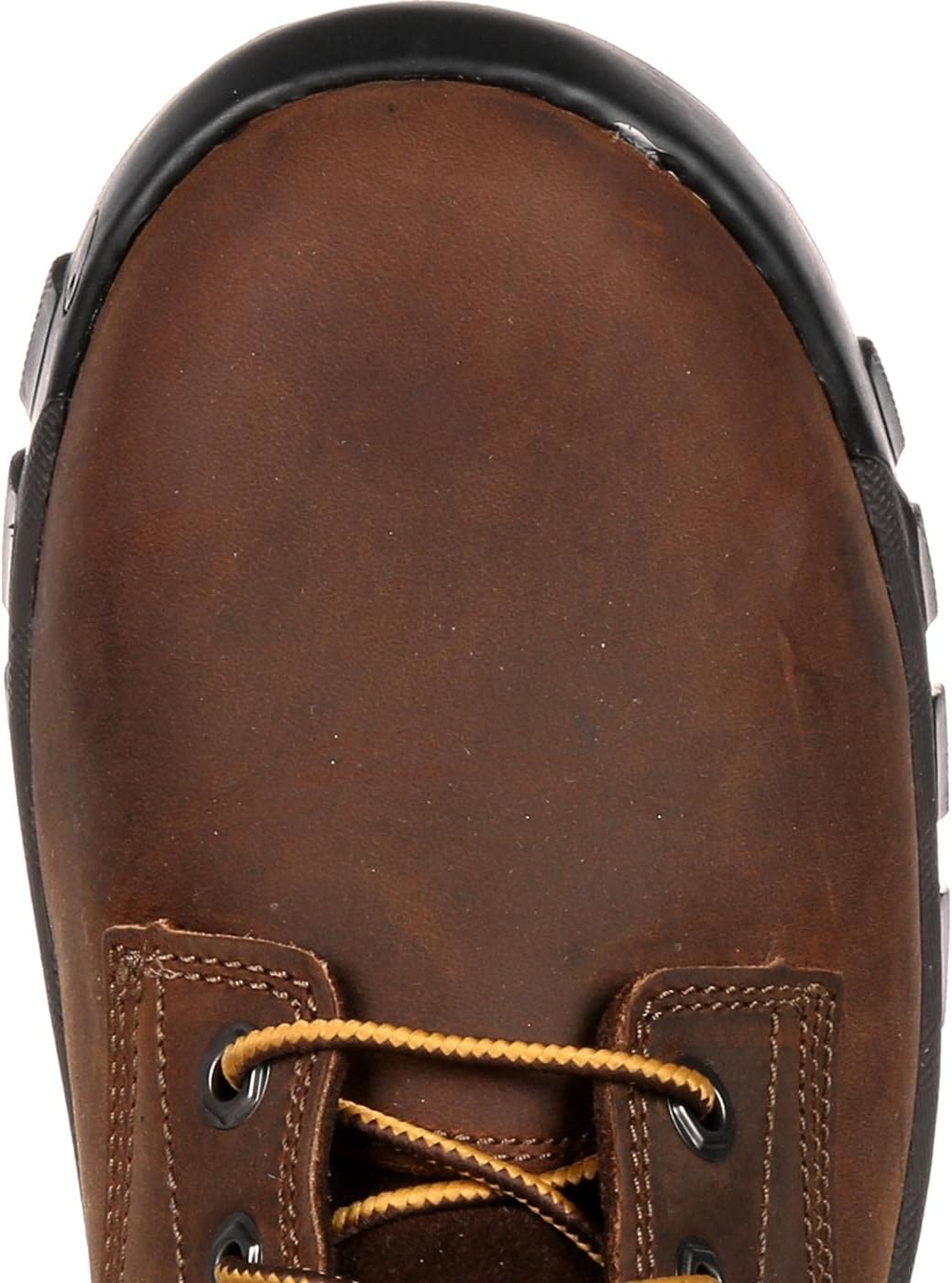
You’ve spent a full shift on concrete — or on a ladder, or a roof — and by noon your feet are done. The boots that felt fine at the hardware store have you walking on your heels by the time the afternoon rolls around. That’s the problem a wedge sole is built to fix. Unlike a traditional lug sole (the chunky, deeply treaded outsole common on hiking boots), a wedge sole is a single flat wedge of dense rubber that runs the full length of the boot’s bottom. It sits closer to the ground, reduces ankle fatigue on flat or hard surfaces, and sheds mud and debris more easily than deep lugs. The moc toe — the horizontal stitching across the toe box that traces its origins to the construction of Native American moccasins — gives the boot a roomier, rounded front that many tradespeople prefer over the pinched feel of a standard cap-toe work boot.
Carhartt has three boots in this wedge-moc-toe format, each targeting a slightly different buyer: the CMX4023 Chukka (a low-cut ankle boot), the CMF6366 (a composite-toe 6-inch with electrical hazard rating), and the CMW6174 Tradition Welt (a budget-oriented 6-inch with welt-stitched construction that reviewers keep reordering). If you’re standing between these three right now — because your jobsite requires EH certification, your feet are wide, or you simply want the lightest possible option — this comparison is built for you. We’ll name the tradeoffs plainly, show the sizing math, and land on a clear if-then decision at the end.
The Three Boots at a Glance
Before going deep, here’s the landscape in plain numbers:
| Boot | Height | Toe | EH Rated | Construction | Relative Price |
|---|---|---|---|---|---|
| CMX4023 Chukka | ~5” ankle | Soft moc toe | No | Cement wedge | Lowest |
| CMF6366 | 6” | Composite safety toe | Yes | Cement wedge | Mid |
| CMW6174 Tradition Welt | 6” | Soft moc toe | No | Welt-stitched wedge | Budget–mid |
The CMW6174’s “Tradition Welt” label is worth unpacking: a Goodyear welt (or welt-stitched construction) means the upper leather is stitched to a strip of leather or synthetic material — the welt — which is then stitched to the sole. Per Heddels’ coverage of work boot construction methods, this approach makes resoling mechanically possible as long as the upper and welt remain structurally sound. We’ll return to whether the CMW6174 is actually worth resoling in a dedicated section below.
Which Boot Is Right for You: Three Head-to-Head Profiles
The CMX4023 Chukka — The Comfort-First Daily Driver
The Chukka is generating some of the most emotionally resonant owner feedback of the three. A veteran dealing with deployment-related foot injuries describes it as a daily solution after years of searching. A buyer who already owns Red Wing and Brunt boots calls the Carhartts “unbelievable” and is on his second pair. That pattern — owners returning for a repeat purchase — is usually a better signal than first-impression reviews.
The Chukka’s appeal is simple: it’s a low-cut boot, which means less material above the ankle, less weight, and a faster break-in than any 6-inch option. The wedge sole keeps you flat to the ground with minimal stack height. For tradespeople who spend most of their day on flat concrete or smooth surfaces — tile setters, finish carpenters, warehouse supervisors — the Chukka is a legitimate all-day option.
What reviewers flag as tradeoffs: The low cut means reduced ankle support compared to a 6-inch boot. If your work involves uneven ground, repeated ladder climbing, or carrying heavy loads across irregular terrain, the ankle height is a real consideration, not just a comfort preference. The Chukka also carries no EH rating, which disqualifies it on worksites that require electrical hazard-rated footwear per OSHA PPE standards.
Sizing note: Owners with wide feet consistently report that the Chukka accommodates them unusually well compared to other Carhartt styles. If you’ve been chased out of other Carhartt boots by narrow toe boxes, the Chukka is worth a closer look. Sizing appears to run true to standard for most buyers, with no consistent half-size adjustment reported across owner feedback.
Carhartt
$109.95
In stock on Amazon
Check price on AmazonThe CMF6366 — The Compliance Boot That Looks Good Off the Job
The CMF6366 is the only boot in this lineup with two critical safety certifications. Per Carhartt’s published specification sheet for the CMF6366 and the requirements of ASTM F2413-18 — the current ASTM International standard governing protective footwear performance — the CMF6366 carries both a composite safety toe rating and an electrical hazard (EH) classification. ASTM International’s documentation of ASTM F2413-18 defines EH-rated footwear as designed to reduce the hazard of accidental contact with live electrical circuits, and Carhartt’s published spec confirms the CMF6366 meets that classification. For electricians, linemen, HVAC technicians, and anyone working near energized equipment, that EH rating is a compliance requirement, not a perk.
What catches reviewers off guard is how the CMF6366 manages to look decent in jeans. The composite toe — a non-metallic safety toe made from materials such as carbon fiber composite or thermoplastic — has a lower profile than a traditional steel toe, which keeps the toe box from looking like a blunt instrument. Reviewers aggregated on Working Person’s Store consistently mention the style crossover: wearing these on the job and then not bothering to change shoes afterward.
Sizing caution: The CMF6366 runs large. Multiple owners recommend sizing down a half size. This is the single most consistent complaint across aggregated reviews — buying your usual size produces a boot with excess length that causes heel slippage and, over time, blister formation. If your standard Carhartt or Red Wing size is a 10, order a 9.5 here.
Tradeoff to name explicitly: Composite toes are lighter than steel but offer slightly less crush resistance at the top end of the force spectrum. For most tradespeople, the ASTM-rated composite toe is fully adequate — the standard requires the same impact and compression performance thresholds regardless of toe material. However, on very heavy industrial jobsites such as steel mills, foundries, or heavy equipment yards, some safety managers continue to specify steel toe. Know your site’s PPE requirements before purchasing.

Carhartt
$139.99
In stock on Amazon
Check price on AmazonThe CMW6174 Tradition Welt — The Quiet Workhorse
The CMW6174 is the least flashy of the three, and it has the most consistent repeat-purchase behavior in aggregated owner feedback. One reviewer on Working Person’s Store documents that their son-in-law requests it every Christmas. That’s not a casual review — that’s a data point on a product that has earned a specific person’s trust across multiple seasons.
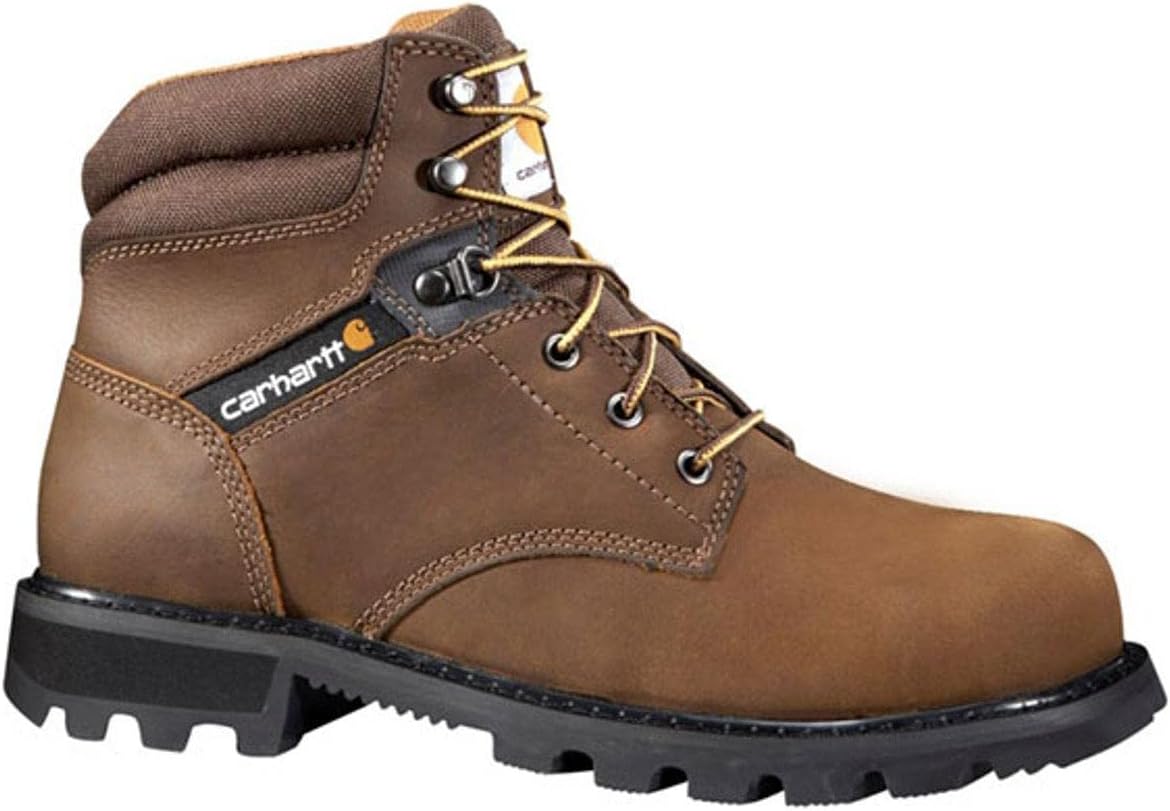
What owners praise: the roomy toe box (critical for tradespeople who spend hours on their feet), triple stitching at stress points (which extends the usable life of the upper before any sole conversation becomes necessary), and the price point, which comes in below the CMF6366 despite featuring welt-stitched construction. The CMW6174 carries no safety-toe rating and no EH certification, which makes it the wrong choice for compliant jobsites but the right choice for tradespeople who work on unregulated or low-hazard sites and want a durable everyday boot.
Sizing note: The CMW6174 runs approximately a half size long compared to other Carhartt styles — not relative to your size-chart measurement, but relative to how other Carhartt boots fit on the same foot. If you’ve adjusted down to a 9.5 in the CMF6366, you may land at a 9.5 in the CMW6174 as well, but owners who wear the two side by side note slight variation. When in doubt, size down a half from your usual Carhartt fit.
Carhartt
$109.95
In stock on Amazon
Check price on AmazonOn Resoling the CMW6174: Worth It or Not?
This question comes up enough in owner forums and boot communities that it deserves a direct answer. Yes, the CMW6174 uses welt-stitched construction, which makes resoling mechanically possible. Heddels, in their ongoing coverage of work boot construction methods, notes that welt-stitched boots can be resoled multiple times as long as the upper leather and welt itself remain structurally sound — a key qualification that many buyers overlook.
The practical question is cost-per-wear math. The CMW6174 sits in the budget tier. Resoling at a competent cobbler typically runs $80–$120 depending on sole material and region. If the boot’s upper is in good condition after the original sole wears out, resoling can extend the boot’s life meaningfully and the math works in your favor. If the upper is cracked, the toe box is collapsing, or the welt shows deterioration, a resole is good money chasing a lost cause.
Decision rule on resoling: Inspect the upper before committing. If the leather is supple, the stitching is intact, and the welt shows no cracking, a resole is worth pursuing. If any of those three conditions fail the check, let the boot go and begin the replacement cycle fresh.
Carhartt vs. Thorogood: The Honest Positioning
Buyers who’ve outgrown one brand and are considering the other ask this comparison regularly. Popular Mechanics’ updated work boot coverage for 2025 places Thorogood — particularly the American Heritage Moc Toe — in the upper tier for leather quality and domestic manufacturing. Thorogood’s American Heritage line uses full-grain leather (the outermost, densest layer of the hide) and is manufactured in Merrill, Wisconsin. Carhartt’s moc toe lineup does not make equivalent domestic-manufacturing claims, and the leather specification language in Carhartt’s published materials does not use “full-grain” terminology.
What this means in practice: Thorogood’s American Heritage, at a higher price point, is likely to outlast Carhartt’s lineup in terms of upper durability and long-horizon construction quality. The Carhartt boots compete on value, comfort out of the box, and the availability of safety-toe and EH-certified options in the wedge-moc-toe format. If you’re building a boot wardrobe for the long term and resolability is central to your plan, Thorogood is the clearer investment. If you need a comfortable, EH-rated, safety-toe boot at a mid-range price and you’re not in a buy-it-for-life mindset, the CMF6366 addresses that requirement directly.
Carhartt
$144.99
In stock on Amazon
Check price on AmazonFrequently Asked Questions
Does the Carhartt CMF6366 meet current EH electrical hazard standards? Yes. Per Carhartt’s published specification sheet for the CMF6366, the boot is rated to ASTM F2413-18, which includes the EH (electrical hazard) classification as documented by ASTM International. Confirm your jobsite’s specific PPE requirements with your safety manager, but the CMF6366 meets the current governing standard.
Which Carhartt moc toe is best for wide feet? The CMX4023 Chukka. Owners with wide feet — including buyers who report being turned away by other Carhartt styles — consistently describe the Chukka’s fit as accommodating in a way the 6-inch options are not. The CMW6174 also draws praise for its roomy toe box, making it a secondary option for wide-footed buyers who need a 6-inch height.
Does the Chukka have enough ankle support for all-day trades work? For flat-surface trades work — concrete, smooth warehouse floors, light industrial environments — reviewers report sufficient support for full shifts. For ladder work, uneven terrain, or load-carrying across variable surfaces, a 6-inch boot offers meaningfully more ankle structure. This is a genuine tradeoff, not a marketing caveat.
Is the CMW6174 Tradition Welt actually resoleable, and is it worth pursuing? The construction is welt-stitched, which makes resoling possible. Whether it’s worth pursuing depends on upper condition at the time of sole wear. If the leather and welt are intact, resoling at $80–$120 extends the boot’s life at favorable cost-per-wear math. If the upper shows significant degradation, replacement is the better call.
How do Carhartt moc toe boots compare to Thorogood on leather quality? Thorogood’s American Heritage Moc Toe uses full-grain leather and domestic manufacturing, placing it above Carhartt’s lineup on raw material quality and long-horizon durability, as noted in Popular Mechanics’ 2025 work boot coverage. Carhartt competes on price, comfort from day one, and availability of safety-toe and EH-certified options in this format. For buyers prioritizing longevity and resolability, Thorogood is the stronger investment. For buyers prioritizing value and compliance certifications, Carhartt fills that need directly.
The Decision Rule
If your jobsite requires EH certification or a safety toe: The CMF6366 is your only option in this lineup. Size down a half size from your usual Carhartt fit. The style bonus is real, but the compliance function is the primary reason to buy it.
If your feet are wide and your work is primarily flat-surface: The CMX4023 Chukka is worth trying first. It has the most accommodating fit geometry in the lineup and the lightest overall package. If you need more ankle structure, step up to the CMW6174.
If you want the best long-horizon value in a 6-inch, non-safety-toe boot: The CMW6174 Tradition Welt wins on repeat-purchase loyalty, construction details (triple stitching, welt-stitched sole), and a price point that makes the cost-per-wear math work — especially if you pursue a resole before replacement. Size down a half from your usual Carhartt fit.
If you’re comparing against Thorogood and longevity is the priority: Go Thorogood. The Carhartt lineup is not competing on that axis, and Popular Mechanics’ 2025 work boot coverage reflects that hierarchy clearly.