You just spent forty minutes on the workwear section of a distributor’s site, staring at three jackets that all look orange — and you still don’t know which one to order before the next crew rotation. The problem isn’t the jackets. It’s that “outer layer” is doing too much work as a category. A hi-vis bomber (an insulated, fluorescent jacket worn over base layers and mid-layers, built to meet federal visibility standards) is solving a different problem than a rain shell (a waterproof outer layer with minimal or no insulation, designed to shed precipitation) or a softshell (a stretch-woven jacket that’s wind-resistant and mildly water-resistant, prioritizing comfort and movement over full weatherproofing). These three jacket types overlap in price, overlap in appearance, and routinely end up in the wrong applications — which is expensive, uncomfortable, and on some sites, a compliance issue.
This comparison breaks down the actual decision logic: what each jacket type does well, where it falls short, and which specific products have earned attention from buyers with real-world stakes. If you have a job that requires ANSI-rated visibility, a climate that swings between dry cold and wet cold, or a crew that needs layering systems that actually function, the next 1,900 words are the research you’d otherwise spend a week pulling together.
What Each Jacket Type Actually Protects Against
Before you compare products, get the matrix straight.
Hi-vis bombers are built around two requirements that exist in tension: thermal performance and conspicuity — the technical term for how visible you are to vehicle operators and equipment. ANSI/ISEA 107-2020, the governing standard published by the International Safety Equipment Association, defines Class 2 and Class 3 visibility levels based on the amount of fluorescent background material and retroreflective striping sewn into the garment. Class 2 covers most roadway and warehouse work; Class 3 is required when workers are exposed to high-speed traffic or low-visibility conditions. Neither class mandates waterproofing. A hi-vis bomber can be soaking wet and still ANSI-compliant.
Rain shells are the opposite prioritization. They exist to keep precipitation out, typically through a laminated membrane combined with a DWR (durable water repellent) coating. Most rain shells carry minimal or no insulation, because insulation that becomes wet loses its thermal value anyway. Consumer Reports covers jacket weather-resistance ratings in their buyer’s guides, noting that shell performance is expressed as a hydrostatic head pressure rating — how many millimeters of water column a fabric can resist before leaking. A rating above 10,000mm is generally considered functional for sustained rain; below that, you’re getting a water-resistant jacket, not a waterproof one.
Softshells split the difference — and that’s both their strength and their liability. Gear Junkie’s comparison of softshell versus hardshell construction explains that softshells use densely woven face fabrics, often with a DWR finish, that handle light moisture and wind while offering stretch and breathability that hardshells and bombers can’t match. Outside Online’s technical outerwear coverage similarly notes that the tradeoff is sustained heavy rain: most softshells eventually saturate and lose thermal value in prolonged downpours. They’re genuinely excellent in cold-but-dry or cool-and-breezy conditions where mobility matters more than full weatherproofing.
Quick-reference matrix:
| Type | ANSI Compliant? | Waterproof? | Insulated? | Best Temp Range |
|---|---|---|---|---|
| Hi-Vis Bomber | Yes (Class 2 or 3) | Varies by model | Usually yes | 20°F–45°F |
| Rain Shell | No (unless ordered with hi-vis) | Yes (typically 10,000mm+) | Minimal | 35°F–60°F |
| Softshell | No | No (water-resistant only) | Light | 40°F–60°F |
The Hi-Vis Bomber Decision: Compliance First, Then Warmth
If your site requires ANSI-rated visibility, this decision is not optional — it’s the starting point. The real questions are: which class, how warm, and how much rain resistance do you actually need layered on top. The following three H3 sections walk through each tier of the hi-vis bomber market with a named pick at each level.
Budget Pick: Ergodyne GloWear Hi-Vis Bomber
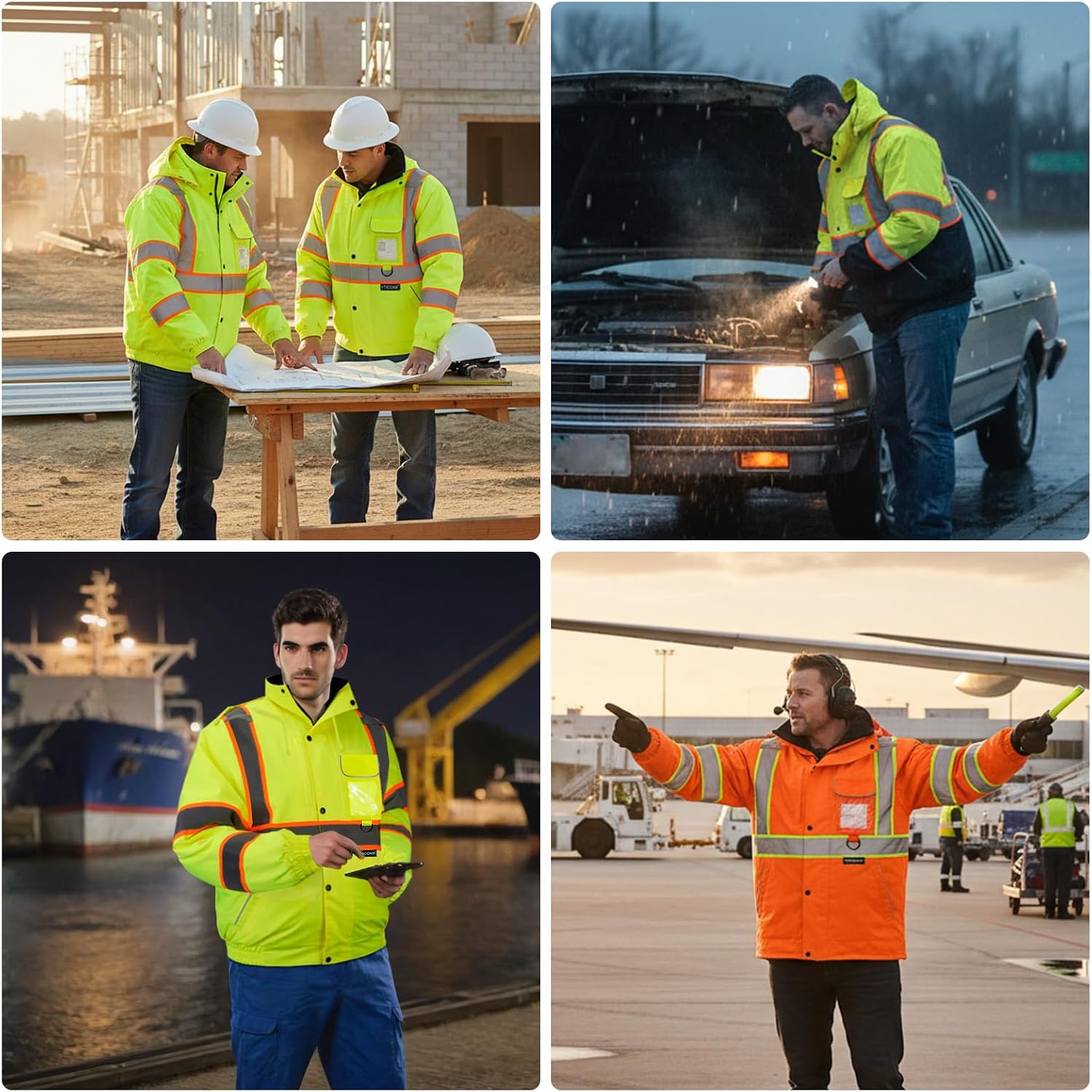
TICONN
$24.99
In stock on Amazon
Check price on AmazonThe Ergodyne GloWear Hi-Vis Bomber has developed a notably strong reputation in the sub-$100 segment of the hi-vis market. Buyers who expected to compromise — measuring it against options at similar or higher price points — consistently report that the insulation, fit, and reflective tape placement exceeded what they anticipated at its price tier. That’s a meaningful signal: in a category where “budget hi-vis” often means flimsy shell fabric and tape that peels after a season, the Ergodyne’s owner feedback breaks from that pattern. It’s not positioned as a premium garment, but reviewers keep returning to the same benchmark-beating narrative: it performs above its price tier.
That makes it a legitimate first buy for workers entering the hi-vis market and a smart volume purchase for small contractors outfitting crews. If sizing is a concern — common with layered workwear — owners in aggregated reviews generally report that the Ergodyne fits true to size when worn over a mid-layer, without needing to size up specifically for the bomber construction. The Ergodyne GloWear 8380 series specification documentation confirms Class 2 compliance with reflective tape placement meeting ANSI/ISEA 107-2020 minimums.
TICONN
$24.99
In stock on Amazon
Check price on AmazonMid-Tier Pick: TICONN Hi-Vis Bomber
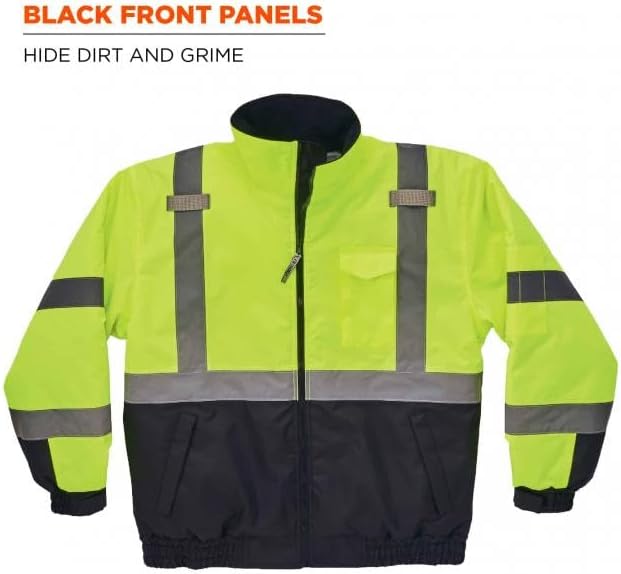
Ergodyne
$26.92
In stock on Amazon
Check price on AmazonThe TICONN Hi-Vis Bomber occupies a useful middle position between an entry-level budget option and a purpose-built compliance garment. One important clarification for buyers: this is a distinct product from the TICONN ANSI Class 3 Trench Coat (covered below), and the two are frequently confused because their marketing photography looks similar. The bomber variant has generated owner feedback noting it is better insulated than it appears at first glance — the jacket photographs like a rain shell but performs more like an insulated bomber. For buyers layering over a light fleece in 30°F conditions, that’s a pleasant surprise; for buyers expecting a packable rain layer, it’s a mismatch. Read the insulation specification carefully before ordering.
At its price point, the TICONN Hi-Vis Bomber makes sense for workers who need reliable Class 2 coverage with a warmer interior feel than the Ergodyne delivers, but who don’t yet need the extended Class 3 retroreflective coverage required on high-speed roadway sites.
Ergodyne
$26.92
In stock on Amazon
Check price on AmazonPremium Pick: TICONN ANSI Class 3 Hi-Vis Trench Coat
Legendary
$129.99
In stock on Amazon
Check price on AmazonThe TICONN ANSI Class 3 Trench Coat addresses a compliance requirement that most jacket reviews overlook entirely: the need for a visible ID or badge pocket that meets site or employer standards. Class 3 designation means more retroreflective material than Class 2, covering the sleeves in addition to the torso — required on many highway construction and utility sites. The trench coat format (longer hem length than a standard bomber) adds coverage in rain and wind without switching to a separate shell.
For workers whose sites require an ID to be displayed at all times — not just clipped to an interior pocket — the exterior ID pocket placement is the actual reason to buy this jacket over a standard bomber. TICONN’s product specification documentation for the ANSI Class 3 series confirms the ID pocket is positioned for exterior visibility, which is a genuine job-site compliance driver, not a marketing footnote. If your employer or site safety plan specifies Class 3, a Class 2 jacket does not satisfy it — the classes are not interchangeable under ANSI/ISEA 107-2020.
Legendary
$129.99
In stock on Amazon
Check price on AmazonRain Shells and Softshells: When ANSI Isn’t the Question
If you work outdoors without a regulatory visibility requirement, the jacket decision simplifies — but the thermal and precipitation tradeoffs still matter considerably.
Rain Shells: Waterproofing as the Primary Spec
For outdoor enthusiasts and tradespeople without ANSI requirements, the rain shell calculus comes down to three variables: how wet, how cold, and for how long. Short commutes and light rain favor a packable shell with DWR treatment. Extended outdoor exposure — a full day in Pacific Northwest conditions, or a roofing job that runs into a storm front — demands a fully seam-sealed membrane with a hydrostatic head rating above 15,000mm, as Consumer Reports’ jacket weather-resistance buyer’s guides consistently recommend for sustained-rain scenarios.
One compliance nuance worth noting: if you have ANSI requirements and are considering layering a hi-vis vest over a non-rated rain shell, be cautious. Under most interpretations of ANSI/ISEA 107-2020, the outermost layer must carry the rating. A hi-vis vest worn over a rain shell can partially obscure the vest’s background material. Consult your site safety officer before improvising a layered compliance system.
Softshells: The Mobility Jacket for Dry-Cold and Shoulder Season
Ergodyne
$26.92
In stock on Amazon
Check price on AmazonThe 33,000ft Softshell Jacket has attracted an unusual reviewer demographic: travelers to high-latitude destinations — Norway, Iceland, coastal Scotland — who provide detailed, conditions-specific wet-weather feedback that typical job-site reviews rarely generate. That’s genuinely useful data. A reviewer describing sustained use in Icelandic wind and drizzle is giving you a controlled-condition account of how the jacket manages moisture and temperature across hours, not just a parking-lot first impression. The consistent report from that cohort: the 33,000ft handles wind and light rain well, maintains comfort across a wide active-use temperature range, and offers enough packability to serve as a travel layer.
The limitation, consistent with softshell physics as described by both Gear Junkie and Outside Online in their respective outerwear construction coverage, is sustained heavy precipitation — extended soaking eventually wins. For job-site use, softshells make sense for utility workers in dry-cold climates who prioritize mobility over rain protection, finishing tradespeople (electricians, painters) working in covered environments, and outdoor professionals in alpine conditions where precipitation falls as snow rather than rain and a hardshell would restrict movement. The temperature range most owners cite as the softshell’s sweet spot — roughly 35°F to 55°F in active use — aligns with shoulder-season conditions across most of the continental United States.
Ergodyne
$26.92
In stock on Amazon
Check price on AmazonThe Waxed Cotton Outlier: Legendary Whitetails Barn Coat
TICONN
$24.99
In stock on Amazon
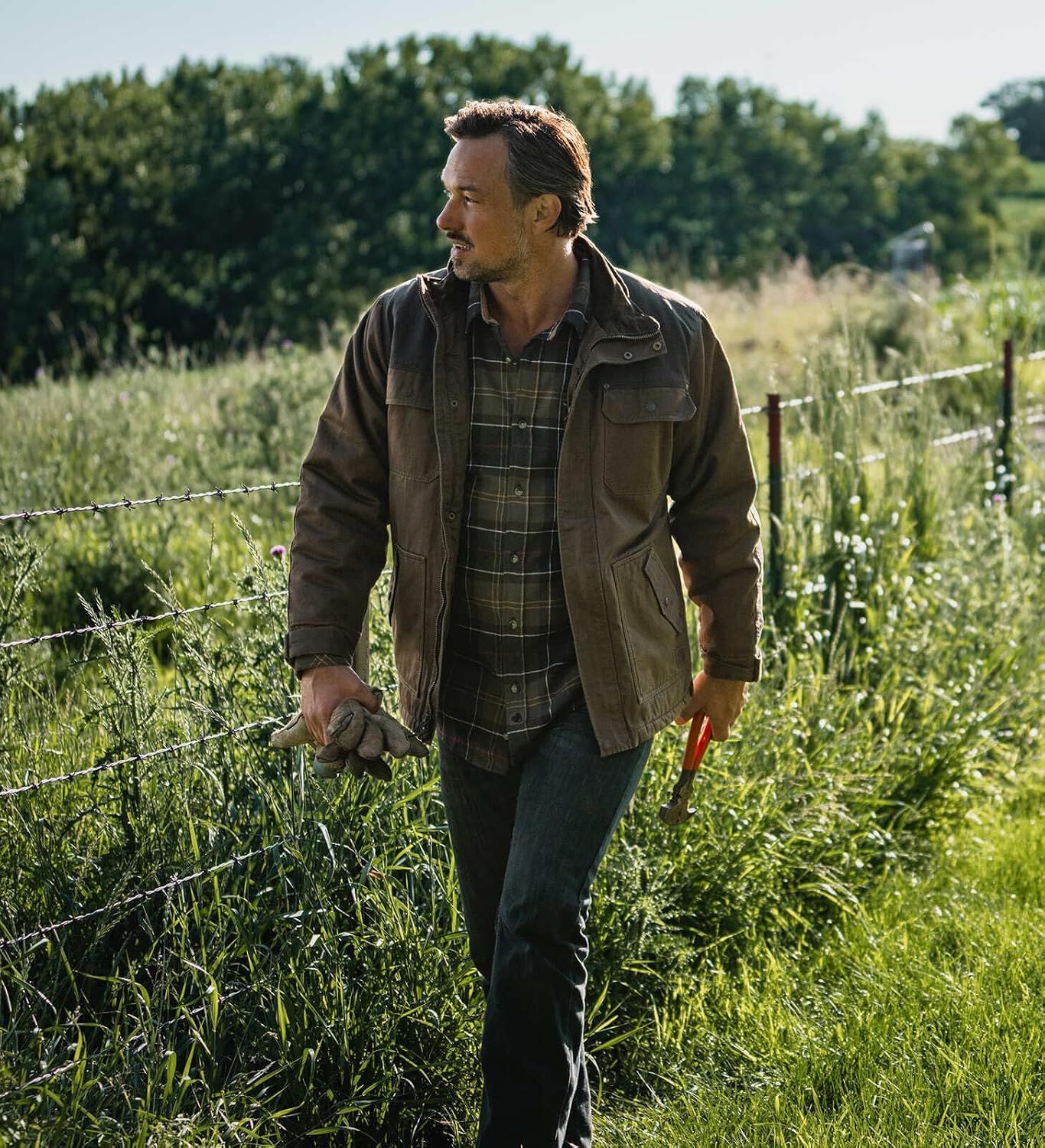
Check price on AmazonThe Legendary Whitetails Waxed Cotton Barn Coat occupies a genuinely different niche than any of the ANSI-rated or membrane-based options above. Waxed cotton — canvas saturated with paraffin or synthetic wax to create water resistance — has a long heritage in farm, ranch, and rural outdoor work. It is not ANSI-rated, not a membrane shell, and not a technical softshell. What it is: a handsome, repairable, re-waxable outer layer that handles light rain and wind with a patina that improves rather than degrades over time. Heddels, which covers heritage workwear construction in depth, notes that waxed cotton garments can be re-treated with products such as Otter Wax or brand-specific treatments when water resistance degrades after multiple seasons of use.
The buyer pattern for this jacket includes a segment who sized into a specific size primarily for sleeve length, suggesting the fit architecture runs slightly compact through the body — worth noting if you’re between sizes, since waxed cotton lacks the stretch of a softshell face fabric. The use case is specific but genuine: ranch work, barn chores, hunting camp, agricultural settings where ANSI compliance isn’t required and longevity matters more than technical weather performance. For a full day in driving rain, a membrane shell is the more reliable choice; for a decade of moderate-weather outdoor work on a working property, waxed cotton is a legitimate long-horizon purchase.
TICONN
$24.99
In stock on Amazon
Check price on AmazonClear Decision Rules
If your job site mandates ANSI Class 2 visibility: Start with the Ergodyne GloWear Hi-Vis Bomber and evaluate whether its weather resistance matches your climate. It performs above its price tier and fits true to size over a standard mid-layer.
If you need Class 3 coverage or an exterior ID pocket: The TICONN ANSI Class 3 Trench Coat is purpose-built for that compliance profile. Class 2 and Class 3 are not interchangeable under ANSI/ISEA 107-2020.
If you work outdoors without ANSI requirements in wet, cold conditions: A dedicated rain shell is the right category. Prioritize a hydrostatic head rating above 10,000mm for sustained rain; above 15,000mm for all-day exposure.
If your conditions are cold-but-dry or shoulder-season active work with significant movement: The softshell — the 33,000ft being a strong example in this price tier — will outperform a bomber or shell on comfort and mobility.
If your work is agricultural, rural, or outdoor-adjacent without technical compliance requirements: Waxed cotton like the Legendary Whitetails Barn Coat is a legitimate long-horizon purchase, just outside the ANSI conversation entirely.
The wrong outer layer in this category isn’t just uncomfortable — it’s a compliance risk or a thermal failure waiting for a bad-weather day. Match the jacket to the actual threat matrix, not the catalog category.
Frequently Asked Questions
What is the difference between ANSI Class 2 and Class 3 hi-vis jackets? Per ANSI/ISEA 107-2020, published by the International Safety Equipment Association, Class 2 requires a minimum of 775 square inches of fluorescent background material and 201 square inches of retroreflective striping. Class 3 raises both thresholds and specifically requires that the reflective material extend to the sleeves, not just the torso. Class 3 is required for workers exposed to high-speed traffic (roads with a posted limit above 50 mph) or conditions of reduced visibility. If your employer or site safety plan specifies Class 3, a Class 2 jacket does not satisfy the requirement.
Is a hi-vis bomber jacket waterproof enough for rain? Most are not fully waterproof. Hi-vis bombers typically have a DWR coating that handles light rain and drizzle, but they are not membrane-sealed shells. Sustained rain will eventually saturate the outer fabric. If you need both ANSI compliance and genuine waterproofing, look specifically for jackets that include seam-sealed membranes alongside their ANSI rating — or a compliant hi-vis trench coat format that layers waterproof treatment into the design.
Do I need to size up in the Ergodyne bomber? Based on aggregated owner feedback, the Ergodyne GloWear bomber fits true to size when worn over a standard mid-layer such as a fleece or light insulated hoodie. Owners do not consistently report needing to size up specifically for the bomber construction. If you’re wearing a thick insulated vest or heavy fleece underneath, factor your layering system into the size selection — that applies to any insulated outer layer.
What temperature range is a softshell jacket suitable for without layering? Most softshell jackets, including the 33,000ft model, are best suited to roughly 40°F–60°F in active outdoor use without additional layering. Below 35°F in sustained cold or wind, most people find a softshell insufficient as a standalone outer layer without at least a mid-layer underneath. Above 60°F, the wind-resistance properties of a softshell can feel warm during physical work.
Can I wear a waxed cotton jacket in heavy rain? Waxed cotton is water-resistant, not waterproof. It handles light to moderate rain well — the wax coating causes water to bead and run off. In sustained heavy rain over several hours, waxed cotton will eventually saturate, particularly at seams, which are not welded or tape-sealed the way membrane shells are. As Heddels notes in its coverage of heritage outerwear care, re-waxing with an appropriate treatment product restores water resistance when it has degraded after extended use. For a full day in driving rain, a membrane shell is the more reliable choice.
Does the TICONN ANSI Class 3 Trench Coat have a pocket for a visible ID badge? Yes. The TICONN ANSI Class 3 Trench Coat includes an exterior ID pocket designed for visible badge display — a genuine compliance feature that most standard hi-vis bombers omit. This is a specific purchasing reason for workers whose employer or site policies require an ID to remain visible at all times rather than stored in an interior chest pocket. Verify placement and pocket orientation against your employer’s specific badge-display requirements before purchase, as policy language varies by employer and site.