You just spent forty-five minutes searching for a basic hi-vis jacket — that’s a high-visibility work jacket, the bright yellow or orange outer layer required by law on most road construction, warehousing, and utility job sites — and everything halfway decent seemed to start at $70 and climb fast. If that search ended in relief when you found something legit under $60, you’re not alone. That exact frustration shows up repeatedly in owner reviews of the jackets covered in this article. The good news: the sub-$60 tier has gotten genuinely usable in the last few years, and the differences between options are specific enough to match to your actual job conditions. This article compares three jackets — the Ergodyne GloWear bomber, the TICONN hi-vis rain shell trench coat, and the TICONN insulated hi-vis bomber — on warmth, weather protection, compliance rating, and the real-world details that matter when you’re buying online without trying anything on.
| EDITOR'S PICKTICONN Reflective Rain Coat | Mid-tierErgodyne Hi Vis Bomber Safety J… | Budget pickTICONN Waterproof Safety Bomber… | |
|---|---|---|---|
| Class | ANSI Class 3 | — | ANSI Class 3 |
| Hi-vis color | Yellow | Lime | Yellow & black |
| Waterproof | ✓ | — | ✓ |
| Reflective | ✓ | — | ✓ |
| Style | Trench coat | Bomber | Bomber |
| Season | — | — | Winter |
| Price | $33.99 | $26.92 | $24.99 |
| See on Amazon → | See on Amazon → | See on Amazon → |
What ANSI Class Means and Why It’s the First Decision You Make
Before price or warmth, the compliance question has to be settled. ANSI (the American National Standards Institute) and ISEA (the International Safety Equipment Association) jointly publish the standard that governs hi-vis apparel in the United States. That standard — ANSI/ISEA 107-2020, American National Standard for High-Visibility Safety Apparel and Accessories, published by the International Safety Equipment Association — defines two main classes you’ll encounter at the jacket level:
- Class 2 requires a minimum of 775 square inches of fluorescent background material and 201 square inches of retroreflective tape, the silver strips that bounce headlight beams back toward a driver.
- Class 3 requires 1,240 square inches of fluorescent material and 310 square inches of retroreflective tape — effectively full-torso and sleeve coverage.
Per OSHA 29 CFR 1926.201, Signaling Requirements for Construction Work Zones (U.S. Occupational Safety and Health Administration), Class 3 is required for flaggers and workers in active traffic lanes moving faster than 50 mph. Many state DOTs and large general contractors have tightened their specs to Class 3 across the board on public road projects, even where OSHA would permit Class 2. If you’re on a road crew, a utility right-of-way, or any site where your employer’s safety plan references the Manual on Uniform Traffic Control Devices, verify Class 3 before you order. Warehouse and forklift environments often allow Class 2, but check your site’s written safety program — many large distribution centers have upgraded their internal requirements in recent years.
Both Ergodyne and TICONN offer Class 3 options in the sub-$60 window. That matters because a decade ago, Class 3 at this price point barely existed in a jacket format.
Three Jackets, Three Jobs: Side-by-Side Comparison
The table below summarizes the structural differences. The H3 sections that follow go deeper on each jacket’s real-world trade-offs.
| Feature | Ergodyne GloWear Bomber | TICONN Trench Coat | TICONN Insulated Bomber |
|---|---|---|---|
| ANSI Class | Class 3 | Class 3 | Class 3 |
| Insulation | Unlined shell | Unlined shell | Insulated liner |
| Sizing behavior | Size up 1–2 sizes | True to size | True to size |
| ID window | No | Yes | No |
| Hem length | Hip | Mid-thigh | Hip |
| Best condition | Rain + visibility | Rain + standing work | Cold dry / layering |

TICONN
$24.99
In stock on Amazon
Check price on AmazonErgodyne GloWear Bomber: The Value-Surprise Champion
TICONN
$24.99
In stock on Amazon
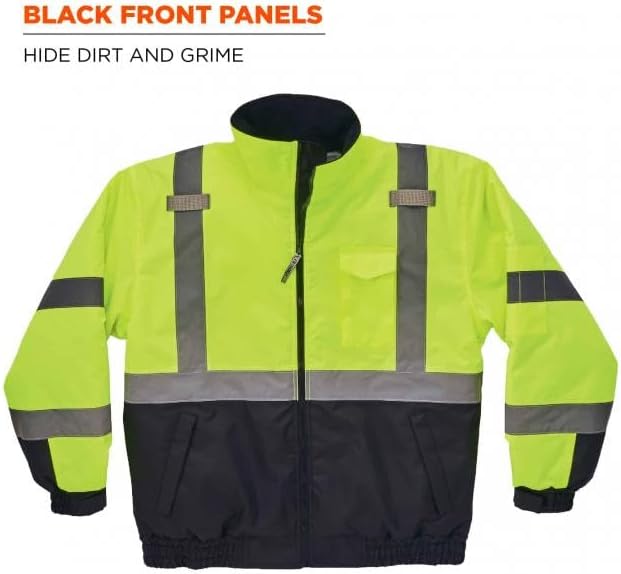
Check price on AmazonThe Ergodyne GloWear bomber — documented in the Ergodyne GloWear 8386 product specification published by Ergodyne Corporation — is the jacket that generates the most surprised positive reviews in the sub-$60 hi-vis category. The most striking pattern in owner feedback is emotional relief. Multiple buyers describe exhaustive searches across safety supply categories, finding everything at $50-plus for basic unlined shells, nearly abandoning the search — and then landing on this jacket at a price that felt like a mistake. One reviewer working night forklift shifts describes staying dry through rain while remaining fully visible to yard trucks. That dual-use case — rain-resistant and Class 3 compliant — is exactly what made the jacket click for buyers who couldn’t justify two separate garments.
What owners consistently report:
The outer shell handles sustained light rain well. In heavy, multi-hour downpours, some operators report moisture eventually working through seams rather than through the shell fabric itself. It is wind-shedding and rain-resistant rather than fully seam-sealed waterproof. If your work involves prolonged exposure in driving rain, that distinction matters before you buy.
Sizing runs small. This is the single most consistent signal across owner feedback: size up at least one size, and if you’re broad through the shoulders or plan to layer a mid-layer fleece underneath, consider two sizes up. Online buying without a fitting room makes this the biggest risk factor for a return.
The reflective tape placement meets Class 3 geometry — shoulders, chest, and sleeve bands — and owners report it holding up through multiple washing cycles without significant peeling when laundered per the care label (cold water, low heat or hang dry).
The honest trade-off: Ergodyne is a professional safety brand with a legitimate product line stocked by industrial distributors and safety supply houses. But at this price tier, construction is utilitarian. Zippers are functional rather than smooth, seam taping is partial rather than full, and the overall feel is worksite-practical rather than refined. That’s the right set of priorities for a $40–50 jacket; just don’t buy it expecting the feel of a $180 FR-rated bomber.
TICONN
$24.99
In stock on Amazon
Check price on AmazonTICONN Hi-Vis Rain Shell Trench Coat: The Flaggers’ Pick
Ergodyne
$26.92
In stock on Amazon
Check price on AmazonThe trench cut — longer hem, typically mid-thigh — solves a problem the bomber format can’t: keeping rain off your lower back and hips when you’re bending, crouching, or working in a sustained downpour. Owners in outdoor flagging, traffic control, and security roles consistently mention this as the reason they chose the longer format over a standard bomber.
One frequently surfaced detail in owner reviews: a dedicated ID window pocket. For workers whose job requires a visible badge at all times — security contractors, transit and transportation workers, government-adjacent roles, and some utility environments — this is a compliance feature, not a nice-to-have. Buyers specifically mention purchasing this jacket because of the ID window, not just because it’s hi-vis. If your site or employer requires visible credentials at all times, that single feature makes the trench coat worth a look over the bomber alternatives.
Practical job-site note on the longer hem: owners raise a valid concern in reviews — on active construction sites with ladder work, confined equipment access, or frequent bending over materials, a mid-thigh hem can snag or restrict range of motion more than a hip-length bomber. If you’re primarily flagging or working stationary traffic control, the length is a benefit. If you’re climbing, crawling, or working in tight mechanical spaces, the shorter bomber profile is likely the better call.
Sizing on the TICONN trench coat runs true to size per owner reports — a meaningful contrast to the Ergodyne, where the consistent advice is to size up at least one size.
Ergodyne
$26.92
In stock on Amazon
Check price on AmazonTICONN Hi-Vis Insulated Bomber: Cold-Weather Value
Ergodyne
$26.92
In stock on Amazon
Check price on AmazonThe insulated bomber in the TICONN line addresses the gap between “I need to be visible” and “I need to be warm.” The surprise most owners report: there is real insulation inside, not a thin liner masquerading as a warm layer. For buyers coming from unlined safety shells, the difference is noticeable. Reviewers describe it functioning as a legitimate outer layer in cold but not extreme conditions — think upper 20s to low 40s Fahrenheit with wind, not sustained single-digit temperatures or multi-day backcountry exposure.
The honest ceiling: at this price point and insulation weight, the TICONN insulated bomber is a three-season workwear layer in cold climates, not a winter-specific system. In temperatures below 20°F, particularly with wind and wet conditions, most owners reach for it as part of a layering system — base layer, mid-layer fleece, then the hi-vis bomber on top — rather than as a standalone. As a standalone outer layer, the sweet spot is fall and early spring job-site conditions. Sizing runs true to size, consistent with the TICONN trench coat and in contrast to the Ergodyne.
Ergodyne
$26.92
In stock on Amazon
Check price on AmazonReflective Tape Longevity: What Washing Actually Does
This question comes up persistently in owner forums and safety supply discussions: does budget ANSI Class 3 tape survive a laundry cycle, or does it peel off and leave you with a non-compliant jacket by month three?
The honest answer is nuanced. Per ANSI/ISEA 107-2020, American National Standard for High-Visibility Safety Apparel and Accessories (International Safety Equipment Association), certified garments are tested to maintain retroreflectivity after a specified number of wash cycles — the standard sets minimums for both the fluorescent background material and the reflective tape. The key variables owners and safety managers consistently flag are: first, wash temperature — hot water accelerates adhesive breakdown on sewn-on tape; and second, tumble-dry heat — high-heat drying is the primary accelerant for tape edge peeling. Both Ergodyne and TICONN care labels specify cold wash and low or no heat dry. Owners who follow those instructions report tape lasting the normal lifespan of the jacket. Owners who run jackets through a hot commercial laundry cycle report peeling within a few months.
The constraint is the laundry process, not fundamentally the tape quality at this tier. If your jackets go through a commercial laundry or high-heat shop washer, factor that into your cost-per-wear math — or treat these as a six-to-twelve month consumable rather than a multi-year piece.
Frequently Asked Questions
Does the Ergodyne bomber stay waterproof in heavy sustained rain or just light rain? Based on owner accounts, it handles light to moderate rain well — wind-driven drizzle and intermittent showers are within its capability. In sustained heavy rain over several hours, some operators report moisture working through at seams rather than through the face fabric. It is rain-resistant and wind-shedding but not fully seam-sealed; buyers who need full waterproofing for extended outdoor exposure should weigh that limitation before ordering.
Should I always size up in the Ergodyne hi-vis bomber, or does it depend on my build? The consistent owner guidance is to size up at least one size. If you’re broad through the chest or shoulders, or if you plan to wear a mid-layer fleece underneath, sizing up two is the safer call when buying online. Slim or slight builds may find a single size-up sufficient. When in doubt, go up.
Is the TICONN insulated bomber warm enough as an outer layer in freezing temperatures? Owners report it functions as a genuine outer layer in the upper 20s to low 40s Fahrenheit range, particularly in dry or light-wind conditions. Below 20°F, or in sustained wet-and-wind conditions, owner accounts consistently describe it as a layering piece over a fleece mid-layer rather than a standalone outer layer. It is not a winter-rated insulated jacket by any objective measure, but it is meaningfully warmer than an unlined shell at the same price point.
Do budget ANSI Class 3 jackets maintain their reflective tape after repeated washing? They can, with the right laundry habits. ANSI/ISEA 107-2020 (International Safety Equipment Association) requires certified garments to maintain retroreflectivity through a test wash protocol. The biggest practical risk is heat — hot water and high tumble-dry heat break down tape adhesive faster than the tape material itself wears out. Cold wash and low or hang dry allows these jackets to hold their tape through the expected lifespan of the garment. Commercial high-heat laundry is the scenario most likely to accelerate failure.
What is the difference between ANSI Class 2 and Class 3, and which do I need? Per ANSI/ISEA 107-2020 (International Safety Equipment Association), Class 3 requires more fluorescent background material and more retroreflective tape than Class 2 — essentially full torso and sleeve coverage versus torso-focused coverage. OSHA 29 CFR 1926.201 requires Class 3 for flaggers and workers in live traffic lanes at higher speeds. Many DOTs, large general contractors, and safety-conscious employers have standardized on Class 3 for all site workers regardless of role. If you are unsure, check your employer’s written safety program or ask your safety officer. Defaulting to Class 3 when there is doubt is almost always the right call, because it satisfies both Class 2 and Class 3 requirements simultaneously.
Does the TICONN trench coat’s length create practical problems on a job site? It can, depending on your work. The longer hem is an asset for flaggers, traffic control workers, and roles with significant stationary standing in rain — it keeps your lower back and hips dry where a bomber cannot. For workers who are climbing, crouching in confined spaces, doing ladder work, or moving through equipment-dense areas, the longer hem can restrict range of motion or create a snag risk. Know your primary work motion before choosing the trench coat over the bomber format.
The Decision Rule
If you work nights or in active traffic and need Class 3 rain protection on a budget, the Ergodyne GloWear bomber is the value anchor — size up and treat it as a durable consumable. If your role requires a visible ID at all times or involves prolonged standing in rain, the TICONN trench coat’s length and ID window solve specific problems the bomber cannot. If cold dry conditions are your primary challenge and you want genuine warmth without a mandatory second layer, the TICONN insulated bomber is the one that surprises owners — it is warmer than anything at this price point has a right to be. None of these is a ten-year jacket. All three are the right tool when your job site requires Class 3 compliance and your budget is real.