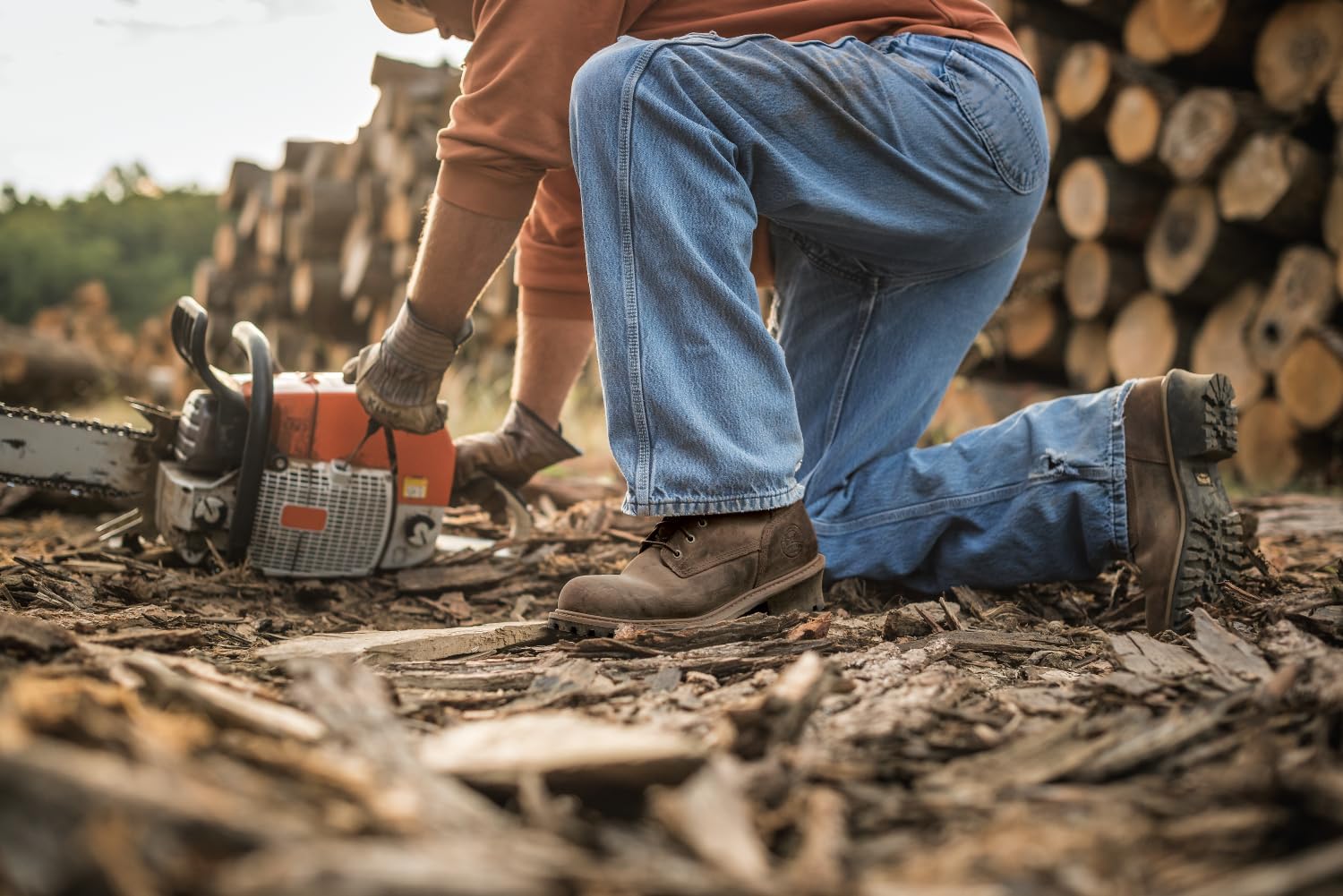
You just dropped somewhere between $150 and $350 on a pair of logger boots — the tall, heavily lugged, often steel-toed work boots built for chainsaw crews, powerline workers, and anyone spending long days on uneven or hazardous terrain — and now the real question hits: are you going to be limping through your first two weeks on the job, or can you lace these up Monday morning and just get to work?
That question splits logger boot buyers into two camps, and the brands themselves land clearly on opposite sides. A “break-in period” in footwear means the time it takes for a stiff new boot — especially one built with full-grain leather, a heavy shank, and a Goodyear welt (a construction method where the outsole is stitched rather than glued, adding durability but also initial rigidity) — to conform to your foot shape. Some boots require days. Some require weeks. A few skip the tax almost entirely. This guide maps those patterns across five brands that dominate the logger market in 2026, using aggregated owner reviews and published specs to tell you which camp each boot falls into — and what the tradeoff is when comfort comes fast.
| EDITOR'S PICKThorogood Logger Series 9” Wate… | Mid-tierGeorgia Boot Steel Toe GORE-TEX… | Budget pickIrish Setter | |
|---|---|---|---|
| Height | 9" | — | 8" |
| Waterproof | ✓ | ✓ (GORE-TEX) | ✓ |
| Insulation | 400g Thinsulate | 400g | — |
| Outsole | Vibram | — | — |
| Upper | Leather | — | — |
| Price | $319.95 | $212.96 | $151.96 |
| See on Amazon → | See on Amazon → | See on Amazon → |
The Brands at a Glance: Break-In Expectations by the Numbers
Before going deep, here’s the practical summary for readers who need a quick frame:
| Brand / Model | Break-In Timeline (owner-reported) | Initial Comfort Rating | Long-Run Reputation |
|---|---|---|---|
| Carhartt Logger | Near-zero (hours to 1 day) | High | Moderate — durability questions at 18+ months |
| Irish Setter Mesabi | Minimal (1–3 days) | High | Good for moderate-duty use |
| Thorogood Logger 9” | Moderate (several wearings, 1–2 weeks) | Low initially | High — traction and protection payoff is consistent |
| Chippewa Super DNA | Moderate to significant | Moderate | Very high — owners cite 2+ years of hard daily use |
| Carolina Logger | Minimal reported | Moderate-High | Very high — repeat buyer loyalty is exceptional |
The No-Break-In Camp: Carhartt and Irish Setter
If your timeline is tight — you start a new job next week, or you need to outfit a crew that can’t afford a two-week productivity dip — the Carhartt Logger is the boot most owners point to first.
The reviews here are unusually specific. Multiple buyers across aggregated feedback report wearing the Carhartt Logger to a full shift within the first fifteen minutes of putting them on, with no significant soreness or hot spots. That’s a remarkable claim for a steel-toe work boot, and it shows up often enough across owner forums and retail review sections that it forms a genuine pattern rather than an outlier. The likely explanation is construction-driven: Carhartt’s logger uses a softer initial leather and a more pre-flexed last (the foot-shaped form the boot is built around) than heritage competitors. The boot arrives closer to broken-in.
The honest tradeoff: owners who push the Carhartt Logger hard — daily exposure to abrasion, rough terrain past 18 months — start reporting wear patterns that suggest the outsole and upper leather don’t hold up the way Thorogood or Chippewa do. You’re trading longevity ceiling for day-one livability. If your use case is seasonal or moderate-intensity, that’s a completely rational trade. If you’re on a logging crew six days a week in the Pacific Northwest, read on.
The Irish Setter Mesabi corroborates the minimal-break-in pattern. Owners who’ve sized up by a half size — a common strategy when anticipating a snug fit — report that even with that adjustment the boot conforms quickly, often within a few wearings. One particularly useful data point from aggregated reviews: a buyer who intentionally ordered half a size up for a snug fit specifically because they wanted to avoid break-in pain still reported essentially no discomfort by day two. That’s a meaningful signal. The Mesabi uses Irish Setter’s RPM technology (a cushioning platform built into the insole) which accounts for some of that early comfort — it’s doing work that might otherwise be left to a $40 aftermarket insole. Gear Junkie’s roundup of work boots for tradespeople notes that Irish Setter consistently scores well on out-of-box wearability relative to its price tier.
The Earn-It Camp: Thorogood and Chippewa
The Thorogood Logger 9-inch occupies a different philosophical space. Owners don’t hide the break-in experience — in fact, one of the more cited reviews describes the boot as feeling like “crap” until broken in, a period spanning several full wearings. That kind of honesty in a review is actually a credibility signal: the person writing it is telling you the whole story, not just the good part.
What comes after that break-in, consistently, is a boot that owners describe in unusually loyal terms. The traction — Thorogood uses a heavy, aggressive lug pattern on their logger outsole — is praised repeatedly in the context of wet bark, muddy slopes, and uneven job-site surfaces. The protection package (steel toe, shank support, ankle height) earns consistent marks as well. Heddels’ construction glossary on Goodyear welt explains why boots built this way take longer to break in but also why they last longer and can be resoled: the welt creates a more rigid initial connection between upper and outsole that softens with wear rather than delaminating under stress.
The practical implication for a buyer: if you can give the Thorogood Logger two full weeks of regular wear before your most demanding conditions, you’ll be rewarded. If you need immediate performance from day one and don’t have that runway, this isn’t your boot right now.
Chippewa’s Super DNA logger runs a similar play. The break-in timeline is moderate to significant — owners don’t report the misery that some heavy leather boots inflict, but they’re clear that the boot takes time. What the Chippewa earns in return is exceptional long-run performance under chemical exposure. The review pattern that stands out most: owners in environments with daily oil and fuel contact — mechanics, equipment operators, certain industrial settings — report the Super DNA holding up past two full years of daily wear without meaningful sole separation or upper breakdown. Popular Mechanics’ guide to work boot durability notes that boots with full-grain leather uppers and oil-resistant outsoles perform measurably better in petrochemical environments, and the Chippewa’s construction spec checks both boxes. If your job site smells like diesel, the Chippewa’s break-in tax may be the most rational investment in this category.
The Outlier: Carolina Logger and the Loyalty Signal
The Carolina Logger doesn’t generate the detailed, granular review prose that the other four brands do. Individual reviews tend to be thinner on specifics. But the signal worth taking seriously here isn’t any single review — it’s the repeat-buyer pattern.
There are documented cases of buyers reporting 40-plus pairs of Carolina loggers purchased over a working lifetime. That number is almost certainly hyperbolic in its precision, but the underlying behavior it describes — returning to the same boot brand across decades, not because of price-point convenience but because the product consistently performs — is the strongest long-run endorsement a workwear brand can receive. Outside Online’s buyer’s guide to durable work footwear specifically calls out repeat-purchaser loyalty as one of the most reliable durability signals available in a category where long-term lab data is limited.
The initial comfort picture is reasonable without being exceptional. Break-in is reportedly minimal for most buyers, though the Carolina Logger doesn’t generate the “zero break-in” claims the Carhartt does. Where Carolina earns its repeat buyers appears to be somewhere in the middle distance — around months four through eighteen — when the boot has conformed and settled, and owners realize they’re not looking for a replacement yet.
Frequently Asked Questions
Which logger boot brands are genuinely comfortable from the first day of wear? Based on aggregated owner reports, the Carhartt Logger and Irish Setter Mesabi are the two clearest examples of boots that most wearers find comfortable within the first day — often within the first hours. Carolina Logger also has a relatively gentle initial period. The Thorogood and Chippewa both require more runway.
How long does break-in typically take for Thorogood or Chippewa logger boots? Owner reports suggest Thorogood Logger owners typically reach comfortable wearability after several full wearings — roughly one to two weeks of regular shifts. Chippewa Super DNA owners report a similar timeline, sometimes extending slightly longer depending on foot shape and fit precision. Both are in the range that workingpersonstore.com’s editorial guidance calls “standard for full-grain Goodyear-welt construction.”
Does ordering a half size up in logger boots reduce break-in pain without sacrificing ankle support? It can help with toe box pressure, but the tradeoff is real. Sizing up in a tall logger boot can reduce the snug forefoot contact that causes early hot spots, but a boot that’s too long creates heel lift — which at ankle height can cause blistering and reduces the lateral stability a logger shank is designed to provide. The Irish Setter Mesabi case (buyer ordered half size up, still had no break-in issues) is a useful data point, but that outcome is fit-specific. A better approach when possible: size true and use a thicker insole during the break-in window, then swap back.
Are logger boots with composite toes as stiff as steel toe versions during break-in? Composite toe caps (made from carbon fiber, Kevlar, or similar non-metal materials) are generally lighter and slightly more flexible than steel caps, which can reduce the rigid “box” feeling in the toe area during early wear. However, the majority of logger boot break-in stiffness comes from the leather upper and the outsole welt, not the toe cap itself — so the difference is real but modest. Owners comparing composite and steel versions of the same model typically report the composite version as marginally more comfortable in week one, but not dramatically so.
How do you know when a logger boot is fully broken in and performing at its best? The clearest signal owners describe is heel lock — when the boot holds your heel firmly without slipping on the upstroke, and there’s no hot spot at the back of the ankle. A fully broken-in logger boot also stops “talking” (the slight creaking sound stiff new leather makes with each step) and the outsole flexes cleanly through your natural stride rather than resisting it. Popular Mechanics’ break-in guide notes that this convergence — heel lock plus quiet flex plus no pressure points — typically arrives together, not incrementally, which is why experienced buyers describe the transition as feeling sudden even when it’s been gradual.
The Decision Rule
If you need a boot that performs on day one and your use case is moderate-intensity or seasonal: the Carhartt Logger or Irish Setter Mesabi are the rational choices. Accept the durability ceiling; the comfort floor is exceptional.
If you’re outfitting for a high-demand, long-horizon role — logging, linework, heavy equipment operation, chemical exposure — and you can tolerate two weeks of break-in: the Thorogood Logger 9-inch or Chippewa Super DNA will repay that investment with years of reliable performance. The Chippewa earns a specific edge if oil and fuel contact is part of your daily environment.
If you want the repeat-buyer signal and a middle-ground break-in experience, and you’re willing to accept thinner initial review data in exchange for a long loyalty track record: the Carolina Logger deserves serious consideration. Forty-pair buyers don’t happen by accident.
The break-in tax is real. But so is the cost-per-wear math on a boot that lasts a decade. Match your choice to your timeline and your terrain — not just to the boot that felt best in the parking lot.