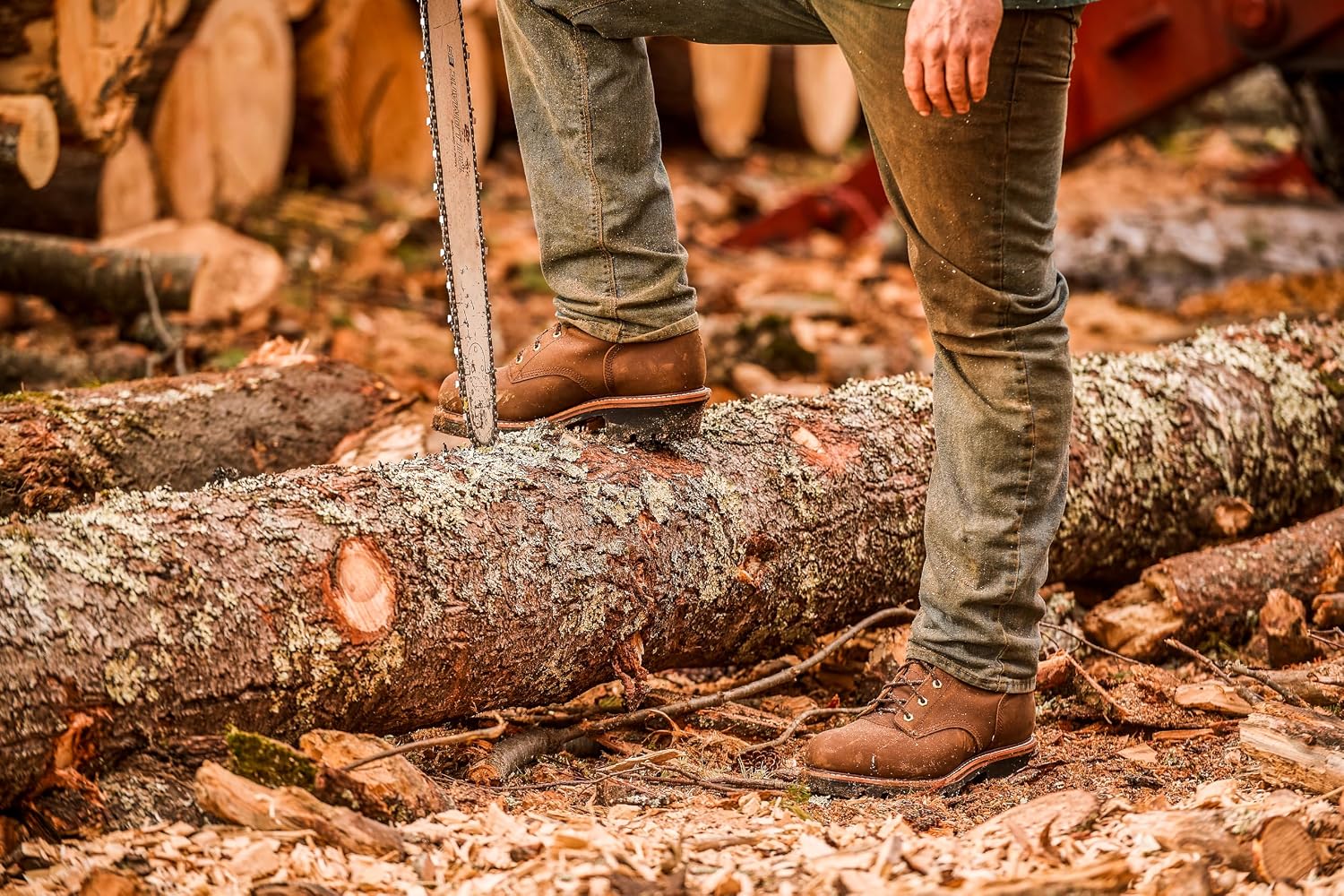
You’re pricing out a pair of logger boots — maybe Whites, maybe Nicks, maybe Wesco — and you keep running into terms like “Goodyear welt,” “Vibram heel,” and “90-degree heel block” in the product descriptions. The retailer’s site uses these like everyone already knows them. You have a sense they matter, but you’re not sure exactly how they connect to the $400–$700 price tag you’re considering.
Here’s the short version before we go deeper: a welt is a strip of leather or synthetic material that stitches the boot’s upper (the part covering your foot) to the outsole (the bottom), creating a seam you can cut open and resole — essentially giving the boot a second or third life. The 90-degree heel is the distinctively squared-off, raised heel block you see on logger boots, designed for gripping into loose ground and locking into chainsaw chaps. These two construction details are the main reasons a $550 logger boot can outlast three pairs of $180 work boots. This guide will walk you through how each welt type affects resole viability, what the heel is actually doing, and how to match construction to your actual use case so you buy right the first time.
| EDITOR'S PICKThorogood Logger Series 9” Wate… | Mid-tierChippewa Men's 8" Lace-To-Toe W… | Budget pickGeorgia Boot Steel Toe GORE-TEX… | |
|---|---|---|---|
| Shaft height | 9" | 8" | — |
| Insulation | 400g Thinsulate | Non insulated | 400G insulated |
| Waterproofing | ✓ | ✓ | GORE-TEX® |
| Outsole | Vibram | — | — |
| Lacing style | — | Lace-to-toe | — |
| Price | $319.95 | $247.96 | $212.96 |
| See on Amazon → | See on Amazon → | See on Amazon → |
Why Welt Type Is the Most Important Spec on Any Logger Boot
When boot people talk about welt types, they’re really talking about repairability — and repairability is the whole argument for spending serious money on footwear.
A boot with no welt (cemented or “glued” construction) is essentially disposable. The sole is bonded directly to the upper with adhesive. When it wears out or delaminates, most cobblers won’t touch it, because separating the layers risks destroying the upper. You’re buying a new boot.
A welted boot is different. The welt creates a buffer layer — a structural ledge — between the upper and the sole. A cobbler can cut the stitching, pull the old sole, and stitch or cement a new one without touching the upper at all. That’s why owners of Whites and Nicks consistently report getting three, four, even five resoles out of a single pair of uppers before retirement.
The three welt types you’ll encounter in logger boots:
1. Goodyear Welt
The Goodyear welt is the most common construction in quality logger boots from Whites, Nicks, Wesco, and Danner. A strip of leather or synthetic material is stitched to both the upper (at the insole board) and the outsole in two separate passes. The cavity between those layers is typically filled with a cork or leather filler that molds to your foot over time — which is why Goodyear-welted boots require a genuine break-in period but eventually conform to your foot in a way cemented boots never do.
Resole viability: Excellent. A skilled cobbler can resole a Goodyear-welted boot 3–5 times depending on upper condition. The welt itself can be replaced separately from the sole if it wears or cracks. Heddels’ definitive guide to boot construction notes that Goodyear welting remains the gold standard for repairability precisely because every layer is independently serviceable.
Trade-off: Goodyear welting adds stiffness and weight — a feature in a logger boot (stability on uneven ground), but worth knowing if you’re cross-shopping against lighter hiking boots.
2. Stitchdown (or Veldtschoen) Welt
The stitchdown construction turns the upper outward at the base and stitches it directly to the outsole, with the welt sitting on top of — rather than between — the layers. The result is a lower-profile silhouette, excellent lateral stability, and a construction that many users find breaks in faster than a Goodyear welt because there’s less rigid structure in the midsole area.
You see stitchdown in some White’s models and in Viberg’s work-focused offerings. It’s particularly common in Pacific Northwest timber boots, where lateral ankle stability on steep sidehills matters as much as underfoot protection.
Resole viability: Good, but slightly more technique-dependent. Because the upper wraps under the boot, a cobbler needs to be careful not to damage the turned leather when cutting the old sole. Owners on long-running boot forums consistently report that finding a cobbler experienced with stitchdown — rather than just Goodyear — makes a meaningful difference in outcome quality.
Trade-off: Stitchdown boots often have a wider footprint at the base. If you’re working on scaffolding or narrow surfaces, that can feel less precise than a Goodyear-welted boot with a trimmer profile.
3. Norwegian Welt
Less common in American logger boots but worth knowing: Norwegian welting stitches through the upper, welt, and outsole in a single pass, with the welt turned outward and visible from the side. It’s extremely durable and nearly waterproof at the seam (the stitching runs along the outside rather than through the sole’s interior). You’ll find it on some Wesco and premium European work boots.
Resole viability: Very good for the upper; the welt is robust. The trade-off is that replacement welts for Norwegian construction can be harder to source from general cobblers — you may need to work with a brand-specific resole program.
The 90-Degree Heel: What It Does and Why Logger Boots Have It
Standard work boots and hiking boots have a heel that curves or angles back into the boot’s profile — what’s called a “riding heel” or standard work heel. Logger boots have a dramatically different heel geometry: the back edge drops nearly straight down at roughly a 90-degree angle, creating a flat, wide heel block typically 1.75 to 2.5 inches tall.
This isn’t aesthetic. It’s load-bearing engineering solving two specific problems:
1. Ground engagement on loose terrain. When you’re walking across a logged slope, a brush pile, or a hillside cut, a standard rounded heel rolls and slides. The squared 90-degree heel digs in and arrests that slide, functioning almost like a cleat. Gear Junkie’s overview of logger boots for chainsaw work notes that the heel block is especially critical when felling — you need a stable, planted stance to manage saw kick and maintain control.
2. Chainsaw chap compatibility. Most chainsaw chaps (the protective leg coverings required in professional timber work) are designed with the logger heel in mind. The heel block gives the chap’s lower strap something to catch against, keeping the chap from riding up the boot during movement. This isn’t an incidental detail — it’s a safety function. Field Mag’s guide to choosing a logger boot calls the 90-degree heel “non-negotiable for anyone running a saw in a professional capacity.”
The practical implication for buyers: if you’re using logger boots for general ranch work, trail work, or pack-out hunting and you’re not running a chainsaw, the 90-degree heel is still useful (excellent on sidehills) but less critical. If saw work is part of your job, it’s not optional.
By the Numbers: Welt Type vs. Resole Economics
| Welt Type | Typical Resole Cost (2026) | Resoles per Upper | Effective CPW Period |
|---|---|---|---|
| Goodyear Welt | $120–$200 | 3–5 | 15–25 years |
| Stitchdown | $130–$220 | 2–4 | 10–20 years |
| Norwegian Welt | $150–$250 | 2–4 | 10–20 years |
| Cement/Glued | Not viable | 0 | 2–4 years |
Resole costs sourced from Working Person’s Store’s logger boot resource page and aggregated cobbler pricing reviewed in Popular Mechanics’ work boot coverage. CPW (cost-per-wear) period assumes regular professional use.
The math here is straightforward: a $550 Goodyear-welted logger boot resoled twice at $160 each totals $870 over 15+ years. A $180 cemented boot replaced every 3 years over the same period runs $900 — and that’s without accounting for the labor and downtime of breaking in a new pair six times.
Matching Construction to Your Actual Use Case
Here’s where practitioners make the mistake: buying for aspiration rather than use. The logger boot market skews heavily toward Pacific Northwest timber heritage, and some of that construction is over-engineered for buyers who just want a tough work boot with a logger heel.
If X, then Y — the decision framework:
-
If you’re a professional timber faller or saw operator: Goodyear or stitchdown welt, 90-degree heel block, Vibram 430 or equivalent lug sole. Whites Semi-Dress and Nicks Handmade Logger are the two most consistently cited options in long-run owner reviews. Expect $550–$750. Budget for a resole every 3–5 years of daily use.
-
If you’re a line worker, arborist, or trail crew member who needs the heel for pole-climbing or sidehill stability but doesn’t run a saw: Goodyear welt is correct; the heel is still useful. You may not need the full 2.5-inch block — a 1.75-inch heel (more common in crossover work boots from Danner or Thorogood’s logger line) will serve you. Price range: $200–$450.
-
If you’re a hunter, backpacker, or rancher attracted to the logger silhouette but primarily walking maintained terrain: The 90-degree heel will fatigue you on flat ground faster than a standard heel. Stitchdown construction in a lower-profile boot (Viberg Service Boot, Danner Bull Run) gives you the resole longevity without the geometry tax.
-
If you’re outfitting a crew and buying multiple pairs at once: Mid-tier Goodyear-welted options from Thorogood’s American Heritage Logger line represent the best resole viability per dollar at scale. Working Person’s Store’s buying guide consistently positions them as the value-anchor in the category — resoleable, American-made, and available in wide widths.
One construction detail worth tracking: White’s Boots published spec sheets confirm they use a full-length leather insole board (not a synthetic substitute) under their Goodyear welt, which is the primary reason their uppers hold structural integrity across multiple resoles. Cheaper “Goodyear-welted” boots often use a fiberboard insole that degrades after one or two resoles, making the welt technically present but practically limited. Always ask what the insole board material is — it’s the canary for true resole longevity.
The bottom line: welt type determines how long your investment pays off. The 90-degree heel determines whether the boot actually fits your work geometry. Get both right for your specific use, and a $600 logger boot stops being expensive — it starts being cheap on a per-year basis.