You just spent four hundred dollars on logger boots and you’re three weeks in — your feet are dry, your ankles feel supported on hillside slash, and you’re wondering why it took you this long to move up from the flat-soled work boots you’d been wearing since trade school. Or maybe you’re on the opposite end: you’re replacing a pair that lasted eight years and you want to know whether the brand you’ve trusted is still worth the money, or whether something else has closed the gap.
Logger boots — tall lace-up boots (typically 8–10 inches high) with a pronounced heel (usually 1¾ to 2 inches) designed to dig into sloped terrain, shed debris from laces, and provide ankle support on uneven ground — are the functional footwear of forestry crews, utility linemen, pipeline workers, and heavy-equipment operators who spend their days on terrain that would destroy a standard work boot in a season. The heel isn’t a style choice; it hooks into a ladder rung or a hillside and keeps you from sliding. The tall shaft protects your ankle and lower leg from brush, chainsaw contact zones, and rolling debris.
This comparison draws on aggregated owner reviews, published spec comparisons, and editorial research from Gear Junkie’s work boot coverage, Heddels’ boot construction guides, Popular Mechanics’ work boot roundups, and the Working Person’s Store logger boot buying guide. No single article can replicate years of field use — but the owner review record across these five boots is deep enough to identify genuine patterns.
| EDITOR'S PICKThorogood Logger Series 9” Wate… | Mid-tierGeorgia Boot Steel Toe GORE-TEX… | Budget pickIrish Setter | |
|---|---|---|---|
| Waterproofing | Waterproof | GORE-TEX | Waterproof |
| Insulation | 400g Thinsulate | 400g | — |
| Shaft height | 9" | — | 8" |
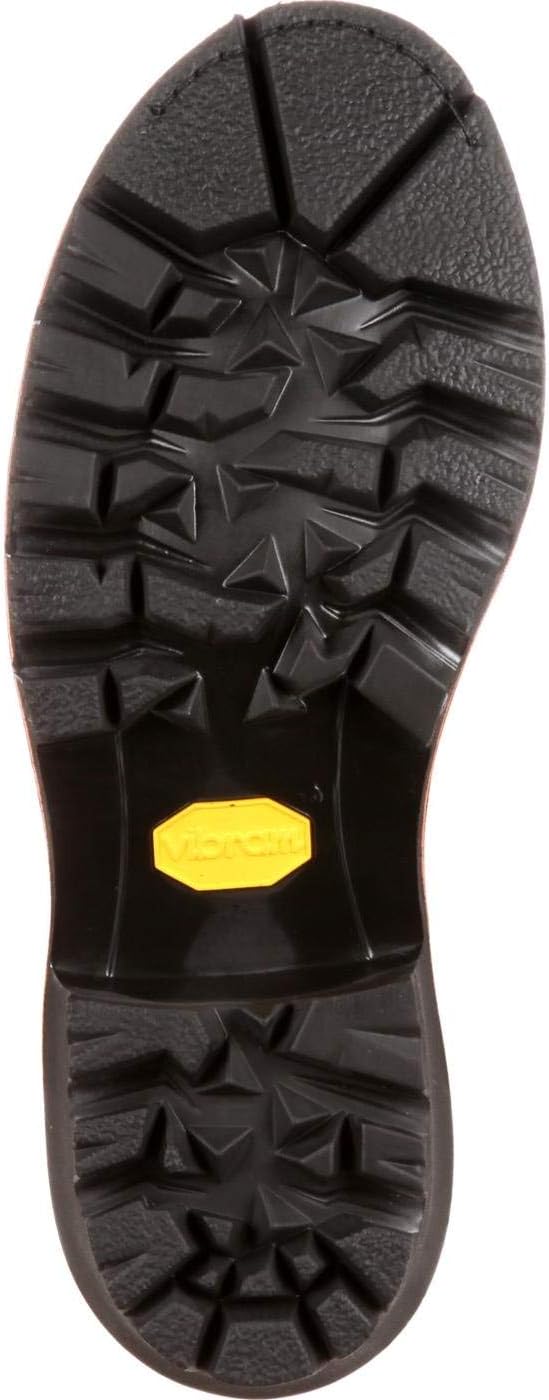
| Outsole | Vibram | — | — |
| Price | $319.95 | $212.96 | $151.96 |
| See on Amazon → | See on Amazon → | See on Amazon → |
Why Logger Boot Construction Determines Long-Term Value
Before scoring individual boots, it helps to understand the two construction methods that define this category — because that single variable shapes every other decision.
Goodyear welt construction is the method where the upper, insole, and outsole are all stitched together through a strip of leather or synthetic welt. The welt creates a physical, stitched bond that can be cut apart and re-stitched when the outsole wears through, making the boot resolable. Heddels’ Ultimate Guide to Boot Construction identifies Goodyear welt as the defining construction of heritage American work boots, noting that the method remained viable at domestic producers like Thorogood’s parent company Weinbrenner Shoe Company through decades when the broader industry was shifting to cement construction.
Cement construction bonds the upper to the outsole with adhesive rather than stitching. The result is a lighter, more flexible boot at lower cost — but when the sole wears through, the boot is finished. There is no practical resole path.
For tradespeople buying a logger boot, this distinction drives the entire cost-per-wear calculation. A $350 Goodyear welt boot resoled twice at $80–$150 per resole yields a decade or more of service. A $200 cement-construction boot replaced every two to three years costs more over the same horizon and produces more landfill waste. The Working Person’s Store logger boot buying guide explicitly flags Goodyear welt as the construction standard buyers should verify before purchasing in this category.
The Five Boots: Construction, Failure Patterns, and Who Each One Fits
Georgia Boot GORE-TEX 400G Logger
The loyalty signal attached to this boot is unlike anything else in the category. One owner — citing more than 40 pairs purchased over a lifetime — states that no other logger boot comes close for all-day comfort and waterproof performance. That is an extreme data point, and the review pool for this specific model is smaller than for some competitors. But when a single buyer reaches that purchase volume, you’re reading a considered, multi-decade cost-per-wear verdict, not brand sentiment.
The Georgia Boot GORE-TEX 400G pairs a full-grain leather upper with a GORE-TEX waterproof membrane — a laminate layer bonded inside the boot that blocks liquid water while allowing vapor to escape — and 400 grams of Thinsulate insulation, a synthetic fill rated for cold-weather work rather than high-output summer logging. Goodyear welt construction means this boot is resolable when the outsole wears through. Gear Junkie’s logger boot coverage notes the Georgia Boot line as a consistent performer in wet-condition ratings.
Who it fits: Cold-weather forestry, winter linework, anyone working in wet Pacific Northwest or Appalachian conditions who wants waterproofing built into the construction rather than applied as a topcoat. The 400G insulation narrows the seasonal window — this is not a July boot in the Southeast.
Tradeoff to know: The smaller owner review sample means the loyalty signal, while remarkable, isn’t backed by the same volume of data as the Carhartt or Thorogood entries in this category.
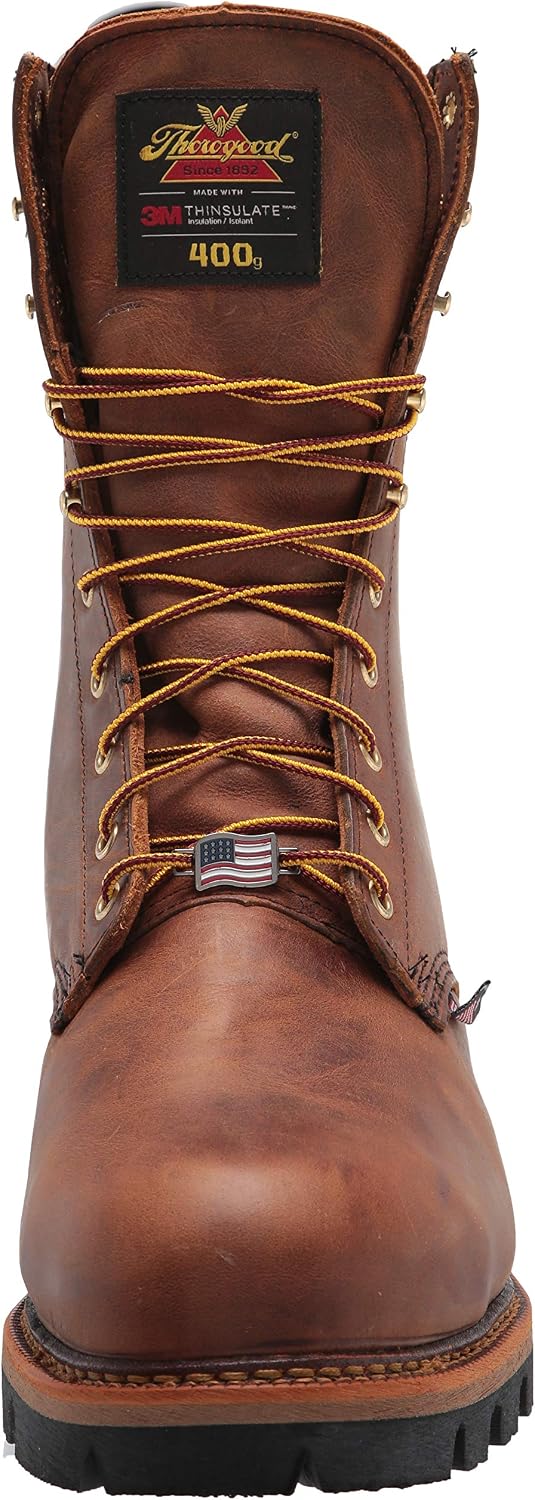
Thorogood
$319.95
In stock on Amazon
Check price on AmazonCarhartt 8” Logger
The most instructive data point on this boot comes from a self-described decade-long Carolina boot loyalist who switched to Carhartt specifically for forestry work — and then documented a failure: a leather hole developing above the composite toe at the crease point where the upper flexes most aggressively during uphill walking.
That failure mode is worth sitting with. A crease failure above the toe box is almost always a leather quality or lasting problem — either the hide wasn’t thick enough in that zone, the lasting process (stretching and shaping the upper over a mold) didn’t distribute stress correctly, or the composite toe cap’s edge created a stress concentration point. It is not a user error.
Popular Mechanics’ Best Work Boots roundup confirms Carhartt as one of the most-purchased brands in the professional workwear segment — but brand volume doesn’t immunize a specific model from construction issues, and a failure point that appears in the review record without widespread rebuttal should be treated as a real risk, not a statistical outlier.
Who it fits: Mid-budget buyers switching from a fashion-adjacent work boot into a genuine logger, or crew outfitters who need a recognizable brand at a price point that doesn’t require a capital expenditure justification.
Tradeoff to know: The leather crease failure above the composite toe is a documented pattern. Buyers who put heavy uphill mileage on their boots — forestry workers on terrain, not flat-grade trade work — should weight this risk more heavily than someone spending most of their day on level ground.
Georgia
$212.96
In stock on Amazon
Check price on AmazonChippewa Super DNA Logger
The Chippewa Super DNA gives buyers something rare: a concrete failure timeline from owners who pushed the boot until it gave out.
Reviewers report that waterproofing held reliably until the leather cracked behind the steel toe — the same flex-zone failure mode documented on the Carhartt, but occurring at a specific point in the boot’s life cycle rather than as an early failure. That distinction matters for cost-per-wear planning. If waterproofing holds for three or four seasons of hard use before the leather cracks at the crease, you’re looking at a boot that delivers on its promise and then fails at a predictable, plannable point.
Chippewa’s heritage in the logger category is genuine — the brand has been producing loggers since the early 20th century. Heddels’ Ultimate Guide to Boot Construction names Chippewa as one of the domestic producers who maintained Goodyear welt production through periods when the broader industry was moving toward cement construction.
By the numbers:
- Typical break-in window cited by owners across this category: 2–6 weeks of daily wear
- Expected waterproofing lifespan (Chippewa Super DNA): 3–4 seasons before crease cracking, based on owner reports
- Goodyear welt resoling cost (industry range, 2026): approximately $80–$150 depending on cobbler and sole selection
- Shaft height range across these five boots: 8–10 inches
Who it fits: Buyers who want documented longevity expectations rather than marketing claims — tradespeople who plan their gear lifecycle and want to know when to schedule a resole rather than be surprised by a failure.
Tradeoff to know: The crease cracking is a structural end-of-first-life signal, not a catastrophic failure. The boot remains resolable at that point if caught before water intrusion damages the insole stack.
Georgia
$212.96
In stock on Amazon
Check price on AmazonIrish Setter Mesabi Logger
The Irish Setter Mesabi generates a specific and consistent sizing complaint in owner reviews: the boot runs small with a tight shaft — but the steel toe has notably more room than in competing boots at this price point.
For buyers who have been bruised by a steel toe cap that sits too close to the toes, or whose cap edge digs into the top of the foot during flex, that’s real information. Steel toe cap placement varies by last, and a brand that built more clearance into the toe box while compressing the shaft fit is a boot that rewards trying on in person, or ordering with a known-accurate Brannock measurement rather than an athletic shoe size.
Irish Setter is a Red Wing subsidiary, carrying Red Wing’s leather sourcing and Goodyear welt infrastructure while positioning at a slightly lower price point. Gear Junkie’s work boot coverage notes Irish Setter as a consistent performer in wet-condition ratings within the logger category.
Who it fits: Buyers with wide forefeet and narrow heels who have historically struggled with steel toe cap bruising — the roomier toe box solves a real ergonomic problem. Most owners reporting fit issues recommend going a half size up.
Tradeoff to know: The shaft tightness is a genuine fit issue, not a perception problem. Buyers with thicker calves or who layer heavy socks in cold-weather work should verify the brand’s calf circumference specification against their own measurement before ordering.
Georgia
$212.96
In stock on Amazon
Check price on AmazonThorogood Logger Series
The Thorogood Logger is where the resole-and-rebuild conversation becomes the central argument. Multiple owners in the review record cite resole viability as the primary justification for the higher price — not just the initial build quality, but the fact that a Thorogood can be sent back into service multiple times, compressing cost-per-wear over a decade-plus horizon.
One reviewer, a welder and pipefitter, names the Thorogood Logger the best boot for all-day concrete work — a surface that destroys cushioning faster than soil or gravel because it offers no give, transmitting every footstrike directly up the kinetic chain. That’s a specific, credible, use-case endorsement.
Thorogood is manufactured in Merrill, Wisconsin, by Weinbrenner Shoe Company, one of the few remaining American logger and work boot producers building at volume. The Working Person’s Store logger boot buying guide identifies Thorogood’s Storm King outsole compound as a particularly durable choice in wet and cold conditions.
Who it fits: Long-horizon buyers — tradespeople who plan to own one pair of boots for a decade, resole twice, and retire them. Welders, pipefitters, and heavy-equipment operators who spend full shifts on concrete or hard-pan. Anyone for whom the resole ecosystem is a feature, not an afterthought.
Tradeoff to know: The higher entry price is real. If your work destroys boots in two years regardless of construction quality — chainsaw contact, chemical exposure, extreme abrasion — the cost-per-wear advantage narrows significantly, and mid-tier options may represent better capital allocation.
Thorogood
$319.95
In stock on Amazon
Check price on AmazonFrequently Asked Questions
Do logger boots require a long break-in period? Yes. Across all five boots reviewed here, owners consistently report a 2–6 week break-in window for full-grain leather construction. Goodyear welt boots are stiffer than cement-construction boots by design — the multiple stitched layers create a firmer platform that softens with heat and use. Wearing new loggers for shorter shifts first and applying a leather conditioner (not a waterproof spray — that’s a separate step) helps accelerate the process without damaging the upper.
Which logger boot is best for forestry and chainsaw work? The Georgia Boot GORE-TEX 400G and the Thorogood Logger Series draw the most specific forestry endorsements in the owner record. For chainsaw work specifically, confirm that your boot meets ASTM F1818 chainsaw protection standards — not all loggers do, and this is a safety specification, not a marketing tier. The Working Person’s Store logger boot buying guide lists chainsaw-rated models separately from general loggers.
How long should a quality logger boot last with daily wear? A Goodyear welt logger from a heritage brand — Thorogood, Chippewa, Georgia Boot, Irish Setter — should deliver 3–5 years of daily hard use before the first resole, and 8–12 years total across multiple sole replacements if the upper is maintained with periodic conditioning and the welt stitching is inspected annually. Cement-construction boots typically last 1–3 years with no rebuild option.
Is GORE-TEX worth the extra cost in a logger boot? In wet-climate forestry and cold-weather linework, the owner record for GORE-TEX-lined loggers — particularly the Georgia Boot — consistently supports the premium. In dry climates or high-output summer work where foot temperature is the primary concern, the membrane can trap heat and the extra cost may not pay off. The tradeoff is straightforward: GORE-TEX wins on waterproof reliability; an unlined but well-conditioned full-grain upper breathes better in heat.
Do logger boots run true to size? Not consistently across brands. The Irish Setter Mesabi is documented as running small with a tight shaft. Thorogood loggers are generally reported as true to size but with a narrow heel. Chippewa and Georgia Boot tend to run closer to true. When ordering online, verify against your Brannock measurement — the standard metal foot-measuring device used in shoe stores — rather than your athletic shoe size, which is often a half-size off.
Can logger boots be resoled? Goodyear welt construction makes resoling straightforward for any cobbler with welt-stitching capability. Thorogood, Chippewa, Irish Setter, and Georgia Boot all use Goodyear welt as standard. Resoling costs ran approximately $80–$150 at independent cobblers in 2026, depending on sole selection and local labor rates. Cement-construction loggers — identifiable by the absence of a visible stitched welt line along the boot’s perimeter — cannot be resoled.
The Decision Rule
Cold, wet forestry or linework with the strongest documented loyalty signal: Georgia Boot GORE-TEX 400G is the lead choice, with the caveat that the review pool is smaller than competitors.
Managing crew budgets and need a recognizable brand at mid-tier price: Carhartt’s 8” logger works for flat-grade trade work, but the crease-failure risk above the composite toe should be documented before deploying it on forestry terrain.
Predictable failure timeline and proven waterproofing life: The Chippewa Super DNA delivers documented longevity before the leather crease failure point — and it’s resolable when it gets there.
Steel toe bruising has cost you before: The Irish Setter Mesabi’s roomier toe box solves a real fit problem. Size up and verify shaft circumference before committing.
Buying one pair for a decade and want the resole math to work: Thorogood Logger Series is the long-horizon choice, with welding and concrete-work endorsements giving it credibility beyond marketing language.
The best logger boot is the one that fits your specific foot, your specific terrain, and the number of years you plan to own it. These five are all legitimate choices. The differences are in the details — and now you have them.