You just picked up a pair of moc toe work boots — or you’re about to — and the options are starting to blur together. A quick note on vocabulary before we go further: a moc toe (short for moccasin toe) is the boot style where a raised seam runs across the top of the toe box, creating extra room and a softer front end than a standard round or steel toe. A Goodyear welt is the construction method where the outsole is stitched — not glued — to the upper, which matters because a stitched sole can be replaced by a cobbler, extending the boot’s life by years. These two features show up together constantly in work boots, and they’re worth understanding before you spend $100 to $230 on a pair. This article compares four of the most-searched moc toe work boots — the Thorogood American Heritage, Timberland PRO Wedge, Carhartt CMF6366, and SUREWAY — using aggregated owner reviews, published specs, and construction details. No hype, no test-bench claims. Just what the research and real-owner feedback actually show.
| EDITOR'S PICKThorogood American Heritage 6”… | Mid-tierCarhartt Men's CMF6366 6 Inch C… | Budget pickSUREWAY Mens Heavy Duty Soft/Co… | |
|---|---|---|---|
| Toe Type | Soft toe | Composite toe | Steel toe |
| Leather | Full-grain | Oil-tanned | Full grain |
| EH Rated | ✓ | — | — |
| Outsole | Wedge | — | Wedge |
| Construction | — | — | Goodyear welt |
| Price | $211.95 | $109.95 | $82.99 |
| See on Amazon → | See on Amazon → | See on Amazon → |
How These Four Boots Are Built (And Why It Matters)
Before the verdict, it’s worth understanding what separates these boots structurally. Construction method is the single biggest driver of long-run value in work boots — more than brand name, more than color.
The term full-grain leather means the hide hasn’t been sanded or buffed to remove natural imperfections — it’s the strongest, most breathable, and most patina-friendly cut. A wedge sole has no distinct heel stack; instead, it tapers gradually from heel to toe, distributing weight evenly across flat surfaces like concrete and steel plate. EH-rated footwear (electrical hazard, per ASTM F2892-18) has a non-conductive sole tested to resist electrical shock — important for anyone working near live circuits. A composite toe is a non-metallic toe cap that meets the same impact and compression ratings as steel, without the conductivity or cold-transfer.
With that vocabulary in hand, here is how the four boots compare at the construction level before we get into how they perform in practice.
Side-by-Side: Construction Specs
| Boot | Welt | Toe Type | EH Rated | Made in USA |
|---|---|---|---|---|
| Thorogood American Heritage | Goodyear | Soft moc | No | Yes |
| Timberland PRO Wedge | Goodyear | Soft moc | No | No |
| Carhartt CMF6366 | Goodyear | Composite | Yes — ASTM F2892-18 | No |
| SUREWAY Moc Toe | Goodyear (owner-confirmed) | Soft moc | No | No |
What Owners Actually Report: Boot by Boot
Thorogood American Heritage Moc Toe
Made in Merrill, Wisconsin, the Thorogood American Heritage is built on a Goodyear welt with a full-grain leather upper and a wedge outsole. Thorogood sources its leather from domestic suppliers; the hide arrives at the factory dense and dry, which is the root cause of the boot’s demanding break-in. Working Person’s Store’s aggregated customer review record for this model shows a consistent owner pattern: conditioning before first wear, two to four weeks of stiff daily use, then a fit that owners describe in near-uniform terms as irreplaceable.
A welder on his sixth consecutive pair and a sheet metal worker with 47 years in the trade independently describe the same arc: brutal for the first month, then the boot molds to the foot and stays there through resoling after resoling. Primer Magazine’s guide “How to Break In Work Boots Without Destroying Your Feet” specifically recommends applying a leather conditioner — mink oil, Obenauf’s Heavy Duty LP, or Leather Honey are the most frequently cited products in owner communities — before the first wear. The Thorogood is the boot that most validates that advice. The cost-per-wear math on a $120–$145 boot that resoles twice and lasts 8–12 years of daily trade wear is favorable almost regardless of the break-in friction.

Thorogood
$211.95
In stock on Amazon
Check price on AmazonTimberland PRO Titan Wedge Moc Toe
The Timberland PRO Wedge is also Goodyear welted with a full-grain leather upper, at a price point that typically runs $20–$40 below the Thorogood. Manufacturing is overseas, but the welt construction means resole capability is genuine. Popular Mechanics’ 2025 “Best Work Boots” roundup includes the Timberland PRO Wedge as a value-tier standout, citing its combination of true welt construction and softer leather at a mid-tier price.
The softer leather is near-universally praised by owners: the boot conforms more quickly than the Thorogood, and multiple reviewers specifically note that it softens and molds even better after getting wet — an unusual and useful quality for wet-environment work. The complication is the toe box. Owner reports across multiple platforms indicate the standard-width toe box fits more like a traditional wide width. If you have a narrow or average foot, sizing down in length may not compensate for the width surplus. If you have a genuinely wide foot, the Timberland PRO Wedge may fit better at nominal sizing than most boots in this category.
Carhartt
$109.95
In stock on Amazon
Check price on AmazonCarhartt CMF6366
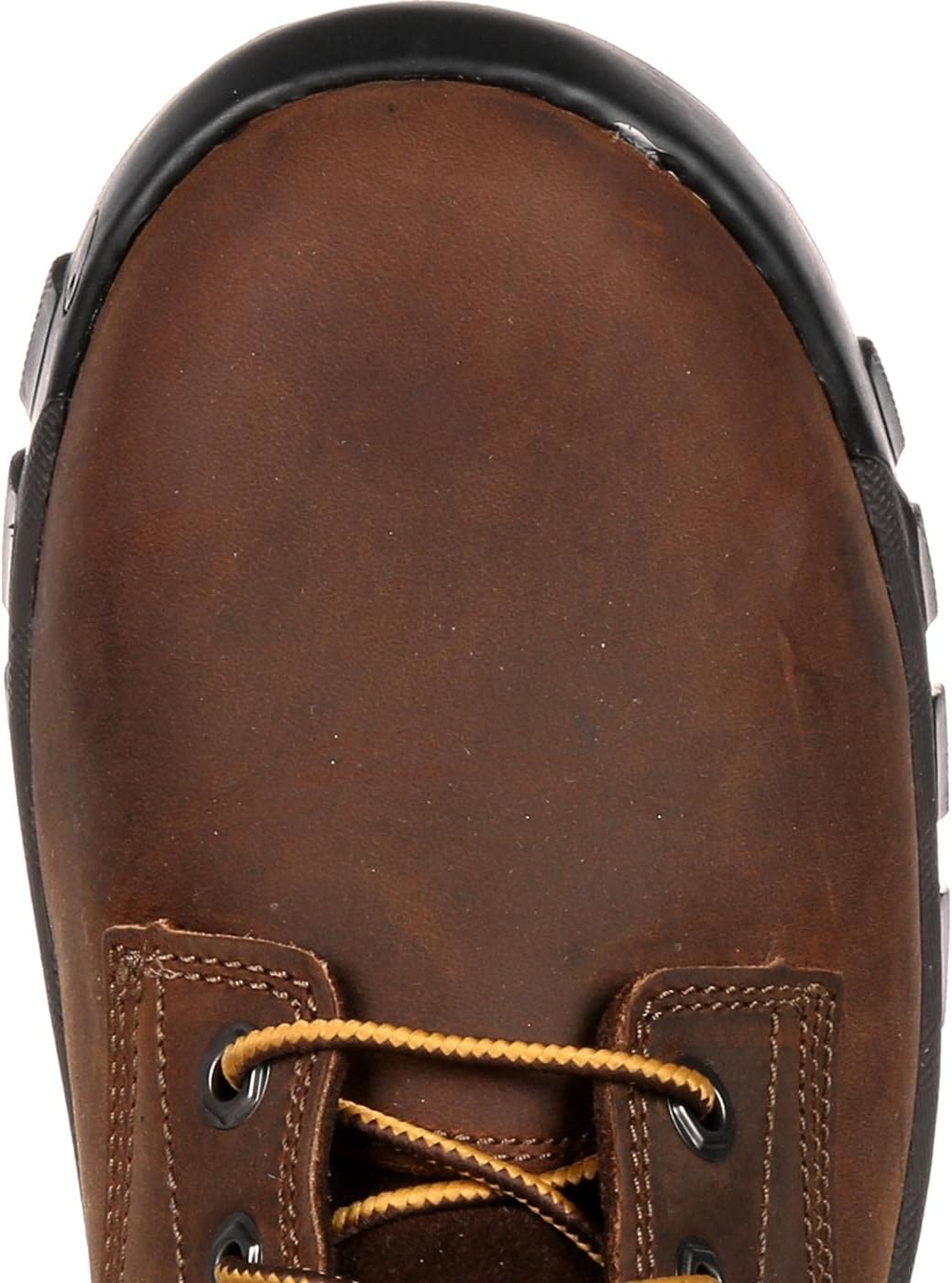
The Carhartt CMF6366 is the only boot in this group built for a defined safety specification: composite toe and ASTM F2892-18 electrical hazard rating. It is Goodyear welted with a full-grain leather upper, made overseas. Owners are clear about why they bought it: the safety specs, full stop. One reviewer describes the composite toe absorbing a direct impact from a dropped outrigger — the kind of incident that converts a work boot into a medical bill. Electricians, linemen, and anyone working near live circuits have a legitimate reason to prioritize EH rating that the other three boots in this comparison simply cannot address.
The construction note that appears in nearly every review thread: sizing runs large, consistently, often by a half to full size. This is not an occasional outlier — it is close to universal in the CMF6366 review record. Order accordingly. The trade-off worth naming plainly is that this boot is a safety-spec tool that happens to be built on a moc toe last. If your job requires composite toe and EH certification, it belongs in your shortlist. If you’re primarily shopping for longevity and comfort without a safety-spec requirement, you’re paying for certifications you may not need.
Carhartt
$109.95
In stock on Amazon
Check price on AmazonSUREWAY Moc Toe
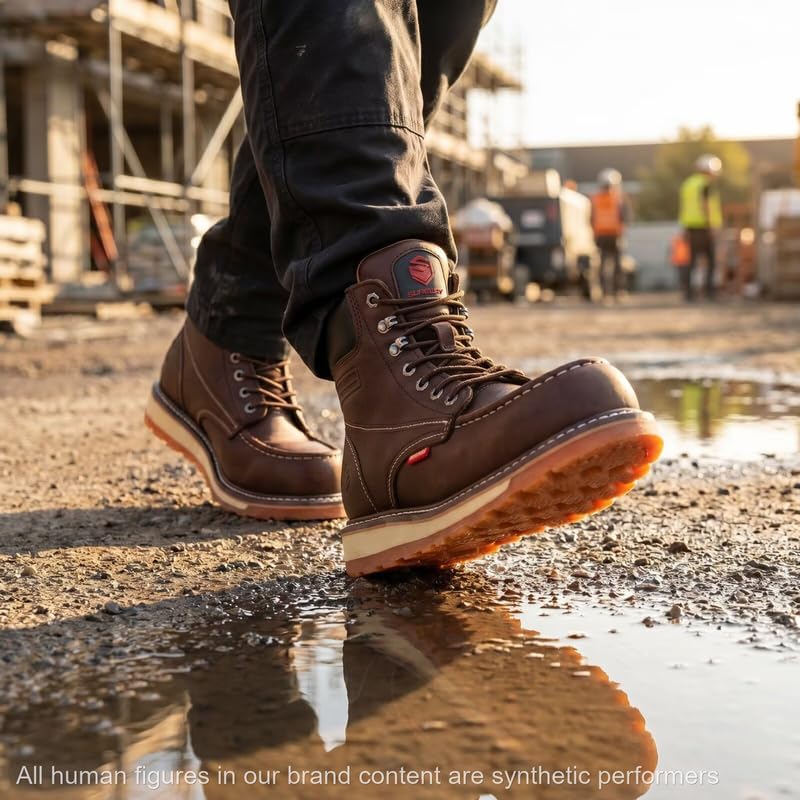
The SUREWAY is the budget entrant and the most complex value calculation of the four. It markets a Goodyear welt and full-grain leather upper at a price point well below the other three. Heddels’ “Complete Guide to Goodyear Welt Construction” notes that Goodyear welt claims deserve scrutiny at low price points — the critical distinction is whether the boot uses a true Goodyear welt (a welt strip stitched to both the insole rib and the upper before the outsole is attached) or a cemented construction that mimics the visual appearance of a welt.
Based on aggregated owner reports, the SUREWAY welt claim appears to hold: multiple owners describe having the boots resoled by local cobblers, which requires a genuine Goodyear welt — a faux or glued welt does not survive the resoling process cleanly. The leather upper also draws consistent praise at the price point. The honest failure points are elsewhere. Owner reports at the 3–9 month mark cluster around two recurring issues: insole compression (stock insoles degrading within 60–120 days of regular wear) and stitching loosening at the moc toe seam around the 6-month mark. The practical guidance from the SUREWAY owner community is consistent: budget for a quality aftermarket insole — a Superfeet or Powerstep model adds $30–$50 — from day one, and inspect the toe seam stitching at the 6-month mark before a small separation becomes a boot-ending failure.
SUREWAY
$82.99
In stock on Amazon
Check price on AmazonFrequently Asked Questions
Do I need to condition a Thorogood before first wear? Based on the consistent owner pattern in Working Person’s Store’s aggregated review record and independent owner accounts, yes — applying a leather conditioner before the first wear is close to standard practice for Thorogood owners. The leather is dense full-grain hide that arrives dry from the factory. Conditioning incrementally softens the leather and reduces the severity of the break-in. Mink oil, Obenauf’s Heavy Duty LP, and Leather Honey are the most commonly named products in owner communities. Skipping this step doesn’t ruin the boot, but it makes the first two weeks noticeably harder on your feet. Primer Magazine’s “How to Break In Work Boots Without Destroying Your Feet” treats pre-wear conditioning as the single highest-return step for any stiff leather boot.
Are SUREWAY boots actually Goodyear welted and can they be resoled? The welt claim is supported by owner experience, not just marketing copy. Multiple SUREWAY owners report successful resoles by local cobblers — a process that requires a genuine Goodyear welt to survive cleanly. The honest caveat is that SUREWAY’s quality control is less consistent than Thorogood’s, and welt quality may vary by production run. The welt itself appears genuine; the insole and toe seam stitching are where the cost-cutting shows. As Heddels’ “Complete Guide to Goodyear Welt Construction” describes, a true welt is identifiable by the strip of leather or synthetic material visible between the upper and the outsole — owners can visually confirm this before committing to a cobbler.
Does the Timberland PRO Wedge run wide even in standard width? Yes, consistently. Owner reports across multiple platforms indicate the standard-width toe box fits closer to a traditional wide width. Sizing down in length may not compensate for the width surplus if you have a narrow or average foot. Owners with genuinely wide feet report that the boot fits well at standard widths — and in some cases fits better than narrow-last competitors in wide widths. Popular Mechanics’ 2025 “Best Work Boots” roundup flags this as a sizing note worth confirming before purchase.
How long do SUREWAY insoles last before needing replacement? Owner reports cluster around 60–120 days of regular wear before the stock insoles compress noticeably. If you’re on your feet for 8 or more hours per day, plan to replace the insoles within the first three months. A quality aftermarket insole at day one is the most consistently recommended fix in the SUREWAY owner community — it materially extends comfort life and reduces the impact of the stock insole’s short service window.
Is the Carhartt CMF6366 EH rated for electrical work? Yes. The CMF6366 carries an ASTM F2892-18 EH rating, meaning the sole has been tested to resist electrical shock at specified voltage levels. This is a meaningful safety specification for electricians, linemen, and anyone working near live circuits. It is not the same as arc flash protection — arc flash environments require dedicated PPE beyond footwear, governed by NFPA 70E standards.
How stiff is the Thorogood break-in compared to the others? Measurably stiffer, based on the owner record. Thorogood owners describe a 2–4 week break-in with notable foot fatigue in the first week. Timberland PRO and Carhartt owners generally report a 1–2 week break-in with less described discomfort. SUREWAY owners describe the softest initial feel of the four. The Thorogood’s stiffness is a direct function of its leather density and domestic construction process — it is the price of the longevity that owners consistently describe on the other side of it.
The Decision Rule
If your job requires composite toe and EH certification, the Carhartt CMF6366 is the only boot in this group that qualifies — and size down half to a full size from your normal measurement.
If you’re building a long-horizon boot investment and can tolerate a stiff break-in, the Thorogood American Heritage is the rational choice. The domestic construction, resoleable welt, and 8–12 year service life reported by repeat owners are hard to argue with over a decade of daily trade wear.
If you need a softer entry point — wide feet, faster break-in, or a lower initial outlay — the Timberland PRO Wedge delivers genuine Goodyear welt quality at a mid-tier price. Confirm your foot width before committing.
If budget is the primary constraint and you’re willing to invest in aftermarket insoles from day one, the SUREWAY is a workable choice with honest limitations. Monitor the toe seam at 6 months and plan for a resole if the leather holds.
The best work boot is the one that matches your actual job requirements — not the one with the most compelling backstory.