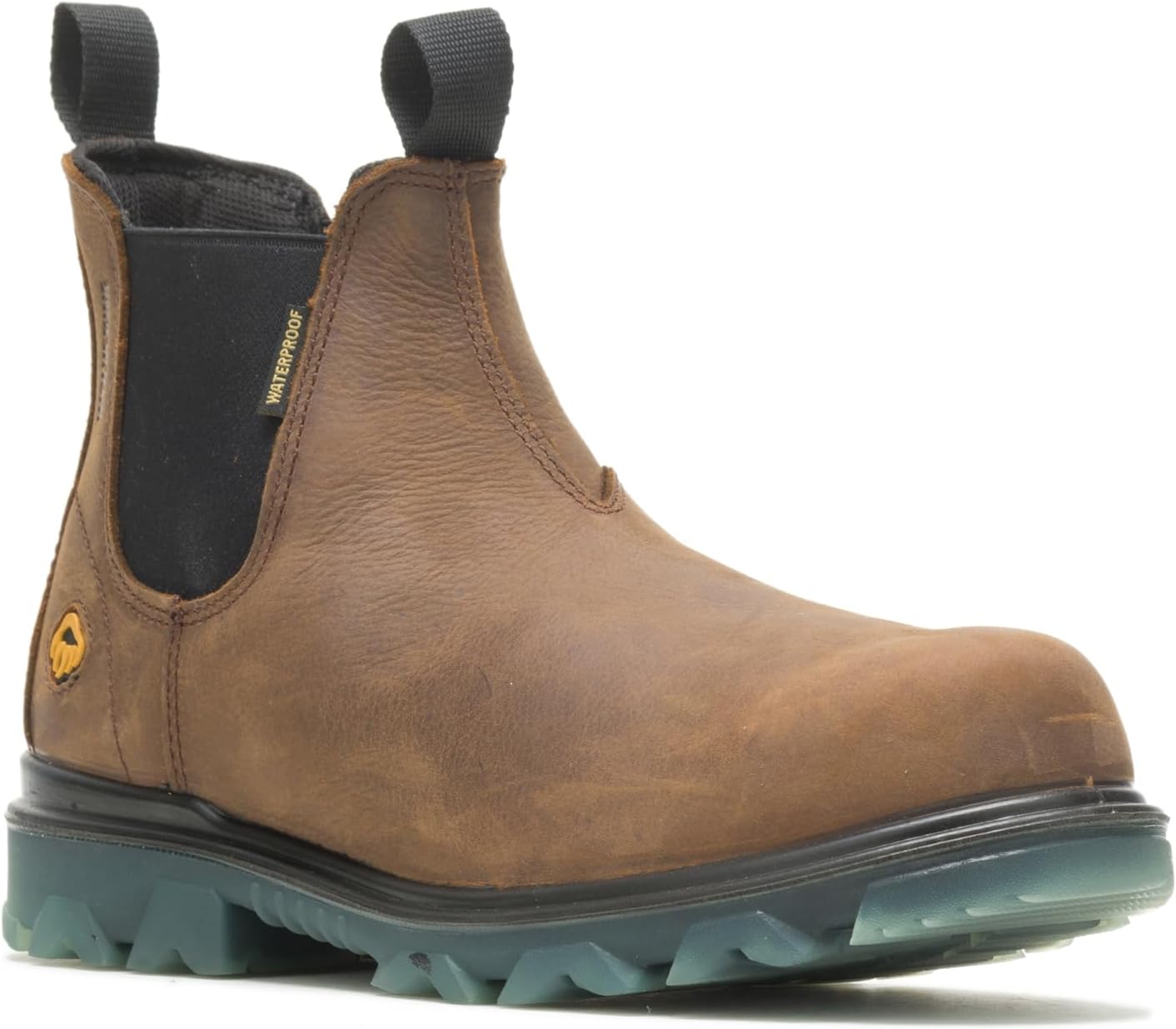
You just spent a full shift on your feet, and the thought of fumbling with lace knots at the end of the day — hands still grimy, back already aching — feels like an insult on top of injury. That’s the real pitch for slip-on work boots: less ceremony, more function. A slip-on work boot is exactly what it sounds like — a pull-on or elastic-sided boot with no laces, designed to come off and go on in seconds. They’ve been a staple in agriculture and oilfield work for decades, but the category has broadened, and the Wolverine I-90 Romeo (a “Romeo” is the traditional name for an elastic-sided, laceless boot) has become a reference point for tradespeople asking whether they can go lace-free without sacrificing protection or durability. This guide lays out what slip-ons do well, where they fall short against lace-up work boots, and the specific tradeoffs of the I-90 Romeo — so you can make the call before you’re committed.
What You Actually Give Up (and Gain) Going Lace-Free
Let’s get the honest accounting out of the way, because the slip-on vs. lace-up debate isn’t won by one side.
What you gain:
A well-fitted slip-on gives you genuinely faster transitions — in and out of a truck cab, in and out of a controlled environment, through security checkpoints on commercial job sites. Owners of the Wolverine I-90 Romeo consistently highlight the zero-break-in experience as the defining benefit. That’s not a marketing line — it’s a pattern that shows up across aggregated reviews. A lace-up boot, especially one with a stiff Goodyear welt construction (a method where the upper leather is stitched to a strip of welt that’s then stitched to the sole — producing a durable, resole-able bond), typically requires 40–80 hours of wear before it conforms to your foot. The I-90 Romeo skips that entirely, which matters if you’re starting a new job or season and don’t have time for a deliberate break-in window.
The other consistent owner note: the I-90 Romeo works with slim or fit-cut jeans without bunching at the ankle. That dual work/casual usability is a real benefit for tradespeople who go directly from a site to an errand or a meeting without changing.
What you give up:
Lace-ups let you adjust tension across the foot — snug at the arch, looser at the toe box, tighter over the ankle. That customization is essentially gone in a slip-on. Lateral ankle support — the boot’s resistance when you roll your ankle on uneven terrain — is lower in a Romeo-style boot because the elastic gusset (the stretchy side panel) doesn’t brace the ankle the way a laced shaft does. If your work involves significant uneven terrain, ladder climbing, or unstable footing, that’s a material tradeoff.
There’s also a long-run durability pattern worth noting. Wolverine Loader owners — a lace-up from the same brand family — report roughly one year of usable life under 10–12 hour daily labor, with stitching on the sides as the primary failure mode. Some owners are on their third pair with full awareness of that timeline, effectively treating the Loader as a consumable at a predictable replacement cadence. That kind of data point is useful: it means you can budget the cost per year rather than cost per pair, and it reframes “durability” as lifecycle management rather than a single purchase. The I-90 Romeo occupies a different use-case band — lighter daily labor, mixed work/casual — so direct comparison isn’t apples-to-apples, but it sets context for what “durability” means in Wolverine’s own line.
The Wolverine I-90 Romeo: What the Spec Sheet and Owner Reviews Actually Say
Construction overview:
The I-90 Romeo is built on a Romeo (elastic-sided, no lace) last with a full-grain leather upper. Full-grain leather — the outermost layer of the hide, with the grain intact — is the most durable and water-resistant cut of leather available; it develops a patina over time rather than cracking the way corrected-grain or split leather does. The boot carries Wolverine’s CarbonMAX safety toe, a composite (carbon fiber) toe cap rather than traditional steel.
Per Wolverine’s published specifications, CarbonMAX meets ASTM F2413 impact and compression ratings — the same standard steel toes are tested against. The practical difference: carbon composite toes are lighter than steel (roughly 20–30% weight reduction depending on the specific cap), don’t conduct temperature (no cold transfer in winter, no heat transfer in summer), and are metal-detector friendly for job sites with security checkpoints. The protection threshold is equivalent; the material and weight profile differ. Popular Mechanics’ work boot roundup notes composite toes as increasingly preferred in commercial construction and industrial settings specifically because of the checkpoint and temperature factors.
Waterproofing:
The I-90 Romeo is rated as waterproof via a membrane lining. The more useful data point: at least one owner in the review corpus has provided a two-year update confirming the waterproofing remains functional. For a slip-on, that’s meaningful — Romeo-style boots have two potential leak points that lace-ups don’t: the elastic gussets. Owners report no significant ingress through those gussets after extended use, which suggests the construction is holding up to the expected stress point.
That said, waterproofing in any boot is a maintenance-sensitive rating. Full-grain leather benefits from periodic conditioning (a leather conditioner or wax) that keeps the pores from drying and cracking. Neglecting this shortens the effective waterproof life of any boot, not just the I-90 Romeo.
Sizing:
Owner reports on the I-90 Romeo and on Wolverine’s Floorhand line (a separate slip-on style with 15-plus years of brand loyalty among some reviewers) converge on the same finding: Wolverine slip-ons run true to size. That’s not universal across the brand — some Wolverine lace-up models run wide or long — but for the Romeo and Floorhand, sizing your street shoe size appears to be the right call based on consistent owner feedback.
By the numbers:
| Wolverine I-90 Romeo | Wolverine Loader (lace-up, same brand family) | |
|---|---|---|
| Safety toe type | CarbonMAX composite | Steel |
| Break-in period (owner reports) | Minimal to none | Moderate (stiff initially) |
| Reported useful life, hard daily labor | Not well-documented at that intensity | ~1 year (daily 10–12 hr labor) |
| Waterproof rating | Yes (membrane) | Yes (varies by model) |
| Lateral ankle support | Lower (elastic gusset) | Higher (laced shaft) |
OSHA, Job Sites, and the Slip-On Acceptability Question
This comes up more than it should, and the answer is simpler than the anxiety around it suggests.
OSHA’s foot protection standard — 29 CFR 1910.136 — requires protective footwear when workers are exposed to falling or rolling objects, objects that could pierce the sole, or electrical hazards. It does not specify lace-up construction. The standard references ASTM F2413, which is a performance specification: it tests impact resistance, compression resistance, and (for metatarsal and EH ratings) specific additional hazards. A slip-on boot that carries ASTM F2413 certification meets the OSHA-mandated protection standard, period.
Where slip-ons can run into job site friction is at the employer or general contractor policy level — some GCs have PPE policies that specify “lace-up work boots” explicitly, either for ankle support reasons or because a policy was written before the composite-toe slip-on category matured. If your job site has a written PPE policy, check it before you order. If it doesn’t specify lace-up, OSHA compliance rests on the ASTM rating alone.
Gear Junkie’s work boot buyer’s guide flags this same nuance: the regulatory floor is met by the safety standard, but site-specific policies can add requirements above that floor.
Cold Weather Range and the I-90 Romeo’s Limits
The I-90 Romeo is not an insulated boot. Wolverine’s published specs don’t list a temperature rating with insulation, and owners don’t describe it as a cold-weather performer. What full-grain leather and a waterproof membrane give you is resistance to wet and moderate cold — the kind of early-morning chill or mild winter condition that a good sock system (merino wool or synthetic thermal sock) can handle.
For sustained cold — consistent sub-freezing temperatures, outdoor labor in winter conditions — an insulated boot rated at 400g or 800g Thinsulate is the right tool. The I-90 Romeo sits in a three-season work boot category: spring through fall, or year-round in mild climates. Using it as your primary winter boot in genuinely cold conditions will end in cold feet.
The Decision Frame: If X, Then Y
You’ve got the tradeoffs. Here’s how to apply them:
If your work involves daily hard labor at 10–12 hours, rough terrain, or significant ankle stress — a lace-up with a stiff shaft and aggressive tread is the right call. The ankle support and fit customization that lace-ups provide is doing real work under those conditions. The Wolverine I-90 Romeo is not built for that intensity.
If you’re in light-to-moderate daily labor — trades with controlled environments, concrete floors, light outdoor exposure — the I-90 Romeo’s zero break-in and effortless transitions are genuine productivity gains, not just comfort features. Getting in and out of a boot dozens of times a day adds up.
If metal detectors are in your workflow (commercial construction, federal sites, airports during site work) — composite toe is the clear answer, and the I-90 Romeo’s CarbonMAX toe handles that cleanly.
If you need a boot that crosses into casual wear — fit-cut jeans, errands after work — the Romeo profile is designed for exactly that dual use. A steel-toed lace-up with a work sole reads as workwear everywhere; a Romeo reads closer to a chelsea boot at distance.
If your budget is built around a one-year replacement cadence at hard labor — study the Wolverine Loader pattern: some owners are on their third pair and have essentially priced the boot as an annual operating cost. That’s a legitimate way to think about mid-tier work boots, and it’s worth knowing that pattern exists before you buy expecting a five-year boot.
If you’re in cold winter conditions consistently — add an insulated boot to your rotation. The I-90 Romeo is a three-season tool.
The slip-on category isn’t a compromise for tradespeople who do their homework — it’s a right-tool-for-the-job choice with a specific profile of strengths. The Wolverine I-90 Romeo has legitimate durability evidence behind it, a composite toe that meets the same protection standard as steel, and an owner feedback pattern that’s unusually consistent about what it does well. Match it to the right work context and it earns its place in the rotation.
Frequently Asked Questions
Does the Wolverine I-90 Romeo actually stay waterproof after extended use? Based on owner feedback across aggregated reviews, yes — at least one owner has confirmed sustained waterproofing at the two-year mark, which is an unusually strong data point for a slip-on in this category. Maintaining the leather with periodic conditioning is what keeps that rating functional over time.
Is the CarbonMAX toe the same protection level as steel? Per ASTM F2413 testing, yes. Both steel and CarbonMAX composite toes are tested to the same impact and compression thresholds. The differences are weight (composite is lighter), temperature conductivity (composite doesn’t transfer cold or heat the way steel does), and metal-detector compatibility (composite passes through without alarming).
How long do Wolverine Loader boots realistically last under daily hard labor? Owner reports in the review corpus put the Loader at roughly one year under 10–12 hour daily hard labor, with side stitching as the primary failure mode. Some owners are on their third pair with full awareness of this timeline and treat replacement as a predictable annual cost.
Do Wolverine slip-ons run true to size or should I size up? Owner reports on both the I-90 Romeo and the Wolverine Floorhand consistently indicate true-to-size fit. Order your standard street shoe size as a baseline.
Are slip-on work boots OSHA-acceptable for most job sites? Yes, provided they carry the applicable ASTM F2413 safety rating. OSHA’s 29 CFR 1910.136 standard references performance specifications, not construction style. Individual employer or GC policies may add requirements above that floor — check your site’s written PPE policy if one exists.
What’s the warmth range of the I-90 Romeo in cold weather? The I-90 Romeo is not an insulated boot and doesn’t carry a temperature rating. Full-grain leather and a waterproof membrane provide protection from wet and moderate cold. For sustained sub-freezing conditions, an insulated boot (400g–800g Thinsulate range) is the appropriate tool. The I-90 Romeo is best treated as a three-season boot.