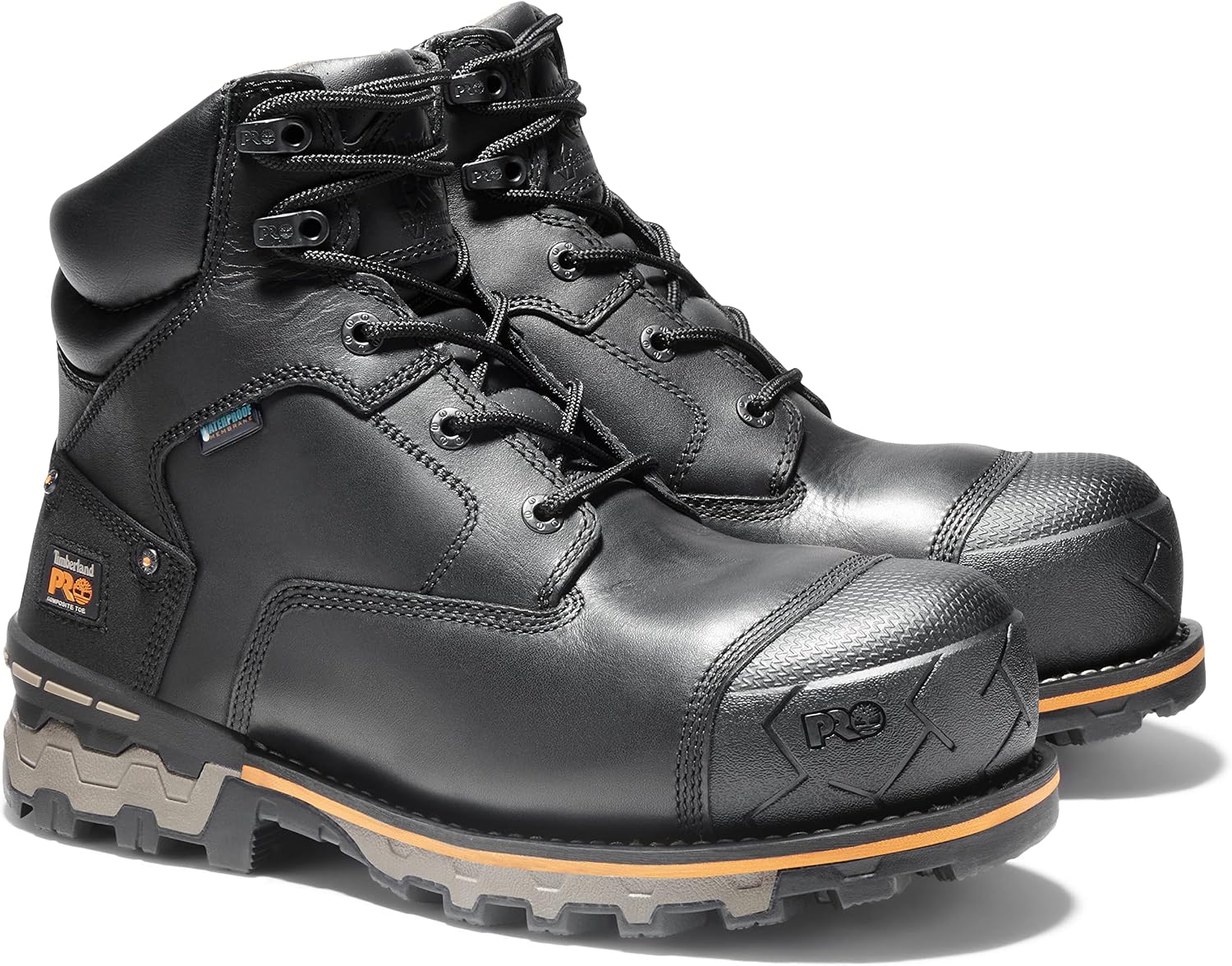
You just started a new job site, and the first morning brief includes the phrase “metal detector at the gate.” If you showed up in steel toe boots, you’re already behind — because now you either take them off, walk through in socks, and feel like a kindergartner at the airport, or you hold up the entire crew. Toe cap material is one of those spec-sheet details that sounds like a footnote until the moment it actually matters.
Here’s the plain-language version: almost every work boot sold today uses one of three materials inside the reinforced toe box — the protective shell over the front of your foot. Steel is the original, heavy-duty option. Composite means non-metal materials (usually fiberglass, Kevlar, carbon fiber, or a combination) engineered to hit the same safety ratings. Aluminum (sometimes called alloy toe) sits in between — lighter than steel, still conductive, still metal. All three are governed by the same ASTM International standard — ASTM F2413 — which sets minimum compression and impact resistance requirements. Passing that standard is the baseline; the differences between materials show up in weight, warmth, detector clearance, and how the cap actually feels under your foot after a ten-hour shift. This article maps those tradeoffs with enough specificity that you can match the right cap type to your actual working conditions.
| EDITOR'S PICKThorogood American Heritage 6”… | Mid-tierIrish Setter | Budget pickCarhartt Men's CMF6366 6 Inch C… | |
|---|---|---|---|
| Toe type | Soft toe | Aluminum toe | Composite toe |
| Safety toe | ✗ | ✓ | ✓ |
| Upper material | Full-grain leather | — | Leather |
| Outsole | Wedge | — | — |
| EH rated | ✓ | — | — |
| Price | $211.95 | $143.96 | $109.95 |
| See on Amazon → | See on Amazon → | See on Amazon → |
How the Three Toe Types Actually Compare
Steel Toe: The Baseline Everything Is Measured Against
Steel is the oldest safety toe standard, and it’s still the density-to-cost winner. A steel cap protecting the same foot volume as a composite cap will be thinner — which means the boot’s toe box can sit lower, closer to a dress-boot profile, and still pass ASTM F2413 compression ratings. That narrower cap is why some reviewers of the Thorogood American Heritage steel toe specifically praise how the boot doesn’t look like a blunt instrument from across the room.
The documented tradeoff reviewers return to most consistently is break-in. Owners of the Thorogood American Heritage steel toe report a stiffness at the toe cap during the first few weeks that soft-toe versions of the same boot don’t produce — the cap doesn’t flex with the leather the way a soft toe does, so the front of your foot is working against a rigid shell until the surrounding leather softens enough to compensate. This isn’t a defect; it’s physics. But it’s worth knowing before week two has you questioning the investment.
Steel also conducts temperature. In environments below freezing, a steel cap will pull heat away from your toes faster than composite or aluminum. In hot environments — asphalt, summer roofing, foundry-adjacent work — it absorbs and holds heat. Neither effect is catastrophic if you’re wearing the right sock weight, but the delta is real.
One more non-negotiable: steel triggers metal detectors. That sounds obvious until you’re the person who spent a decade avoiding certain job sites because of it.
Composite Toe: The Job-Site Chameleon
The defining moment for composite toe in owner reviews isn’t abstract. One buyer in the Timberland PRO Boondock composite toe review thread notes he waited over ten years for a composite version of a boot he trusted, because the steel toe version was effectively off-limits at facilities with metal detector entry. That’s not a spec-sheet preference — that’s a decade-long workaround finally resolved by one product decision. Security checkpoints, nuclear facilities, semiconductor fabs, some utilities infrastructure — any site where metal detection is a daily entry procedure makes composite toe the only practical choice.
Composite materials are also genuine electrical hazard (EH) performers. Per OSHA’s foot protection guidance and confirmed by ASTM F2413’s EH designation, composite toe boots with EH ratings provide a secondary layer of protection against open electrical circuits. The cap itself is non-conductive by nature — there’s no metal pathway for current to travel through.
The Carhartt CMF6366 composite toe carries perhaps the most striking safety account in this product category: a reviewer describes a foot caught under an outrigger crane, attributing the absence of serious injury directly to the composite toe. That’s anecdote, not controlled data — but it’s the kind of account that clarifies what “meets ASTM F2413” actually means in practice.
The tradeoff: composite caps must be physically thicker than steel to achieve the same compression rating, which means the toe box of a composite boot will often be taller or wider. Fit can vary across brands. If you’re coming from a steel toe boot and sizing directly into a composite, it’s worth checking brand-specific fit notes before ordering.
Composite is also the lightest option of the three, which matters more than most buyers expect until they’re eight hours into a shift.
Aluminum Toe: The Middle Ground That’s Often Overlooked
Aluminum (alloy) toe sits between steel and composite in almost every dimension — lighter than steel, heavier than composite; thinner than composite, thicker than steel; metal-detector-triggering (it’s still metal), but warmer than steel because aluminum is a less aggressive heat conductor.
The Irish Setter Ashby aluminum toe has a specific review pattern worth surfacing: owners consistently praise all-day wearability and ladder comfort — a specific mention that shows up across multiple reviews — with one buyer noting the first comments on the boots came from coworkers complimenting the look. That’s meaningful. Aluminum toe boots can achieve a sleeker silhouette than composite while still delivering lighter-than-steel daily fatigue numbers. If your job involves frequent ladder climbing, where the front of the boot contacts rungs repeatedly, the thinner aluminum profile reduces that pressure point noticeably compared to composite.
The honest limitation: if your site requires metal-detector clearance, aluminum doesn’t help you. It will trigger. And if electrical hazard is a primary concern, aluminum is conductive — composite is still the right call.
The Numbers: Weight, Warmth, and Clearance at a Glance
| Cap Type | Detector Clearance | Cold Weather | Cap Thickness | Relative Weight |
|---|---|---|---|---|
| Steel | ✗ No | Coldest | Thinnest | Heaviest |
| Aluminum | ✗ No | Middle | Middle | Middle |
| Composite | ✓ Yes | Warmest | Thickest | Lightest |
All three cap types can achieve ASTM F2413 certification. Source: ASTM International F2412/F2413 specification.
Where Cap Placement and Fit Matter as Much as Material
One underappreciated detail in the toe-cap conversation is positioning — specifically, how far forward and how high the cap sits relative to your longest toe. Reviewers of the Timberland PRO Keele Ridge steel toe specifically flag the cap placement as non-intrusive, which implies a real baseline problem: poorly positioned caps in other boots that press down on the longest toe after a few hours of standing. The Keele Ridge callout shows that buyers have been burned by this enough that good cap placement becomes a praise-worthy feature, not a given.
This is worth checking in any toe-cap boot, regardless of material. When trying on or sizing a new boot, the Working Person’s Store composite vs. steel toe editorial overview recommends confirming you have roughly a thumb’s width of space between your longest toe and the front of the cap — not just the front of the boot. The cap creates an internal shelf; if it’s positioned low or far back, it limits effective toe clearance even in a correctly-sized boot.
The Decision Framework
If you’re mid-decision and the job site conditions are clear, here’s how the logic flows:
If you pass through a metal detector at any point in your workday — entry checkpoint, security screening, sensitive facility — composite is the only viable choice. Full stop. A decade of workarounds, as the Timberland PRO Boondock reviewer discovered, is too long to wait for the obvious answer.
If electrical hazard is in your job’s PPE requirements, check for the EH rating designation specifically. Composite toe boots can earn EH ratings; steel and aluminum cannot provide the same non-conductive protection at the toe cap level.
If all-day ladder work or extended ladder climbing is your primary load, aluminum toe — specifically the Irish Setter Ashby’s profile — is worth prioritizing over composite’s thicker box. The thinner cap reduces rung pressure over the course of a shift.
If toe box aesthetics matter for a dual-use boot (job site in the morning, client meeting in the afternoon), steel’s thinner cap allows a lower, cleaner profile. The Thorogood American Heritage remains a reference point here, though factor in the documented break-in stiffness and budget time accordingly.
If cold weather is the dominant variable, composite’s non-conductive material insulates better at the cap than steel. Pair with appropriate sock weight and you’ve addressed the two biggest cold-toe variables in one decision.
If you’re outfitting a crew on a budget and all sites are detector-free, steel toe remains the cost-effective baseline. The price differential between steel and composite versions of the same boot often runs $20–$50, and on volume purchasing, that adds up without a compensating job-site benefit.
Frequently Asked Questions
Can I wear composite toe boots through a metal detector? Yes. Composite toe caps contain no metal components and will not trigger standard metal detectors or security screening equipment. This is their most operationally significant advantage over steel and aluminum.
Are composite toe boots as safe as steel toe? Yes, when both carry ASTM F2413 certification. The standard sets minimum impact (75 ft-lb) and compression (2,500 lb) requirements regardless of cap material. A certified composite toe meets the same performance floor as a certified steel toe. Per ASTM International’s F2412/F2413 specification, material type is not a factor in certification — performance is.
Which toe type is warmest in winter? Composite, because non-conductive materials don’t transfer heat away from your foot the way metal does. Steel is the coldest option; aluminum is intermediate. Sock weight and boot insulation rating matter more overall, but the cap material creates a meaningful differential in sustained cold.
Does an aluminum toe cap feel different from steel inside the boot? Owners generally report aluminum toe as less noticeable than steel — the cap tends to be positioned with a slightly roomier feel, and the lighter weight reduces end-of-day fatigue. The internal sensation is similar enough that most buyers don’t distinguish between the two until they’ve worn both side by side.
Do composite toe boots pass EH electrical hazard ratings? Composite toe boots can carry EH ratings, but the EH designation is separate from the toe cap material designation — it applies to the boot’s overall construction, including the sole. Check the boot’s label for “EH” specifically; a composite cap alone doesn’t guarantee electrical hazard protection. Per OSHA’s foot protection guidance, EH-rated footwear must be verified at purchase.
Which toe type is lightest for all-day wear? Composite is consistently the lightest, followed by aluminum, then steel. Gear Junkie’s 2025 work boot roundup notes composite toe as a meaningful advantage for tradespeople logging 10,000+ steps daily. The difference in cap weight alone may seem marginal per boot, but across a full shift, the cumulative effect on foot fatigue is real and frequently mentioned in long-run owner reviews.