
You just dropped somewhere north of $200 on a pair of Thorogood Moc Toes — boots made in the USA, Goodyear-welted (meaning the sole is stitched rather than glued, which makes them resole-worthy for decades), and built on a last that fits a wider toe box than most competitors. Good call. But now you’re staring at the product page trying to figure out: 6-inch or 8-inch? The height difference sounds minor. It isn’t. The two boots serve meaningfully different use cases, and picking the wrong one means either fighting ankle fatigue where you don’t need to or losing the lateral support your work actually demands. This article walks through the real tradeoffs — by trade, by terrain, by fit preference — so you can make the call with confidence before the box ships.
| EDITOR'S PICKThorogood American Heritage 8”… | Mid-tierThorogood American Heritage 6”… | Budget pickThorogood American Heritage 6”… | |
|---|---|---|---|
| Boot height | 8" | 6" | 6" |
| Toe type | Steel toe | Steel toe | Soft toe |
| Leather finish | Tobacco oil-tan | Tobacco oil-tan | — |
| Price | $227.95 | $219.95 | $211.95 |
| See on Amazon → | See on Amazon → | See on Amazon → |
What the Height Difference Actually Does
The 6-inch shaft (the section of the boot above the ankle) ends right at the ankle bone or just above it. The 8-inch shaft clears the ankle entirely and supports the lower calf. That two-inch gap sounds small until you spend ten hours on a ladder, on a cab floor, or walking uneven ground — at which point it becomes the difference between a stable platform and a boot that’s working against you.
Here’s what the height change does mechanically:
- Lateral stability: The taller collar wraps more tendon and soft tissue, reducing side-to-side roll. This matters most on uneven substrates — gravel, rebar mats, timber decks — or when you’re on pole-climbing spurs or bucket-truck pegs where your ankle is under constant angular load.
- Debris exclusion: An 8-inch boot sheds gravel, concrete splatter, and weld spatter more effectively than a 6-inch. Welders and pipefitters consistently cite this advantage in long-run owner reviews aggregated at Working Person’s Store (workingpersonstore.com).
- Warmth and moisture management: More shaft means more insulation in cold conditions and, conversely, more heat retention in summer. If your work is primarily indoors on concrete, the 6-inch runs cooler and still delivers the full cushion benefit of the 1957 series sole unit.
- Break-in timeline: The 8-inch requires a longer break-in period because there’s more leather to soften — more on that in the FAQ section below.
Neither height is “better.” They’re purpose-built for different conditions. The decision tree is simpler than it looks once you understand who each boot actually serves.
Head-to-Head: Three Use Cases That Decide the Question
For Tradespeople on Varied Terrain and Job-Site Movement
The 6-inch Moc Toe is Thorogood’s volume seller for a reason — it covers the widest range of tradespeople. If you’re a general contractor moving between job sites, a carpenter working on decking and framing, or an electrician doing mostly residential rough-in, the 6-inch delivers everything you need without the extra weight and stiffness of a taller collar.
Operators who spend significant time seated — equipment operators, truck drivers, skid-steer and telehandler operators — specifically prefer the 6-inch because the 8-inch collar can bind against the shin when the knee is bent at cab-seat angle for extended periods. This is a recurring complaint documented in long-run owner reviews at Working Person’s Store, and it’s worth taking seriously if your day involves more than two hours of seated operation.
The 6-inch also wins on all-day wearability for concrete-floor environments. The 1957 Waterproof series in particular — which layers a waterproof membrane into the upper without sacrificing the moc-toe silhouette — has earned a loyal following among concrete finishers, warehouse supervisors, and inspectors who log five-plus miles a day on hard surfaces. Field Mag’s roundup titled “Best Heritage Work Boots for Tradespeople” specifically calls out the 1957 series sole unit as one of the more effective anti-fatigue platforms in the under-$300 tier.
Verdict for this use case: The 6-inch is the right call for most general-trades buyers who need all-day comfort without sustained lateral load.
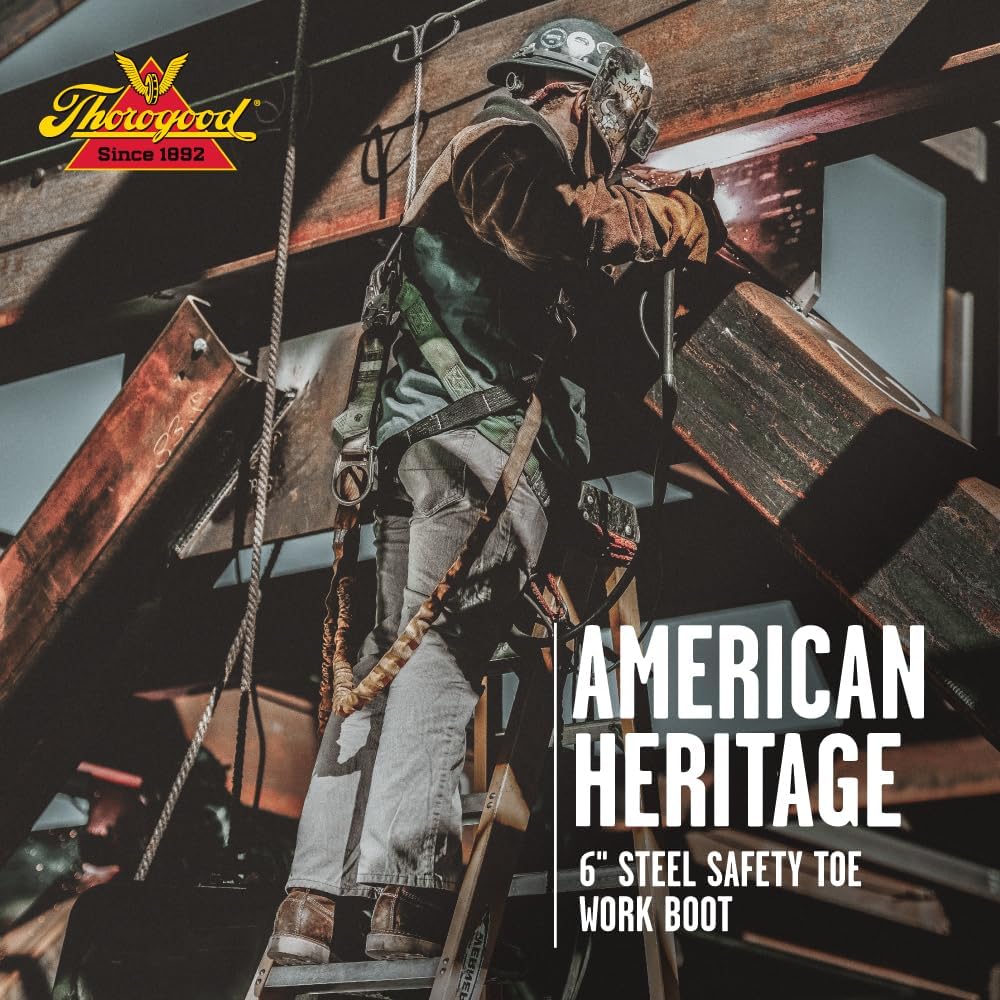
Thorogood
$219.95
In stock on Amazon
Check price on AmazonFor Linemen, Pole Climbers, and Welders
The 8-inch Moc Toe draws a narrower, more specific buyer — and that buyer tends to be emphatic about needing it. Linemen and pole climbers report that ankle support during climbing is non-negotiable, and multiple reviewers with 20-plus years in the trade treat the 8-inch as the minimum acceptable shaft height. The taller collar works in concert with climbing gaffs and climbing belts to stabilize the ankle during load transfer.
Welders represent the second clear 8-inch use case. Weld spatter — small droplets of molten metal — lands on the boot shaft regularly, and a 6-inch boot leaves a gap between the boot top and the pant leg that a longer collar closes. Several welders in owner reviews aggregated at Working Person’s Store specifically note that the 8-inch steel-toe model has survived years of shop work without burn-through failure at the shaft.
Heavy equipment mechanics who work under machinery and spend time on their knees also trend toward the 8-inch for the added debris protection. Pipefitters working in tight trenches with gravel or chip rock underfoot give similar feedback in long-run owner accounts.
Verdict for this use case: If your ankle is under angular or climbing load, or your environment throws debris and spatter at the boot shaft, the 8-inch is the right tool.

Thorogood
$227.95
In stock on Amazon
Check price on AmazonFor Buyers Crossing Over from Other Heritage Boot Brands
One recurring signal across aggregated reviews — including buyers who crossed over from Red Wing — is that Thorogood’s Moc Toe last runs notably wide in the toe box even in standard D width. A former Red Wing Heritage buyer noted in Working Person’s Store’s review base that the Thorogood felt meaningfully roomier through the forefoot without sizing up, which relieved the toe crowding that had accumulated after long shifts. This is not a defect; it’s the moc-toe construction working as intended. The hand-sewn moccasin seam creates a gathered, rounded toe that doesn’t compress the forefoot the way a standard cap-toe last does.
For crossover buyers, the height question carries a secondary fit dimension: the 8-inch collar will feel more restrictive around the ankle and lower calf than most 6-inch heritage boots from competing brands, and the break-in period for the 8-inch is meaningfully longer — owners report four to six weeks versus two to four weeks for the 6-inch. If you’re new to taller-collar boots, plan accordingly.
Heddels’ brand profile on Thorogood (heddels.com) confirms the company’s Marshfield, Wisconsin production history and notes that the Union-made construction has been a continuous differentiator for the brand in the heritage work boot segment — context that matters if you’re choosing between Thorogood and an import-sourced alternative at a similar price point.
Verdict for this use case: Heritage-brand crossover buyers should size true to length, expect a wider toe box than they’re used to, and choose height based on their actual work environment rather than brand convention.
Thorogood
$219.95
In stock on Amazon
Check price on AmazonBy the Numbers
| Factor | 6-Inch | 8-Inch |
|---|---|---|
| Shaft height above ankle | ~0–1 in. above ankle | ~2–3 in. above ankle |
| Break-in timeline (owners report) | 2–4 weeks | 4–6 weeks |
| Best for seated operation | Yes | Often uncomfortable |
| Weld spatter / debris protection | Moderate | High |
| Weight delta (approximate) | Lighter by ~4–6 oz per pair | Heavier |
| Resole viability | Yes — Goodyear welt | Yes — Goodyear welt |
Frequently Asked Questions
How stiff are Thorogood boots out of the box, and what’s the best break-in method?
Stiff. Meaningfully stiff, especially in the 8-inch. Owners with decades in the trade are consistent on this point: don’t try to force a full-day wearing in week one. The approach that experienced buyers recommend runs as follows — apply two to three coats of a quality leather conditioner before the first wear, let each coat absorb fully, then start with half-days and build up. Bick 4 (a thinner conditioner that penetrates quickly without darkening the leather significantly) and Obenauf’s Heavy Duty LP (a heavier wax-based conditioner that adds water resistance alongside conditioning) are the two most frequently cited products in owner discussions. Gear Junkie’s guide titled “How to Break In Work Boots the Right Way” notes that the pre-wear conditioning method shortens the painful phase considerably compared to dry wearing from day one.
Do Thorogood boots run true to size?
In length, yes — most owners land at their standard US size. The variable is width. The Moc Toe last is wider than average in the forefoot, so if you’re accustomed to a narrow or standard-width last from another brand, the toe box may feel roomy at first. Owners report it normalizes within two to three weeks of regular wear as the footbed shapes to the foot.
What leather conditioner do experienced Thorogood owners actually use?
Bick 4 and Obenauf’s Heavy Duty LP dominate the field, with Bick 4 favored for initial conditioning (it penetrates without dramatically altering the leather’s color) and Obenauf’s favored for ongoing protection in wet environments. Several reviewers use both in sequence: Bick 4 first to soften and condition, then Obenauf’s to seal and protect. A smaller number of long-term owners also mention Leather Honey as a softer-touch option for the break-in phase.
Is the 8-inch height necessary for welding or equipment operation, or does the 6-inch suffice?
For welding: the 8-inch is the right call. Weld spatter is the deciding factor. For equipment operation (skid-steer, excavator, loader): the 6-inch is generally preferred because the 8-inch collar creates shin-binding during extended cab time. For pole climbing and linework: the 8-inch is strongly recommended by experienced tradespeople documented in long-run owner reviews at Working Person’s Store.
How does the 1957 Waterproof series differ from the standard American Heritage in real-world wet conditions?
The 1957 Waterproof series adds a waterproof membrane bonded into the upper construction, which owners consistently report as effective for standing water, wet concrete, and rain exposure during the normal workday. The tradeoff is modest — the membrane slightly reduces breathability compared to the standard American Heritage leather upper. For concrete-floor workers and anyone who routinely encounters standing water, the 1957 series earns repeat buyers at a notable rate. One reviewer in Working Person’s Store’s aggregated feedback noted they were on their sixth pair specifically for concrete-floor performance.
Are Thorogood Moc Toe boots resole-worthy, and where do owners get them resoled?
Yes — this is one of the core value arguments for the line. Thorogood builds on a Goodyear welt, meaning the sole is stitched to a welt strip around the perimeter of the boot rather than glued directly to the upper. Popular Mechanics’ “Best Work Boots” buyer’s guide identifies Goodyear welt construction as the key indicator of resole viability in the heritage work boot category. Owners typically get three to five years of heavy use before the first resole, and well-maintained uppers can sustain two to three resole cycles. Local cobblers who work with Vibram-type sole units can handle the job; some owners also send boots to specialty resole shops that focus on heritage boot work.
The Decision Rule
If your day involves ladder climbing, pole work, welding, or any environment that throws debris at the boot shaft — buy the 8-inch. You will pay a modest break-in tax, but the ankle support and spatter protection are doing real mechanical work.
If your day is split between walking job sites, operating equipment, and moving through varied terrain without sustained lateral load — buy the 6-inch. The all-day comfort advantage is real, and the Goodyear welt means you’re not leaving resole value on the table either way.
Both heights share the same moc-toe last, the same American-made construction from Thorogood’s Union-made Wisconsin facility documented in Heddels’ brand profile on thorogood.com, and the same resole ecosystem. The shaft height is the only functional variable. Get that right, and the rest of the boot will handle itself.