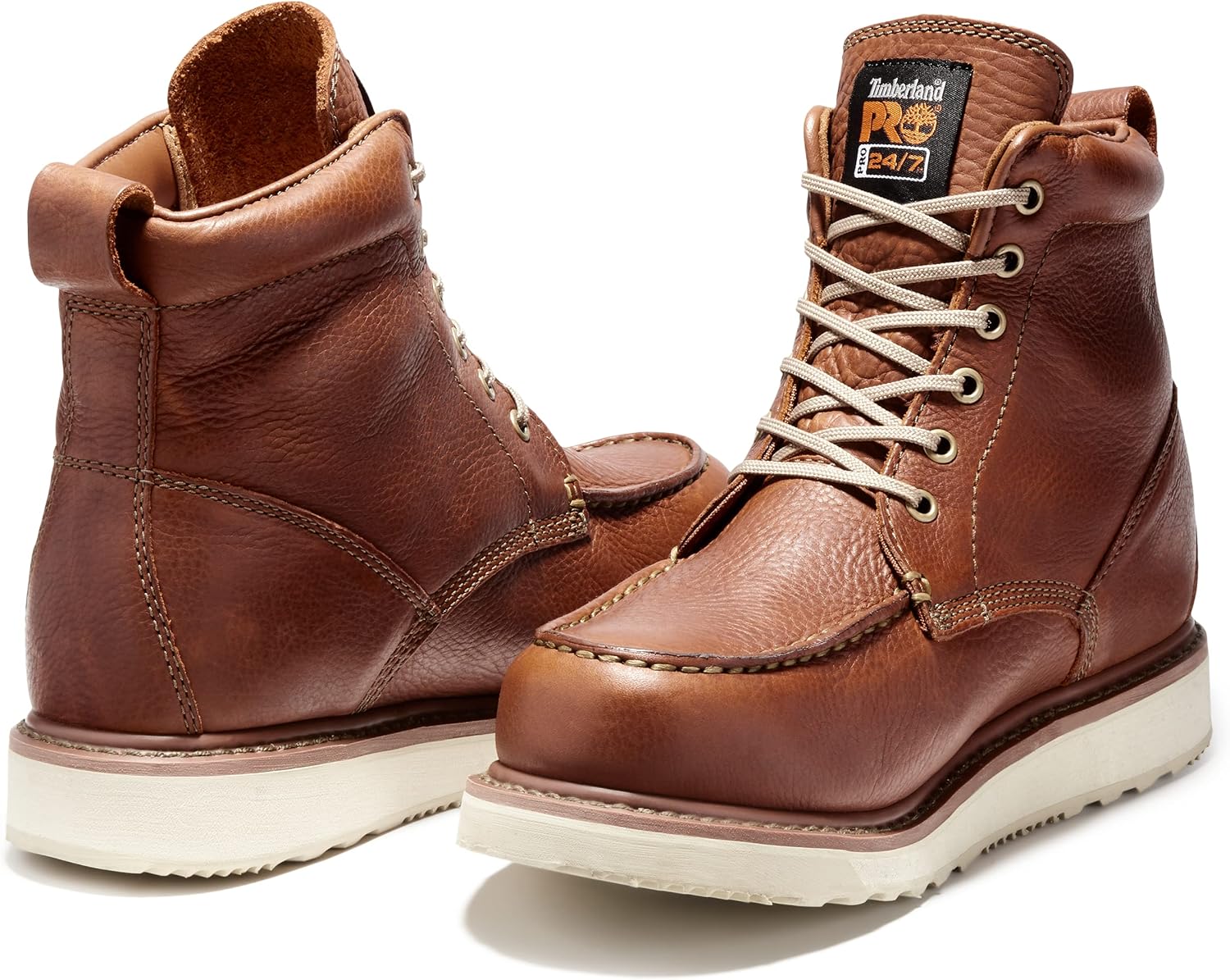
You just decided to get serious about your work boot situation — maybe the pair you’ve been wearing for two years finally gave out, or you’re outfitting a new crew and can’t afford to guess wrong. You’ve landed on Timberland PRO as a shortlist because they show up on job sites, in ranch reviews, and in trades-adjacent forums consistently. But now you’re staring at three models — the Wedge Moc Toe, the Boondock, and the Keele Ridge — and they look more similar than they are.
Quick orientation if you’re still getting your footing in work boot language: a moc toe is a stitched seam across the toe box that gives more room for your toes to splay naturally; a wedge sole is a flat-bottomed rubber sole without a traditional heel, which is easier on knees and preferred on hard, flat surfaces; and a composite toe is a safety toe cap made from non-metal materials — typically fiberglass or carbon fiber — that meets the same impact rating as steel but won’t set off metal detectors. With that settled, here’s how these three boots actually differ and a clear decision framework so you’re not just guessing at checkout.
| EDITOR'S PICKTimberland PRO Men's Boondock 6… | Mid-tierTimberland PRO mens Gridworks W… | Budget pickTimberland PRO Unisex Adult Pro… | |
|---|---|---|---|
| Safety Toe Type | Composite | Alloy | Soft |
| Waterproof | ✓ | ✓ | — |
| Toe Shape | — | Wedge | Wedge |
| Color | Black | Golden Brown | Rust |
| Size | 10 Wide | 10.5 | 7.5 |
| Price | $128.96 | $119.95 | $104.97 |
| See on Amazon → | See on Amazon → | See on Amazon → |
The Core Differences, Before We Go Deep
These aren’t the same boot with different names. They’re built around different use cases, and the details matter.
By the numbers:
| Model | Sole Type | Safety Toe Options | Upper Leather | Break-In Reports |
|---|---|---|---|---|
| Wedge Moc Toe | Rubber wedge | Soft toe, steel toe | Full-grain oiled | Moderate; improves sharply with conditioning |
| Boondock | Lug outsole | Soft, steel, composite | Full-grain | Short to moderate; noted as supple |
| Keele Ridge | Lug outsole | Soft toe, composite | Full-grain | Minimal; comfortable from day one |
The Wedge Moc Toe is the flat-surface specialist. The Boondock is the long-haul generalist with the deepest owner history. The Keele Ridge is the newer outdoor-leaning entry that is earning fast loyalty from ranch and utility workers. The sections below break each one down properly, including where each boot earns its reputation and where it runs out of road.
The Three Boots, Head to Head
Timberland PRO Wedge Moc Toe: The Trade-Ready Flat-Surface Boot
The Wedge Moc Toe is built for environments where you spend most of your day on hard, level ground — concrete floors, scaffolding, warehouse decking, paved job sites. The wedge sole (no stacked heel, just a continuous rubber platform) distributes your weight more evenly than a traditional work boot heel, which most tradespeople working on flat surfaces find significantly easier on the knees and lower back over a full shift.
What reviewers consistently flag: the out-of-box experience is good, but the ceiling is measurably higher with basic maintenance. Buyers who condition the leather before the first wear — using a penetrating wax or oil-based conditioner — and who swap the factory insole for an aftermarket orthotic report results that push the Wedge Moc Toe into genuinely outstanding territory. Reviewers who skip that step tend to rate the boot as solid but not exceptional. Verified buyer aggregations at Working Person’s Store show a consistent pattern: owners who prepped the leather rate comfort and water resistance higher than those who wore them straight out of the box. The difference is not subtle.
The moc toe construction gives your toes real room, which electricians, plumbers, and any trade where you’re kneeling frequently will appreciate. Compressed toes at the end of an eight-hour day is a real productivity and health problem that wider toe boxes solve. Full-grain oiled leather holds up well to light moisture and scuffs, though conditioning before first wear significantly raises the waterproofing baseline. Heddels, in their work boot leather care and conditioning guide, notes that full-grain oiled leather responds strongly to conditioning because added oils replenish what the tanning process provides, and untreated boots off the shelf are often under-conditioned for heavy daily use.
Who this is for: Flat-surface trades — electrical, plumbing rough-in, concrete finishing, light fabrication. Anyone willing to spend 20 minutes on leather prep before first wear and who wants a boot that rewards maintenance.
Watch out for: If you’re on uneven terrain, muddy job sites, or scrambling in and out of a truck constantly, the wedge sole’s flat profile gives you less grip purchase than a lug sole. The flat bottom is also the wrong geometry on sloped surfaces.
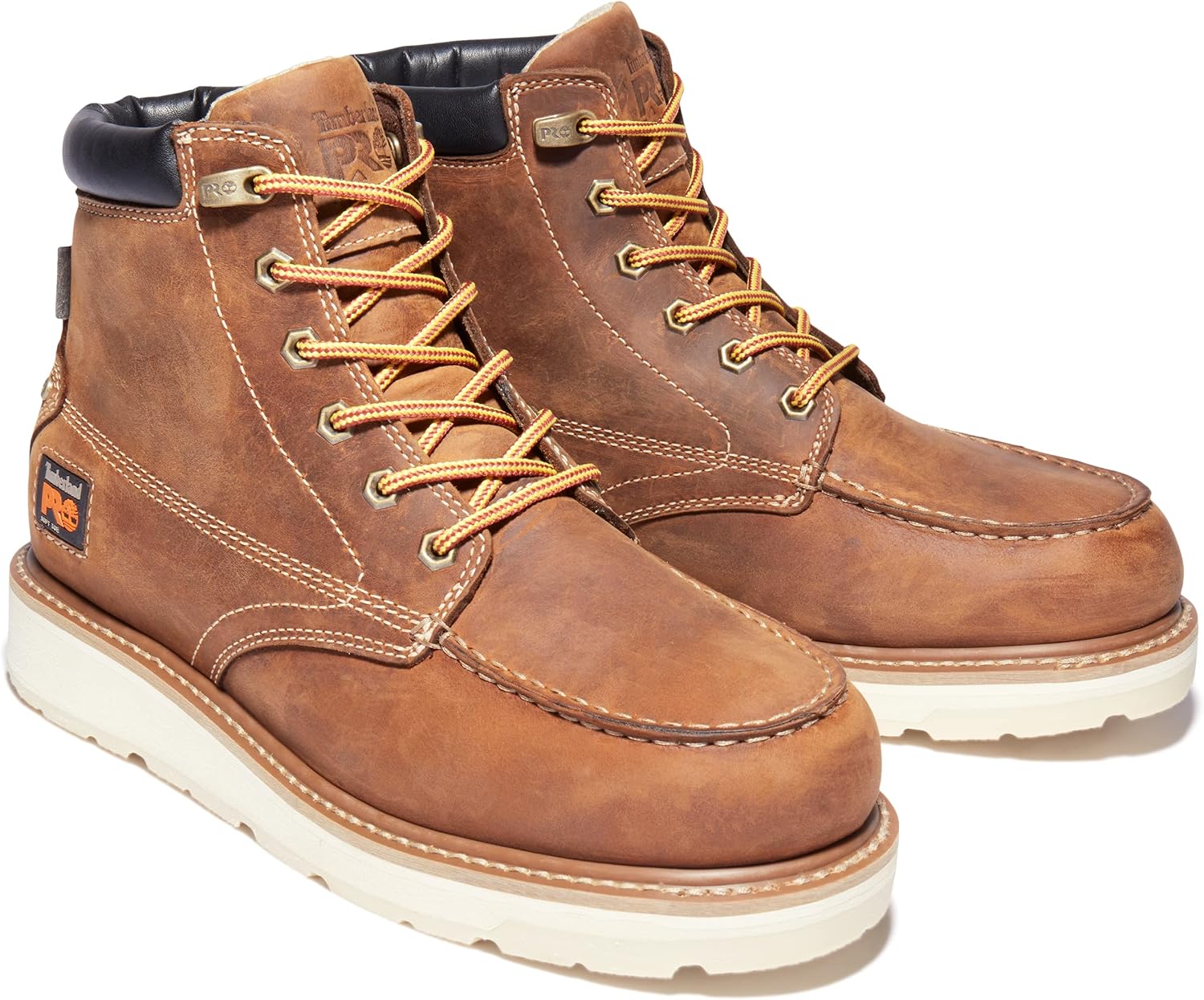
Timberland
$119.95
In stock on Amazon
Check price on AmazonTimberland PRO Boondock: The Long-Haul Loyalty Story
The Boondock has the deepest documented wear history of these three models, and that matters when you’re making a long-horizon boot decision. Owner accounts of three pairs across more than a decade — same model, same last (the foot-shaped mold a boot is built around), each pair lasting multiple years of hard use — represent the kind of real-world durability signal that marketing copy cannot manufacture. That repeat-purchase loyalty is a meaningful data point visible in aggregated verified buyer reviews at Working Person’s Store across both the 6-inch and composite toe variants.
The leather story is worth calling out directly. Reviewers specifically note the Boondock’s leather as unusually supple compared to some competing heritage work boots, where aggressive break-in periods are a known complaint. The Boondock’s reputation is for a shorter, more forgiving break-in curve with leather that moves with the foot faster than average.
The composite toe variant of the Boondock is a genuinely important product for a specific buyer segment: tradespeople who work in metal-detector environments — security-sensitive facilities, certain government or utilities infrastructure work, semiconductor fabrication plants — who have spent years making do with non-safety-toe options because steel-toe boots trigger detectors every single shift. The composite toe version addresses that directly without sacrificing the ASTM F2413 impact and compression rating. Gear Junkie, in their Best Work Boots Tested and Reviewed roundup, identified composite toe availability as a significant differentiator in the Boondock’s positioning for professional buyers with site-access requirements.
The lug outsole on the Boondock gives it versatility across surfaces that the Wedge Moc Toe does not match — uneven ground, gravel, light mud, exterior stair work. It is not a hiking boot, but it is a legitimate all-conditions work boot in a way the Wedge Moc Toe is not designed to be.
Who this is for: Tradespeople who want a proven multi-year platform across varied terrain. Anyone in a metal-detector environment who needs a composite toe safety rating. Buyers who want the shortest break-in curve in this group on a lug-sole boot.
Watch out for: If you need a flat sole for specific knee or back reasons, the Boondock’s lug sole is the wrong geometry. The larger review pool also means more variance in fit reports — see the FAQ section on sizing.
Timberland
$119.95
In stock on Amazon
Check price on AmazonTimberland PRO Keele Ridge: The Surprise Performer for Outdoor Trades
The Keele Ridge has a thinner review history than the Boondock — it is the newest entrant in this comparison — but the early signals are meaningful. Ranch workers and outdoor utility tradespeople report comfort from day one, which is genuinely unusual in work boots at this price tier. Most lug-sole leather boots require 20 to 40 hours of break-in before they stop fighting your foot; Keele Ridge reviews suggest that number is significantly compressed, likely due to construction choices in the footbed and flex point.
Gear Junkie, in their Best Work Boots Tested and Reviewed roundup, noted the Keele Ridge’s performance-to-price positioning as competitive, particularly for buyers coming from outdoor-performance footwear backgrounds who find traditional work boots stiff and punishing. If you have spent years in trail runners or hiking boots and are stepping into a work boot for the first time, the Keele Ridge’s fit logic will translate faster than a traditional stacked-heel logger.
One specific complaint worth surfacing explicitly: owners report slippage on smooth concrete in extreme cold. This is a real limitation for warehouse workers, shop-floor employees, or anyone working in cold-storage environments or northern winters on polished surfaces. The outsole that performs well on outdoor terrain loses traction on interior smooth floors when temperatures drop significantly. Popular Mechanics, in their Best Work Boots for Every Job analysis, notes that outsole compound hardness at low temperatures is a known performance variable across lug-sole boots — cold rubber stiffens and loses grip — and the Keele Ridge complaint pattern clusters specifically around smooth concrete in cold conditions, which is a particular combination to flag for warehouse or refrigerated-facility workers.
The early confirmation of true-to-size fit in size 14 is also worth noting for larger-footed buyers, who often face unavailability or inconsistent sizing in specialty work boots.
Who this is for: Ranch workers, outdoor utility trades, land surveyors, fence crews, anyone moving between outdoor terrain and light indoor use. Buyers transitioning from outdoor or hiking footwear who want a work boot with a lower learning curve.
Watch out for: Smooth, cold interior floors. If your job involves significant time on polished concrete in a cold warehouse or shop, the Keele Ridge outsole is the wrong choice for that specific combination.
Timberland
$119.95
In stock on Amazon
Check price on AmazonThe Decision Framework
If your workday is primarily flat hard surfaces — concrete, asphalt, scaffolding — and you are willing to do a quick leather-conditioning session before first wear, the Wedge Moc Toe is your boot. The knee and back relief from the wedge sole is real and compounds over a full career of long shifts.
If you need a proven multi-year platform across mixed terrain, want the shortest break-in curve in this group, or work in an environment where metal-detector clearance is a daily reality, the Boondock is the pick. The repeat-purchase loyalty visible in long-run owner reviews at Working Person’s Store is not an accident — it reflects a boot that earns its next purchase on merit.
If you are working primarily outdoors or in mixed outdoor and light-indoor conditions, and especially if you are coming from a trail or hiking boot background, the Keele Ridge will adapt to your foot fastest. Just do not put it on a cold, polished warehouse floor and expect the outdoor-terrain grip to transfer.
Frequently Asked Questions
Is the Timberland PRO Boondock composite toe actually metal-detector safe?
Yes. Composite toe caps are constructed from non-metallic materials — typically fiberglass, carbon fiber, or Kevlar-blend composites — and do not contain ferrous or conductive metals. They meet ASTM F2413 impact and compression ratings equivalent to steel toe but will not trigger standard electromagnetic metal detectors. Timberland PRO rates the composite toe Boondock as non-metallic in their official product specification sheets for the Boondock line. That said, always confirm with your facility’s security team, since some sensitive environments use multi-frequency or millimeter-wave screening that behaves differently than standard EM detectors.
How does the Wedge Moc Toe fit compared to other Timberland PRO models — does it run wide?
The moc toe construction gives the toe box more interior volume than a standard work boot profile, so buyers with average or slightly wide feet often find it comfortable at their normal size. Owners with genuinely narrow feet report some slop in the toe box. If standard Timberland PRO models have run slightly wide on you previously, size down a half size or look for a narrower-width option if available. If other Timberland PRO models fit true on you, the Wedge Moc Toe will likely fit true or slightly roomy.
Can the Keele Ridge be worn on a concrete warehouse floor all day, or is it strictly an outdoor boot?
It handles mixed use, and reviewers report good comfort on general interior surfaces. The specific limitation flagged by owners is smooth concrete in cold conditions — the outsole loses meaningful grip in that combination. In a climate-controlled warehouse or shop above roughly 50°F, the Keele Ridge performs adequately for general movement. In cold-storage environments or northern winters with polished floors, it is the wrong outsole choice.
Does conditioning the leather on the Wedge Moc Toe really make a significant difference?
Based on aggregated owner reviews at Working Person’s Store and leather-care guidance from the Heddels work boot leather care and conditioning guide, yes — and the gap is larger than most buyers expect. Full-grain oiled leather responds strongly to conditioning because the oils replenish what the tanning process adds; untreated boots off the shelf are often under-conditioned for heavy use. Owners who conditioned the Wedge Moc Toe before first wear consistently rate both comfort and water resistance higher than owners who did not. A single 20-minute conditioning session with a penetrating wax or oil-based conditioner before the first wear appears to compress the break-in timeline and measurably raise the waterproofing baseline.
Which Timberland PRO model has the longest documented wear life from real owners?
Based on publicly available long-run owner accounts aggregated at Working Person’s Store and echoed across trade-focused review communities, the Boondock has the deepest documented wear history — with multi-pair, multi-decade repeat-purchase patterns being the most cited signal in owner communities. The Wedge Moc Toe has strong multi-year accounts among flat-surface tradespeople, but the volume of documented long-run use skews toward the Boondock. The Keele Ridge is too new to have equivalent longitudinal data.