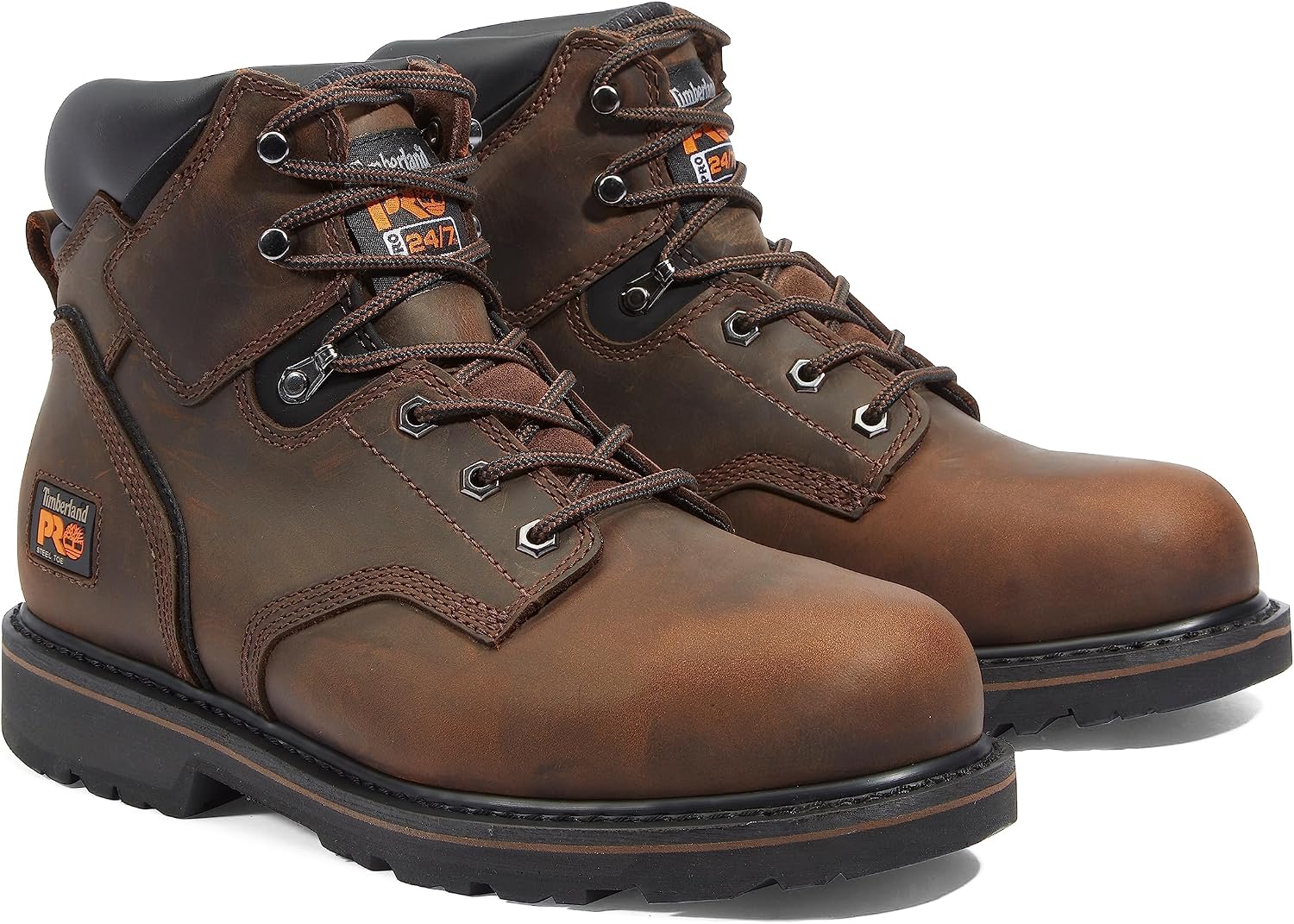
You bought a pair of Timberland PROs because the price felt right and someone on your crew swore by them — but now you’re staring at a product page with six model names, three toe-cap materials, and a $60 spread between the cheapest and most expensive option, and you’re not sure whether you’re about to upgrade or just spend more money. Work boots are personal protective equipment first and footwear second: the wrong toe protection or midsole rating for your site can mean a safety citation or, worse, an injury. This guide cuts through the lineup confusion. We’ll compare the most relevant Timberland PRO models — anchored on the Pit Boss, Boondock, and a few key models in between — so you can match the right build to your actual workload, not the one that photographs best.
| EDITOR'S PICKTimberland PRO Men's Boondock 6… | Mid-tier[Timberland PRO mens Gridworks W](https://www.amazon.com/dp/B0CK1FZHMG?tag=greenflower20-20)… | Budget pick[Timberland PRO mens Keele Ridge](https://www.amazon.com/dp/B0CKTZ63ST?tag=greenflower20-20)… | |
|---|---|---|---|
| Safety toe | Composite | Alloy | Steel |
| Width | Wide | — | — |
| Color | Black | Golden Brown | Brown |
| Shaft height | 6" | 6" | — |
| Price | $128.96 | $119.95 | $109.95 |
| See on Amazon → | See on Amazon → | See on Amazon → |
The Lineup at a Glance: What Timberland PRO Is Actually Selling
Timberland PRO positions itself as the volume tier of serious work footwear — priced above the commodity shelf at your local big-box store, but below the Danner Quarry or White’s Boots range where you’re paying for welt construction and a resole ecosystem. Most models run $130–$200 at full retail as of spring 2026, making them accessible for individual buyers and practical for small crews that can’t outfit everyone in $300 boots.
The brand segments its lineup roughly by intended environment:
- Pit Boss — the entry-level workhorse, built for indoor industrial environments
- Boondock — the flagship, aimed at outdoor tradespeople and job sites with mixed terrain
- Titan series — mid-tier, bridging the gap between the two
- Hypercharge — a newer category leaning on comfort tech over traditional construction
Understanding that segmentation matters before you buy. A boot optimized for a warehouse floor is not the same as one optimized for a muddy framing site, even if they look similar in a product thumbnail.
By the numbers:
| Model | Approx. Retail (2026) | Shank | Toe Option | Upper Material |
|---|---|---|---|---|
| Pit Boss 6” | ~$130 | Fiberglass | Steel or Composite | Full-grain leather |
| Titan Oxford | ~$140 | Fiberglass | Steel or Composite | Full-grain leather |
| Boondock 6” | ~$190 | Steel | Steel or Composite | Full-grain leather |
| Boondock HD | ~$200 | Steel | Composite | Waterproof leather |
Prices reflect Working Person’s Store and manufacturer suggested retail as of May 2026. Regional variation applies.
Steel Toe vs. Composite Toe: The Decision You Make Before You Pick a Model
If you’re still thinking of this as a style preference, pause here. Per Timberland PRO’s published ASTM F2413-18 safety ratings — ASTM (American Society for Testing and Materials) sets the federal standard for protective footwear — both steel and composite toes meet the same compression and impact threshold (75 foot-pounds of impact, 2,500 pounds of compression). The material difference plays out in three practical ways:
1. Metal detector clearance. If you’re working in a facility with security screening — correctional work, certain manufacturing plants, DOT-adjacent infrastructure — composite toe is the practical requirement. Steel toes trigger detectors and require removal, which compounds into real time loss across a shift. Gear Junkie’s work boot roundup from fall 2025 flags this as one of the most under-discussed reasons tradespeople switch to composite.
2. Temperature conductivity. Steel conducts cold. On an outdoor site in January, steel-toe boots will chill your feet faster than composite in the same conditions. Heddels’ materials glossary notes that composite toe materials — typically fiberglass, carbon fiber, or Kevlar blends — are thermal insulators by nature. Owners in northern climate forums consistently report composite toes running noticeably warmer in sub-freezing conditions, which affects whether you’re finishing the day at full function or managing cold feet.
3. Weight. Composite toes are lighter, typically by a few ounces per boot. Over an eight-to-ten-hour shift, Popular Mechanics’ 2025 work boot buyer’s guide notes that cumulative foot fatigue tracks meaningfully with boot weight — a point that matters more on a site with heavy vertical movement (ladders, scaffolding) than on a flat floor.
The tradeoff: Composite toes are slightly bulkier in the toe box to achieve the same protection rating. If you have a narrow foot or prefer a closer-fitting toe profile, steel toe often fits trimmer. This is worth sizing for in person when possible.
Pit Boss: The Honest Case For and Against
The Pit Boss is Timberland PRO’s most recognizable model and still one of their top sellers. That’s not marketing — Working Person’s Store editorial reviews consistently list it as a go-to recommendation for indoor industrial buyers on a budget.
What it does well:
The Pit Boss runs on a direct-attach construction (the outsole is chemically bonded to the upper, not stitched or welted). That’s a cost-reduction choice that lets Timberland PRO hit the $130 price point. For an indoor environment — concrete, tile, controlled surfaces — the Pit Boss’s anti-fatigue footbed and slip-resistant outsole deliver genuine value. Owners in aggregated reviews consistently describe the break-in period as shorter than competitors at this price, which matters if you’re outfitting a crew that needs to be functional on day one.
The fiberglass shank (the stiff internal support that runs through the arch) is adequate for flat to moderate terrain.
Where it falls short:
That direct-attach construction means no resole. When the outsole wears out, the boot is done. On rough outdoor terrain, the outsole typically degrades faster than on interior floors. If your site involves mud, gravel, uneven ground, or prolonged outdoor exposure, the Pit Boss will show wear at the midsole and heel faster than the Boondock. Owners working outdoor construction consistently note this in long-run reviews — the boot is priced honestly for what it is, but buyers who use it outside its design envelope feel burned.
The fiberglass shank also lacks the torsional rigidity you want when you’re working off-level ground or navigating debris fields. It’s fine for standing; it’s less confidence-inspiring when lateral stability is actually tested.
If X, then Y: If your site is primarily indoor or controlled-surface — factory floor, warehouse, airport tarmac, light commercial — the Pit Boss at $130 is a defensible choice and probably the right one. If you spend more than 20% of your day on uneven or outdoor terrain, keep reading.
Boondock: Where the Lineup Actually Gets Serious
The Boondock is the model Timberland PRO built when they acknowledged that a meaningful portion of their buyers were using Pit Boss boots in conditions the Pit Boss wasn’t designed for. The upgrades are specific and functional, not cosmetic.
Construction differences that matter:
The Boondock runs a steel shank instead of fiberglass. Steel shanks offer greater torsional resistance — resistance to twisting through the arch — which translates to more stable footing on uneven ground, rooftops, rocky terrain, and ladder rungs. If you’re a framer, ironworker, or anyone working elevation changes throughout the day, this is the shank you want. Gear Junkie’s fall 2025 work boot roundup specifically calls out shank stiffness as an overlooked spec for trades that involve ladder and scaffold work.
The Boondock also features a more aggressive outsole lug pattern (the raised tread blocks on the bottom of the boot) compared to the Pit Boss’s flatter, slip-resistance-optimized profile. On mud, loose gravel, and wet wood, the lug pattern provides genuine mechanical grip — the kind that comes from geometry, not just rubber compound.
The waterproof membrane on Boondock HD variants (the brand uses a proprietary system marketed as 400g or 200g insulation options depending on season) is integrated, not just a coating. For buyers working outdoor sites through variable weather, this is meaningful. Coated leather repels water until the coating fails; a membrane maintains waterproofing across the boot’s functional life with proper care.
What you’re trading away:
The Boondock costs roughly $60 more than the Pit Boss. For a single buyer, that’s a manageable delta. For a crew of six, that’s $360, which changes the calculus. The Boondock’s outsole is also direct-attach — like the Pit Boss, it’s not a resole candidate. At $190, you’re buying a durable but ultimately disposable boot, which is the honest position of the entire Timberland PRO line relative to Goodyear-welted options.
The Boondock is also heavier than the Pit Boss by design. Owners in aggregated reviews note that buyers who transition from the Pit Boss sometimes find the Boondock fatiguing in the first two weeks before adaptation. The tradeoff is real: the stability features that make the Boondock better on rough terrain add mass.
The Models in Between: Titan and Hypercharge
The Titan series occupies a genuine middle ground. It shares the Pit Boss’s fiberglass shank but adds some of the Boondock’s outsole durability improvements. At roughly $140, it’s a reasonable choice for buyers who work split environments — partially indoor, partially light outdoor — and don’t need the Boondock’s full terrain capability. Working Person’s Store editorial notes describe it as underrated precisely because it doesn’t fit cleanly into either the budget or flagship narrative.
The Hypercharge line is Timberland PRO’s response to the athletic-style work boot trend. It uses foam-intensive midsoles (the cushioning layer between the insole and outsole) that feel immediately comfortable and prioritize all-day standing. Owners in comfort-focused reviews rate it highly. The tradeoff: the foam compresses faster than traditional materials under heavy load, and the athletic silhouette sacrifices some of the ankle support you’d get from a traditional work boot last. For light commercial or service industry work, it makes sense. For physical trades, most long-run owner reviews suggest the Boondock outlasts it.
The Decision Rule
Here’s the framework, stated plainly:
If your work is primarily indoors or on controlled surfaces, and you’re price-conscious or outfitting a crew: Pit Boss at ~$130 is the right answer. Don’t pay for terrain capability you won’t use.
If you split time between indoor and outdoor, or want one boot that handles both: Titan at ~$140 is the underrated middle move.
If you’re consistently on outdoor, mixed, or rough terrain — framing, roofing, utilities, outdoor infrastructure: Boondock at ~$190. The shank and outsole differences are real and the $60 premium earns out over a season of hard use.
If you’re running these boots to destruction and resole economics matter to you: None of the Timberland PRO line is your long-term answer. The direct-attach construction means you’re on a two-to-three-year replacement cycle under heavy use. That’s not a knock — it’s the honest cost-per-use model for this tier. When you’re ready to move into Goodyear-welt territory (Danner, Thorogood, White’s), the investment math changes substantially, and we cover that separately.
One last note on composite vs. steel: if your site has metal detector checkpoints or you work in cold-weather outdoor conditions more than a couple months per year, composite toe is worth specifying regardless of which model you land on. The protection rating is identical; the practical advantages in those conditions are not.