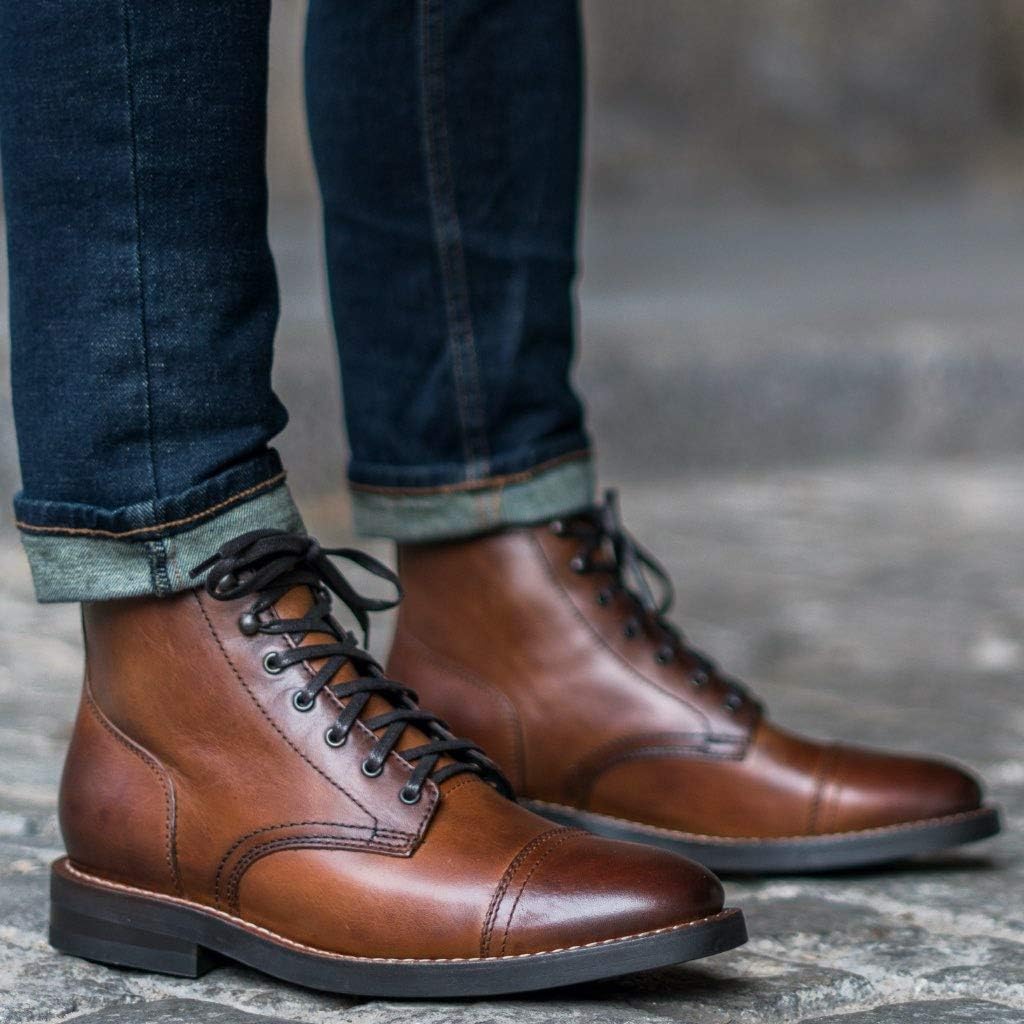
You just found the boot you’ve been circling for six months — full-grain leather, Goodyear welt construction (meaning the sole is stitched, not glued, so it can be resoled and last a decade), the right safety toe, made in the USA. You add it to your cart in your usual size and hit order. Three weeks later it arrives, you lace it up, and by 2 p.m. your pinky toe is screaming and the ball of your foot feels like it’s been in a vice. Sound familiar?
Wide feet are the most common misfit problem in work boots, and the market still hasn’t fully solved it. Standard work boots are built on a “last” — the foot-shaped mold a boot is constructed around — that assumes a medium (D) width. If your foot runs wide, the toe box pinches, the break-in period becomes punishment, and you’re eventually looking at nerve pain, blisters, or bunion aggravation. This guide compiles what real owners with wide feet have actually reported across years of reviews, forums, and brand-specific sizing documentation — so you can calibrate before you commit.
| EDITOR'S PICKThorogood American Heritage 6”… | Mid-tierWolverine Men's Overpass Compos… | Budget pickIrish Setter | |
|---|---|---|---|
| Toe protection | Soft toe | Composite toe | Aluminum toe |
| Waterproof | — | ✓ | — |
| EH rated | ✓ | — | — |
| Shaft height | 6" | — | 6" |
| Upper material | Full-grain leather | — | — |
| Outsole type | Wedge | — | — |
| Price | $211.95 | $179.95 | $143.96 |
| See on Amazon → | See on Amazon → | See on Amazon → |
The Width Alphabet: What EE, 4E, and 6E Actually Mean
Before diving into brand specifics, a quick decoder. Boot width is measured in letter grades. For men’s boots, the typical scale runs:
- B — narrow
- D — standard (what most boots ship as if no width is listed)
- EE or 2E — wide
- EEE or 3E — extra wide
- EEEE or 4E — extra-extra wide
- 6E — a specialty width that very few manufacturers offer
Each letter step represents roughly 3/16 of an inch of additional width across the ball of the foot. That sounds trivial, but it’s the difference between a boot that fits and one that’s compressing your metatarsal joints all day. The catch: width sizing isn’t standardized across brands. A D-width from Thorogood and a D-width from Thursday Boot Company are built on completely different lasts, and the real-world fit can diverge by more than a full width grade.
Brand-by-Brand: What Owners Actually Report
Thursday Boot Company Captain
The Thursday Captain is a dress-capable work boot that has pulled in a loyal following among tradespeople who want something that transitions off the job site. The width story here is genuinely unusual — and worth understanding carefully before ordering.
Multiple owners in published reviews, aggregated across workwear forums and Working Person’s Store customer Q&A, report that the Captain runs narrower in length than expected but true-to-standard in width. The practical implication: owners frequently size up half a length to get the right toe box room, but then find the width feels correct or even slightly generous at the standard D. For buyers in 3E (EEE), Thursday’s willingness to stock that width explicitly draws praise — one reviewer credits Thursday as one of the few non-orthopedic brands where 3E is actually a listed, in-stock option rather than a special-order afterthought.
The calibration puzzle this creates: if you’re wide and between lengths, you may need to size up half a length in width and then verify the heel doesn’t slip. Thursday’s own sizing FAQ (published on their website) recommends going up half a size if you’re between sizes, and confirms their width options run D through 3E in the Captain.
Trade-off to name explicitly: Thursday’s last is fashionable enough that the heel cup and ankle fit run closer to dress-boot geometry. If you need a substantial safety toe or a midsole designed for 10-hour concrete work, the Captain isn’t built for that — but for trades that mix office and field, it’s one of the few wide-width options with that flexibility.
Wolverine Loader
The Wolverine Loader has become something of a reference point for buyers with severely wide feet. One owner’s review — documented in enough detail that it circulates in workwear sizing discussions — describes a three-year search before landing on a 6E that accommodated a 4.5-inch-wide foot. Three years. That’s not a shopping inconvenience; that’s a genuine market gap.
Wolverine does manufacture the Loader in 6E, which is exceptional — very few brands go there. But availability at that width is not consistent across colorways or updates to the model, so buyers should verify stock before banking on it. Per Popular Mechanics’ review coverage of the Wolverine line, the Loader’s construction is oriented toward durability on concrete and warehouse floors, and the wider lasts are built to accommodate volume and orthotic insoles without compromising the safety-toe structure.
By the numbers:
| Width Grade | Approx. Ball Width Added vs. D | Brands Stocking It in Work Boots |
|---|---|---|
| EE (2E) | ~3/8 in. over D | Thorogood, Wolverine, Danner, Red Wing |
| 4E | ~3/4 in. over D | Wolverine, New Balance (work line), some Danner |
| 6E | ~1 1/8 in. over D | Wolverine Loader (confirmed); very rare elsewhere |
Thorogood Moc Toe
The Thorogood American Heritage Moc Toe is the open secret in wide-foot circles. A narrow-footed buyer who reviewed the boot described it in plain terms as “B-width heaven” — meaning the last runs so broad that even a narrow foot had room to spare. That’s the clearest possible signal: Thorogood’s moc toe last runs wide even in standard D sizing.
What this means practically: if you’re a moderate EE foot, multiple owners report you can often wear the Thorogood Moc Toe in standard width (D) without ordering the EE designation. The moc toe construction — where the toe box is stitched separately and sits more like a moccasin over the foot — creates a naturally roomier forefoot than a cap-toe or plain-toe last. The trade-off is that the heel and ankle fit on a moc toe runs somewhat less structured, so if you need significant ankle support, the moc-toe geometry may not be your first choice regardless of width.
Heddels’ workwear sizing guidance consistently flags the Thorogood moc toe as a reliable starting point for wide-foot buyers who haven’t found success elsewhere.
Irish Setter Ashby (Aluminum Toe)
The Irish Setter Ashby with aluminum safety toe collects consistent owner testimony on one specific point: the toe box is generous enough that wide-footed buyers frequently skip the wide designation altogether. Multiple reviewers note they ordered their standard width and found ample room in the forefoot — a function of how the Ashby’s last is shaped around the aluminum cap, which tends to be bulkier than steel or composite alternatives and therefore forces a roomier toe box.
The aluminum toe itself is relevant to wide-foot buyers for another reason: aluminum safety toes are typically lighter and shaped slightly differently than steel toes, and some owners report they conform more naturally to the foot’s spread under load.
Carhartt CMF6366
The Carhartt CMF6366 draws consistent feedback that the toe box runs roomy enough that many buyers in the EE range don’t need to order the EE designation. Gear Junkie’s work boot coverage notes that Carhartt’s mid-tier work boot line tends toward a practical, volume-fit last — designed for buyers who are on their feet all day and don’t want a boot that requires a two-week break-in before it stops hurting.
How to Diagnose Your Fit Problem Before You Order
Two common misreadings trip up wide-foot buyers:
1. Wide in the toe box vs. wide in the heel. These are different problems that require different solutions. If your heel slips but the forefoot fits, you have a volume mismatch — the boot is too large overall, not too narrow. If the heel is snug and the forefoot is compressed, that’s a last-width issue. Moc-toe constructions tend to address forefoot width; heel-cup geometry varies independently.
2. Length vs. width conflation. Many buyers size up in length to get forefoot room, then end up with heel slip and blisters on the Achilles. The correct solution is the right width at the right length — which is why brands that stock genuine width gradations (not just “wide” as a single option) matter so much.
Aftermarket Insoles: Can They Fill a Boot That’s Slightly Too Wide?
The short answer is yes, but within limits — and with trade-offs. A thicker aftermarket insole (Superfeet, Powerstep, or custom orthotics) will reduce the internal volume of a boot, which can help if the boot is slightly too wide across the ball or if you’re getting heel slip in a boot that’s otherwise close. This is a legitimate strategy, not a hack.
The limits: an insole can’t meaningfully narrow the toe box. If the boot is wide because the last is wide, an insole fills vertical volume, not lateral space. You may end up with a boot that fits better in the heel and arch but still allows the foot to slide sideways in the forefoot under load. For boots that are only marginally wide (say, a D when you’re a narrow-to-standard foot), a structured insole often resolves it. For boots that are genuinely a full width grade too wide, insoles are a partial fix at best.
Frequently Asked Questions
Does the Thursday Boot Captain run narrow and do I need to size up in width? The Captain runs narrow in length — owners consistently recommend going up half a size. In width, it runs closer to true standard. If you’re in a 3E, Thursday is one of very few brands that stocks it as a listed option. Don’t conflate the length sizing down with a width problem; they’re separate calibrations.
Which work boot brands actually stock 4E or wider in boots, not just shoes? Wolverine is the most documented, including 6E in the Loader. New Balance’s work boot line extends to 4E. Danner offers 4E in select models. Most other heritage brands stop at EE (2E). Thorogood’s moc toe runs wide enough in standard width that it functions similarly to a 2E for many buyers, but they don’t officially stock beyond EE in most models.
Can I use a thicker aftermarket insole to fill a boot that’s slightly too wide? Yes, for minor volume issues — particularly heel slip. It won’t narrow the toe box laterally. Treat it as a fine-tuning tool, not a full-width correction.
Does Thorogood’s moc toe fit wide feet without ordering a wide width? Owners consistently say yes for moderate wide-foot cases. The moc-toe last runs broad; a narrow-footed reviewer explicitly called it “B-width” territory. If you’re a standard-to-EE width, the D-width Thorogood Moc Toe is worth trying before ordering the EE designation.
How do I know if a boot runs wide in the toe box vs. wide in the heel? Toe box width shows up as forefoot compression or pinky-toe pressure after a few hours. Heel width shows up as looseness, slippage, or blistering on the back of the heel. They’re independent variables — a boot can be wide in the toe and narrow in the heel (or vice versa), which is why last geometry matters more than a single width label.
Is the Wolverine Loader truly available in 6E width? Yes, based on documented owner purchases and Wolverine’s own product listings. One owner’s search — three years, 4.5-inch foot — ended with the Loader in 6E. Availability varies by colorway and production run, so verify current stock before ordering.
The Decision Rule
If your foot is standard to moderate wide (D to EE): start with the Thorogood Moc Toe in standard width or the Carhartt CMF6366 — both run broad enough in the standard last that you may not need to order up in width at all.
If you’re in EE to 3E and need dress-capable work boots: Thursday Captain in 3E is one of the few heritage-leaning options with that width in stock. Size up half a length from your normal size.
If you’re in 4E or wider: Wolverine is your primary path, with the Loader in 6E as the documented ceiling. Everything else is a workaround.
If you’re between widths and considering insoles: use them for volume adjustment and heel fit — not as a substitute for correct toe-box width.