You just found a boot that costs $130–$160 and has a fan base that keeps buying the same model on repeat — third pair, same style, no hesitation. That loyalty loop is either a red flag (maybe they wear out fast?) or a genuine signal (maybe they nail the value-to-comfort ratio). With Wolverine’s wedge-sole lineup, the honest answer is: both, depending on which model you pick and what you’re asking it to do. A wedge sole — meaning the outsole is a single flat wedge of rubber running from heel to toe with no separate heel block — distributes your weight more evenly than a traditional heeled boot. That matters on concrete, ladders, and scaffolding where a stacked heel can torque your ankle. If you’re a tradesperson, warehouse worker, or serious outdoorsperson trying to sort out which Wolverine wedge is right for you, this comparison breaks down four models: the Loader 6-Inch, the Loader 8-Inch, the I-90 Romeo, and the Raider DuraShocks. We’ll name the tradeoffs, show the math, and give you a clear decision rule at the end.
| EDITOR'S PICKWolverine Men's I-90 Waterproof… | Mid-tierWolverine Men's Loader 6" Soft… | Budget pickWolverine Men's Raider DuraShoc… | |
|---|---|---|---|
| Height | Romeo | 6 in | 6 in |
| Waterproof | Waterproof | — | — |
| Toe | CarbonMAX | Soft toe | — |
| Slip-on | ✓ | — | — |
| Sole | — | Wedge | DuraShocks |
| Price | $159.95 | $139.95 | $129.99 |
| See on Amazon → | See on Amazon → | See on Amazon → |
What Makes the Wolverine Wedge Lineup Tick (and Where It Falls Short)
Before getting model-specific, it’s worth understanding what Wolverine is selling across this tier. These are not Goodyear-welted boots — meaning they don’t use the traditional sewn channel between the upper and outsole that allows a cobbler to resole them repeatedly for decades. They’re cement-constructed (the upper is glued to the midsole) or direct-attach, which makes them lighter and initially more comfortable but puts a hard ceiling on lifespan. That’s not a dealbreaker at this price point, but it’s a facts-on-the-table detail that changes how you should think about cost-per-wear.
Wolverine’s wedge models use full-grain leather uppers — the top layer of the hide, the densest and most durable cut — on most SKUs. The brand leans on its Contour Welt construction, a hybrid that reads as welt-adjacent but is not resoleable in the traditional sense, and its proprietary DuraShocks cushioning system on select models.
Working Person’s Store buyer review aggregation for the Wolverine Loader and Raider lines consistently notes that Wolverine’s leather quality punches above competitors at the $130–$160 price band. One Raider owner with over two years of documented daily use explicitly called out that the leather showed no cracking, contrasting it with other brands oiled every three months that still cracked. That’s a meaningful real-world data point about hide quality — not a claim this article is making independently.
Model-by-Model Breakdown
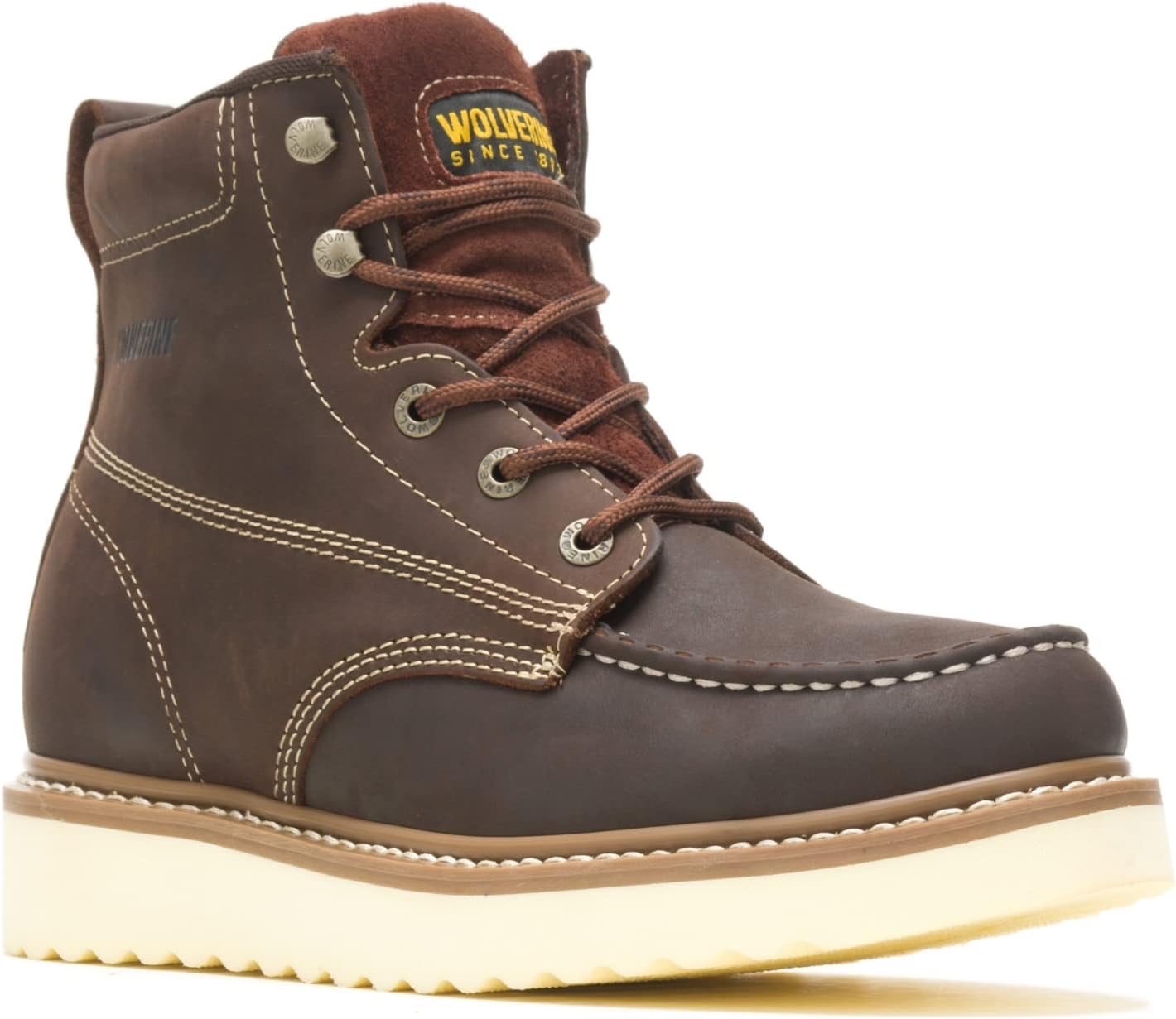
Wolverine Loader 6-Inch and Loader 8-Inch
The Loader is Wolverine’s flagship wedge for general trades — the boot that generates the loyalty loop described above. Owners documented in the Working Person’s Store buyer review aggregation for the Wolverine Loader frequently report 10–14 months of hard daily use before the primary failure mode appears: side-seam stitching that cracks or separates, typically starting around the toe box flex zone. One verified buyer is documented on his third consecutive pair, each lasting roughly that window.
Here’s how to think about that honestly:
By the Numbers — Loader Cost-Per-Wear Math
- Retail: ~$140 (6-inch) / ~$150 (8-inch)
- Hard-use lifespan: ~12 months daily
- Cost per workday (250 days/year): ~$0.56–$0.60/day
- Comparable resoleable boot at $280–$350: pencils out after year 2–3 if resole cost is $80–$100
If you’re a tradesperson who rotates two pairs and doesn’t have a cobbler in the loop, the Loader’s math is competitive. If you’re in the buy-it-for-life camp expecting a decade of service, this is the wrong tool.
6-Inch vs. 8-Inch: The 6-inch is lighter and breaks in faster — reviewers consistently prefer it for summer or mixed indoor/outdoor work. The 8-inch provides more ankle support on uneven terrain and better protection from debris in excavation or framing work. Both share the same outsole and essentially the same lifespan pattern.
Sizing flag: Loader X-Wide buyers repeatedly report the boot runs large even within the wide sizing. Multiple owners in the Working Person’s Store aggregation recommend going down a half size when ordering X-Wide. If you’re a true wide-foot buyer, try the standard Wide (W) first — the X-Wide may float on your foot and cause heel slippage, which accelerates wear.
Wolverine
$139.95
In stock on Amazon
Check price on AmazonWolverine I-90 Romeo
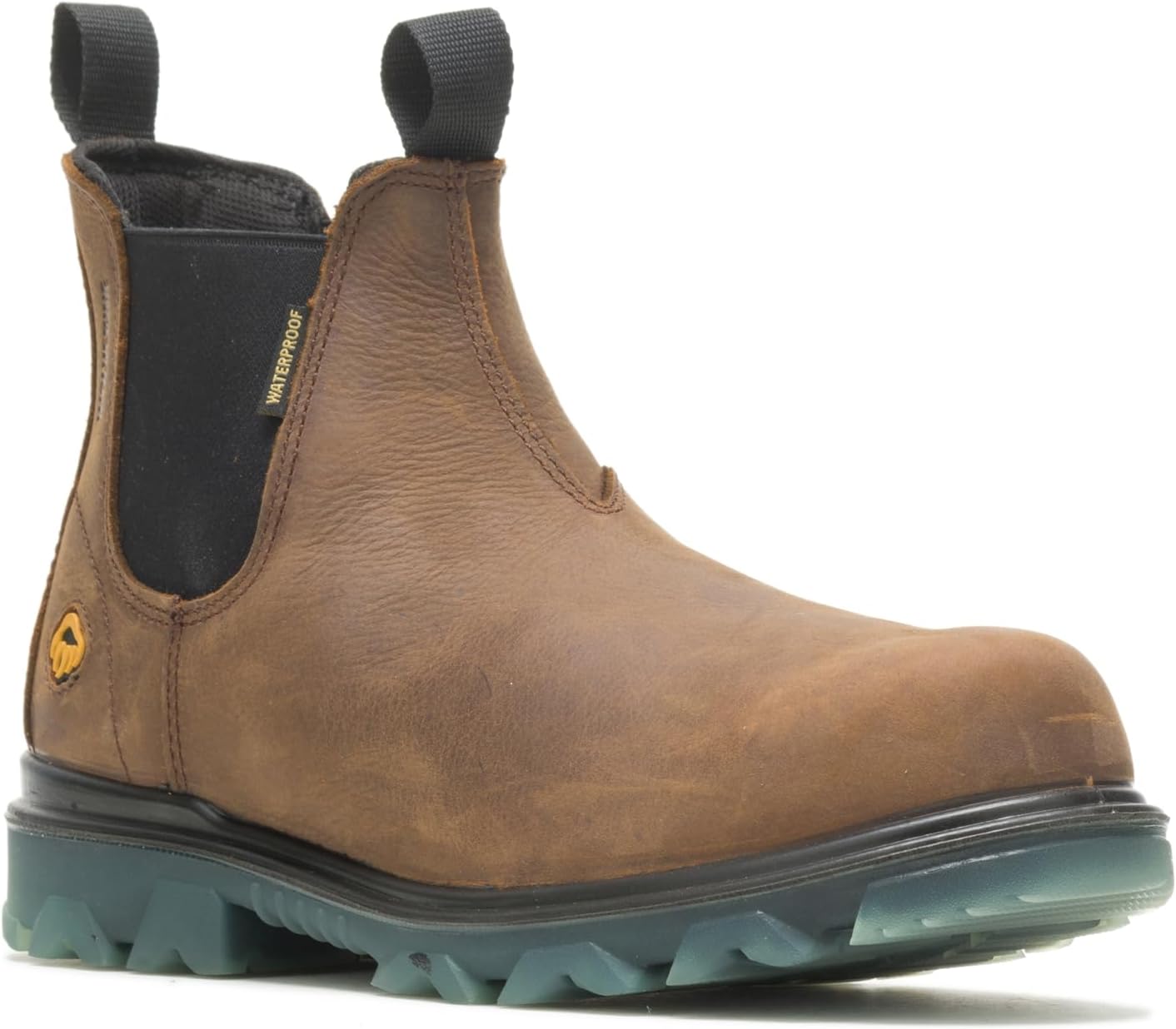
The Romeo is a slip-on work boot — no laces, elastic side panels, pull-on design. It’s aimed at buyers who need fast on/off: delivery drivers, warehouse workers, and job-site supervisors who move between truck and site constantly. The construction is similar to the Loader but the silhouette eliminates lacing points as a potential failure mode.
The waterproofing question comes up constantly. Wolverine rates the I-90 Romeo with waterproof construction — a waterproof membrane lining, not just a surface treatment. One verified owner documented in the Working Person’s Store buyer review aggregation for the I-90 Romeo published a two-year follow-up noting continued waterproofing performance and no structural failures. That’s a strong long-run data point for a boot in this price tier. “Water-resistant” (surface-treated) and “waterproof” (membrane-lined) are meaningfully different: the former fails when the DWR finish wears off, usually within months of heavy use; the latter holds until the seam tape degrades, which typically takes years.
Tradeoffs: The Romeo’s slip-on design means less adjustability than a laced boot. Buyers with narrow heels or high insteps report fit inconsistency — the elastic gives enough to get the boot on but not enough to lock a narrow foot in place. If you’re between widths, the laced Loader is more forgiving. The Romeo also doesn’t have the ankle height of the 8-inch Loader, so it’s not the right call for environments with ankle-turn risk.
Wolverine
$139.95
In stock on Amazon
Check price on AmazonWolverine Raider DuraShocks
The Raider is the comfort-focused outlier in this comparison. It uses Wolverine’s DuraShocks system — a multi-layer midsole platform combining a polyurethane footbed, an EVA (ethylene-vinyl acetate, a lightweight foam) midsole layer, and a rubber outsole — designed to absorb impact on concrete and hard surfaces. This is the model that attracts buyers whose primary concern is end-of-day pain rather than pure durability metrics.
The most striking owner account in the Working Person’s Store buyer review aggregation for the Wolverine Raider DuraShocks: a buyer who had been prescribed Vionic medical footwear for plantar fasciitis — a painful condition caused by inflammation of the connective tissue along the bottom of the foot — switched to the Raider DuraShocks and explicitly credited the boot with eliminating their pain. They added a thin aftermarket insole for incremental relief and reported the combination outperformed their medical footwear for work use. That’s a strong signal for anyone managing foot-pain conditions in a standing-work environment.
DuraShocks vs. a Standard Insole Swap: On the base Loader or I-90, the most common owner upgrade is swapping in an aftermarket insole such as Superfeet Green or a comparable model. That gets you roughly 70–80% of the DuraShocks comfort benefit at around $50 in additional cost — but it also raises your heel slightly inside the boot, which can affect fit. The Raider’s system is engineered as a unit, so the geometry is correct from the factory. For buyers with diagnosed foot conditions or jobs that demand 10-plus hours of standing, the integrated system is worth the slight price premium over the base Loader.
Durability note: The two-year documented review on the Raider in the Working Person’s Store aggregation showing intact leather and no cracking suggests the upper construction is at minimum comparable to the Loader. The thicker midsole stack can compress over time — DuraShocks reviewers in the same aggregation note the cushioning plateaus around 14–18 months of daily use, after which it firms up noticeably. That doesn’t mean the boot fails; it means the comfort advantage narrows over time.
Wolverine
$139.95
In stock on Amazon
Check price on AmazonWolverine at This Price Point vs. the Competition
Gear Junkie, in its “Best Work Boots” roundup, and Popular Mechanics, in its “Best Work Boots We’ve Researched” feature, consistently place Wolverine in the upper half of the $130–$175 cement-construction tier for leather quality and initial comfort. Where Wolverine loses ground is in the resoleable and repairable ecosystem.
At roughly $150, a Thorogood American Heritage wedge — also cement-constructed but manufactured in the United States — is a direct competitor. As Heddels has covered in its ongoing heritage-brand reporting on domestic boot manufacturing, Thorogood’s domestic production means easier warranty resolution and a stronger brand-quality trajectory. Wolverine manufactures overseas but sources full-grain leather that reviewers in the Working Person’s Store aggregation consistently rate ahead of comparable overseas-produced competitors.
If your budget ceiling is $200 and you’re debating between a resoleable boot at that threshold versus a Wolverine, the decision tree in the next section is where it matters most.
If X, Then Y: The Decision Rule
The four models above cover distinct buyer profiles. Here’s how to route yourself.
If you want a workhorse boot, don’t mind repurchasing every 12–14 months, and rotate two pairs: The Loader 6-Inch or 8-Inch is your call. The math works, the loyalty loop is real, and the stitching failure mode is predictable enough to plan around.
Wolverine
$139.95
In stock on Amazon
Check price on AmazonIf you need fast on/off, work in wet environments, and have a standard or slightly wide foot: The I-90 Romeo is the right fit. The waterproof membrane is legitimate, the two-year hold-up data from Working Person’s Store is encouraging, and the slip-on design is a genuine productivity feature if your day involves frequent transitions between truck and job site.
Wolverine
$139.95
In stock on Amazon
Check price on AmazonIf you’re managing plantar fasciitis, chronic foot pain, or a high-impact standing job: The Raider DuraShocks earns its price premium. The integrated cushioning system outperforms an aftermarket insole swap for buyers with diagnosed conditions, with the caveat that the midsole firms up noticeably after 14–18 months of daily use.
Wolverine
$139.95
In stock on Amazon
Check price on AmazonIf you’re expecting buy-it-for-life longevity: None of these models are the right tool. Step up to a Goodyear-welted boot from Thorogood, Danner, or White’s Boots — the repair ecosystem alone justifies the higher entry cost over a five-to-ten-year horizon. Heddels’ coverage of heritage boot brands provides a useful primer on what to look for in resoleable construction at that tier.
Wolverine
$159.95
In stock on Amazon
Check price on AmazonFrequently Asked Questions
How long do Wolverine Loader boots realistically last with daily hard use? Owners documented in the Working Person’s Store buyer review aggregation for the Wolverine Loader consistently report 10–14 months of hard daily use before the primary failure mode — side-seam stitching cracks or separates — appears. Rotating two pairs extends individual boot life somewhat.
What is the most common failure mode on the Wolverine Loader and when does it typically appear? Side-seam stitching separation, typically beginning at the toe box flex zone. Most owners see it emerge in the 10–12 month window with daily hard use.
Is the I-90 Romeo genuinely waterproof or just water-resistant? Waterproof — it uses a membrane lining, not just a surface treatment. A verified owner’s two-year follow-up documented in the Working Person’s Store buyer review aggregation confirms the waterproofing held over extended use, which distinguishes it from surface-DWR-only treatments that degrade quickly.
Are Wolverine boots a good option for buyers with plantar fasciitis? The Raider DuraShocks specifically has documented owner accounts of relieving plantar fasciitis symptoms, including one buyer who switched from prescribed medical footwear. The integrated multi-layer midsole is the key feature — other Wolverine models would need an aftermarket insole upgrade to approach that level of support.
Do the Loader boots run true to size or should buyers adjust for wide or X-wide sizing? The standard and Wide (W) Loader generally runs true. The X-Wide consistently runs large — multiple owners in the Working Person’s Store aggregation recommend going down a half size in X-Wide or trying the standard Wide first.
How does the DuraShocks cushioning system compare to a standard insole upgrade on other Wolverine models? An aftermarket insole swap on a base Loader or I-90 gets you most of the comfort benefit at around $50 extra, but the geometry isn’t optimized for the boot. DuraShocks is engineered as an integrated unit — better for buyers with diagnosed conditions or demanding standing schedules — with the caveat that the cushioning firms up noticeably after 14–18 months of daily use.